
The Senate’s year-long inquiry into university governance has come to an end with the release of its final report. With the sector in crisis, the inquiry’s public hearings were often highly robust affairs. Many in the higher education community – staff and students – were captivated by the grilling that senior leaders were forced to endure.
To this observer, two particular witness appearances stood out – one by a vice-chancellor and the other by a chancellor. These were a tale of two testimonies, which taken together provide insights into directions in which the sector needs to move.
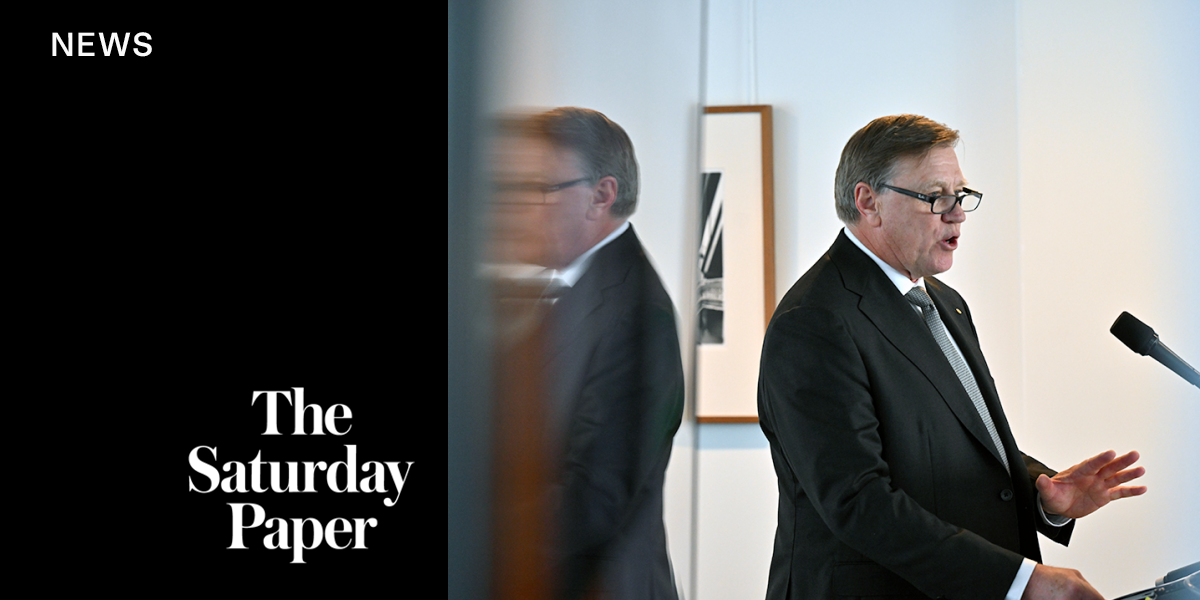
First, the chancellor. There was some anticipation about the scheduled appearance of Professor John Pollaers, the chancellor of Swinburne University of Technology, and also convenor of the University Chancellors Council. The UCC, which represents chancellors across the country, is one of the sector’s central governance bodies.
Previously, the Senate had been less than impressed with the submission provided by this group, which seemed largely based on pretending there was no crisis in the sector. The Senate’s interim report in September noted the UCC document “contained only one allusion to problems in the sector”. Hence Pollaers’ scheduled attendance.
Things were about to get more difficult for the chancellor, however. On the morning he was due to appear – in early November – The Australian Financial Review ran a story outlining multiple complaints from staff at Swinburne about Pollaers’ behaviour. The allegations were extensive.
He was accused of berating staff and using profane language and also causing the departure of multiple staff.
There were also accusations that he overstepped his role as chancellor, the article said, straying into management and “setting up Swinburne as his own fiefdom”. This, it was suggested, involved conflicts of interest, including efforts to recruit students to work on his rural property at Woodend in Victoria.
Pollaers denied any wrongdoing and the university issued a statement categorically rejecting the allegations. It said governance, accountability and engagement had improved under Pollaers. The chancellor was “widely regarded within the university and across the higher education sector as a champion of integrity, good governance, and social purpose”.
The university said it had not received any formal complaints against the chancellor. It said the proposal regarding his property at Woodend was philanthropic and did not progress beyond a conversation that lasted “only a few minutes and was handled transparently”.
In an environment of cuts to programs and underpayment of staff, the article also noted Pollaers had personally petitioned the Victorian government for a raise in his remuneration, as well as the remuneration of other Swinburne council members, amounting to a potential increase of 20 per cent. The request was reportedly rejected by the minister. The university said any application for a pay increase would have involved approval by the full council.
“Universities have become the political equivalent of the banking sector before the Hayne Royal Commission.”
In the Senate, Pollaers was grilled about the complaints made against him, which he rejected. “I have absolutely no recollection,” he said. “That is not how I work with people.”
Other matters arose. He was challenged about a UCC consultancy awarded by him to an agency that, he was reluctant to acknowledge, had no prior experience in higher education. It was suggested that the awarding of the consultancy may have “flouted” Swinburne’s procurement processes. Subsequent exchanges became heated, with the chancellor asked to withdraw “condescending” comments made to one of the senators, Mehreen Faruqi.
Earlier – and again in the AFR – Pollaers was pilloried for his insistence on being referred to as “Professor” at Swinburne and elsewhere. This was an honorary title temporarily conferred by another university – and to be used only in that institutional context. As the AFR pointed out: “Pollaers has not completed a PhD, does not publish academic work and does not, crucially, actually have a job as a professor.”
The Times Higher Education weighed in to the gathering media storm. The British-based outlet narrowed in on the pay push. “The reformist head of the representative body for Australian university chancellors [UCC], which claims to be addressing the crisis around excessive executive salaries, stands accused of lobbying the government to have his own pay increased.”
Up to that point, Swinburne University had denied all allegations against their chancellor. This wasn’t to last. In an emergency council meeting, from which Pollaers was excluded, a decision was made to hold an independent inquiry into his conduct. While generally welcomed by staff, some have reported “they fear the investigation will not be truly independent and that they will be targeted for taking part”.
The Pollaers case, while arguably an extreme one, is nevertheless emblematic of certain qualities that have taken root in the administrations of Australian universities.
It was a relief, amid all the dismal evidence to emerge in the inquiry, to hear one testimony where such qualities were noticeably absent. This was that provided by the vice-chancellor at Western Sydney University, Professor George Williams.
Williams is rare among the current crop of university leaders for having recently laid out his own thoughtful vision for the sector. In “Aiming Higher: Universities and Australia’s Future”, Williams pulls no punches about the current crisis. At one point he writes: “Universities have become the political equivalent of the banking sector before the Hayne Royal Commission.” A similar inquiry, he says, “is hard to rule out”.
The essay seeks to balance this grim assessment with positive ideas about how things might be turned around. Professor Williams is sure the key is for self-interest to be replaced by a genuine commitment to students – and also staff. “It is why we exist and it must be the front and centre of everything we do.”
In the parliamentary hearings, senators heard how such principles have informed Williams’s leadership at WSU, corroborated by the WSU chancellor, Jennifer Westacott, who attended with him. For example, in cooperation with the National Tertiary Education Union, WSU has embarked on a program of “decasualisation”, recently converting 160 casual teaching positions into ongoing ones. In queries about Williams’s salary, Westacott explained that this was not fixed in-house, the practice at virtually all other universities, but benchmarked externally – in fact, against the lowest Commonwealth departmental secretary level (Veterans’ Affairs). The arrangement was initiated by Williams, who, in the process, willingly took a 20 per cent cut on the salary of his predecessor.
It emerged in the proceedings that Williams also continues to teach, an option available to all current university leaders but one very rarely taken up. One senator offered explicit praise for all of Williams’s efforts: “I’ve been to Western Sydney University many times and I’m very impressed with your organisation, the facilities and the student engagement.”
No other university leader appearing at the hearings received plaudits in this way. Indeed, it was mainly the opposite. Monash University, for example, was flailed for its chronic underpayment of staff; University of Melbourne for the excessive remuneration and conflict-of-interest issues surrounding its former vice-chancellor; the soon-to-merge University of South Australia and University of Adelaide for their exorbitant spending on consultants; University of Technology Sydney for its handling of proposed mass job and course cuts. No one from the Australian National University appeared. The ANU vice-chancellor Genevieve Bell resigned during the inquiry, and its embattled chancellor, Julie Bishop said she had other commitments – although was not able to avoid a grilling about ANU’s troubles at a subsequent Senate estimates.
The Senate’s final report, just released, has now made recommendations to address what it concludes is a situation of “deep mistrust” in our universities. These cover strengthened powers for the quality assurance regulator, the Tertiary Education Quality and Standards Agency; a sanctioned role for the NTEU in industrial compliance matters; improved reporting, especially for casual staff hiring; and the reviewing of state legislation so that research and education are given priority over current corporate agendas.
All are commendable enough, but one wonders how much they will substantially remedy the huge problems that have been identified: the bullying; the conflicts of interest; the waste. What’s missing is any mechanism to guarantee that the right people will end up in charge of institutions to oversee the cultural change so urgently needed.
One idea that has circulated for some time in Australia, but eluded the attention of senators in their inquiry, is to abandon the present opaque methods of appointing senior university leaders and to do this via democratic processes of election. The idea is not so far-fetched. The practice is common at Scandinavian universities. The franchise is typically staff and students. The University of Oslo explains its rationale: “By electing a rector [VC in Australia] employees and students gain influence over the administration, which gives the leadership legitimacy…”
It is not only legitimacy – but also accountability, transparency and trust – that are in short supply at Australian universities. Such a reform would be the type of bold policy initiative that many now crave – in many areas – from the present government. It may take Williams’s royal commission for anything like this to happen, however.
This article was first published in the print edition of The Saturday Paper on
December 20, 2025 as “Parallel university”.
For almost a decade, The Saturday Paper has published Australia’s leading writers and thinkers.
We have pursued stories that are ignored elsewhere, covering them with sensitivity and depth.
We have done this on refugee policy, on government integrity, on robo-debt, on aged care,
on climate change, on the pandemic.
All our journalism is fiercely independent. It relies on the support of readers.
By subscribing to The Saturday Paper, you are ensuring that we can continue to produce essential,
issue-defining coverage, to dig out stories that take time, to doggedly hold to account
politicians and the political class.
There are very few titles that have the freedom and the space to produce journalism like this.
In a country with a concentration of media ownership unlike anything else in the world,
it is vitally important. Your subscription helps make it possible.
Send this article to a friend for free.
Share this subscriber exclusive article with a friend or family member using share credits.

Used 1 of … credits
use share credits to share this article with friend or family.
You’ve shared all of your credits for this month. They will refresh on January 1. If you would like to share more, you can buy a gift subscription for a friend.
SHARE WITH A FRIEND
? CREDITS REMAIN
SHARE WITH A SUBSCRIBER
UNLIMITED
Loading…