
Sign up for the Slatest to get the most insightful analysis, criticism, and advice out there, delivered to your inbox daily.
On Sunday, father-and-son gunmen armed with shotguns killed 15 people and injured 40 more at Bondi Beach in Sydney, Australia. Their target was Chanukah by the Sea, an annual event run by the Chabad of Bondi. The dead include a Holocaust survivor, a rabbi, and a 10-year-old girl. It is the deadliest mass shooting to occur in Australia since the Port Arthur massacre in 1996, a tragedy that reshaped the nation and led to the creation of gun laws that have, until now, prevented such violence from being a regular occurrence.
It is hard to parse this violence as a person from a country where it is abnormal. It is impossible not to personalize the grief, shock, and confusion. I was scrolling Instagram Stories on a sleepy Sunday arvo when I saw a friend post “just heard what I think are gunshots at Bondi – what’s going on?” The events unfolded so rapidly and brutally that it has shocked Australia into a whiplash of the soul that we will be grappling with for years to come.
We are in shock. This does not happen here. And yet, it has. It is difficult to reconcile that reality with who we are and who we imagine ourselves to be as a nation.
In the worst ways possible, the early response to the attack has taken on contours that would be familiar to Americans. That’s partly because authorities have said the shooters were motivated by “Islamic State ideology,” and because Israel’s genocide in Gaza—and the Australian complicity in it, mostly at the hands of Americans—has been a roiling issue here.
In the immediate aftermath of this attack, Benjamin Netanyahu blamed the tragedy on Australia’s prime minister, Anthony Albanese of the Australian Labor Party, for recognizing an independent state of Palestine back in September. In his early career, Albanese was an ally of Palestine, co-founding the Parliamentary Friends of Palestine in 1999, but as prime minister he has tacitly supported Israel, Netanyahu, and the genocide in every material sense beyond a few empty gestures and hollow statements. This has divided Labor’s moderate base and beyond, and the government’s unwillingness to criticize Israel, let alone stop selling them arms, has been a major reason for the mass protests that have had hundreds of thousands of Australians marching through the streets of our major cities every weekend since Oct. 7, 2023.
Earlier this year, Albanese controversially appointed an “Antisemitism envoy” to appease Zionist interest groups. Jillian Segal, whose husband had donated to the Nazi-adjacent far-right group Advance Australia, used this position to put forth a highly censorious and constitutionally dubious list of proposed reforms framed as a “plan to combat antisemitism” that would all but outlaw criticism of Israel in Australia if adopted (which they weren’t, but likely will be in the wake of this weekend’s events). Segal has done little else in this perfunctory role other than push the narrative that the boom in antisemitism stems from the peaceful pro-Palestine movement—a falsehood she was quick to repeat in immediate response to the attacks. She has ignored the many neo-Nazi and white nationalist marches that have taken place in Australia this year, and many have concluded that she perceives more antisemitic hatred in a keffiyeh than a literal swastika.
Despite neither of the shooters being at all linked as of this writing with the pro-Palestine movement, Australia’s conservative politicians, its conservative media (which is most of it), and its right, far right, and alt right have all been quick to link the attack to the pro-Palestine crowd, particularly the campus protests, where some claim the shooter was “radicalized.” Which is odd, as the young shooter appears to be a brickie (Australian for bricklayer) who never attended university. In fact, the shooters have been found to have affiliations with the Islamic State, which is a known enemy of the Palestinian people, the pro-Palestine movement, Hamas, and Hezbollah.
Still, Australia’s right, like America’s, do not turn their nose up at an opportunity. They have had a rough time of it of late. Our conservative party, the Coalition (a combination of the Liberals and the Nationals), now headed by placeholder leader Sussan Ley, was annihilated in one of the most resounding electoral defeats in Australia’s history in May 2025. So disastrous is Ley, the Coalition’s polling, and the Coalition’s electoral prospects both on the state and federal level, that our major conservative party is essentially on the point of extinction.
Unable to find a weak spot in Albanese’s radically Zen centrism, the Coalition cynically exploited Sunday’s bloodbath almost immediately. Ley laid the blame at Albanese’s feet, and Josh Frydenberg, a major figure of the party’s hard right, demanded Albanese take “personal responsibility” for the attack. Former Prime Minister John Howard—imagine Ronald Reagan crossed with Dick Cheney crossed with Gollum, or imagine if Richard Nixon was your longest-serving president—emerged from his lair to point fingers at Albanese, his government, and Howard’s oldest, most loathed enemy, the amorphous “left.” (Howard looms over the Coalition like Darth Sidious, and as prime minister, he was the architect of Australia’s involvement in the illegal Iraq war.)
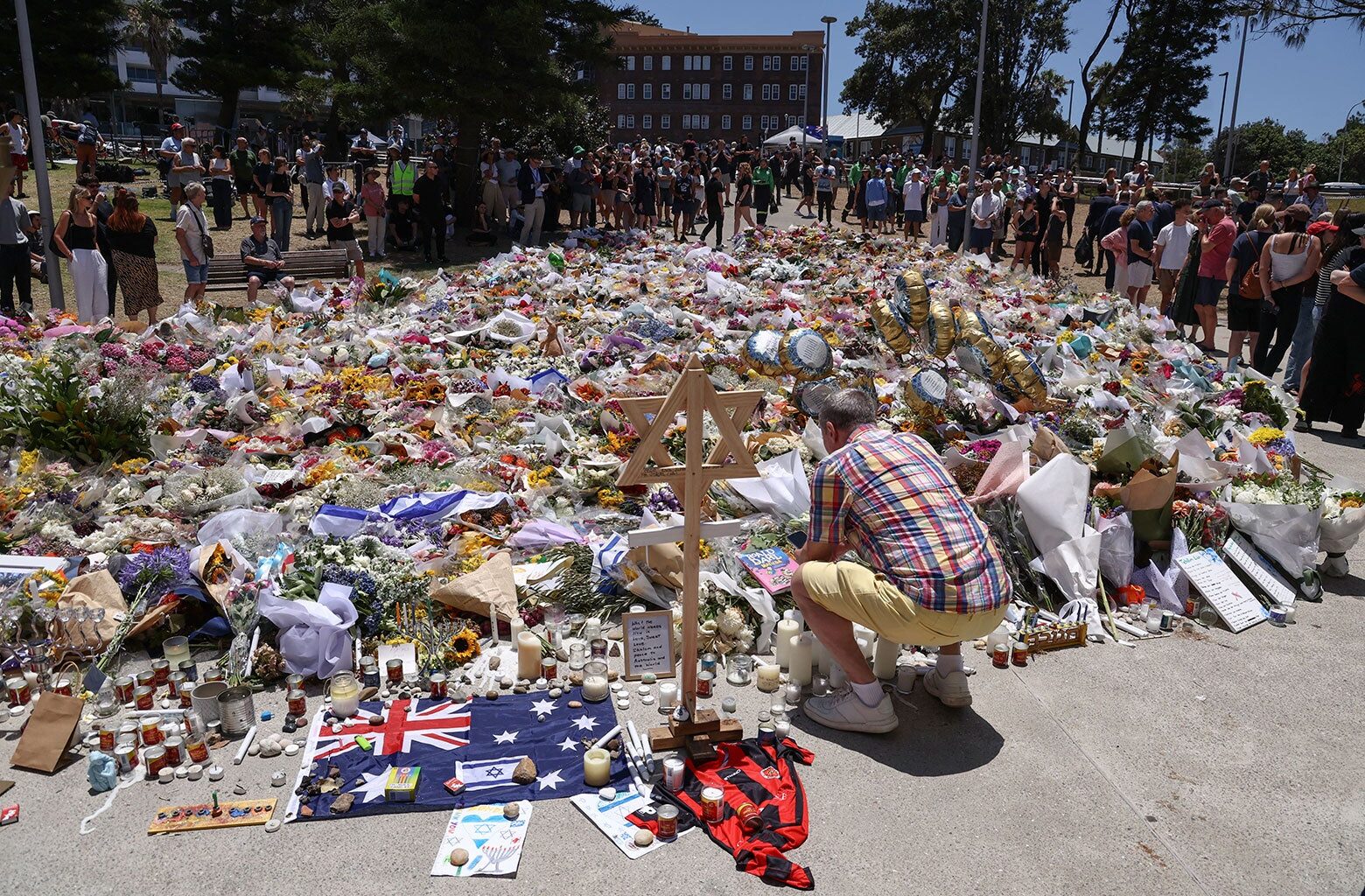
These are the mainstream of Australian conservatism and the Australian right. Behind them are a cavalcade of bloodthirsty grifters, knuckle-draggers, and hatemongers whose immediate response to the news was to lick their lips. They have been waiting for an event like this their entire lives. Pauline Hanson, founder and head of One Nation, a party that has been the fetishized mascot of white nationalism and paranoiac race hatred in Australia for 30 years, arrived with her newly anointed goon Barnaby Joyce to fire off a hateful screed before the freshly laid memorial flowers. She condemned the prime minister, Muslims, and antisemitism—somewhat of an irony, as she was recently the headline speaker at one of the many neo-Nazi marches that have recurred in Melbourne and Sydney this past year.
Other prominent bigots preferred the safety of the internet. “Western civilisation enjoyer” Drew Pavlou, a basement-dwelling influencer known best for taking a decade to complete an undergrad degree, immediately began livestreaming the shootings on his monetized YouTube channel. He took to X and began firing out dangerous misinformation, egging on racial violence with the rabid Islamophobia that has become his bread and butter. As people still lay dying, he falsely claimed that a preplanned Christmas firework event taking place in Sydney was in fact the city’s Muslim community taking to the streets in celebration. As I write, he is livestreaming himself at the public memorial, where his excitement at the prospect of inciting a race war is palpable.
I focus on Drew as a particularly grotesque case study of the breed of professional hate-peddlers that America is all too aware and fond of. The deluge of misinformation that promulgated in the immediate wake of the attacks was fueled by American social media platforms that have prioritized and monetized bigotry and psychosis. X, Meta, and YouTube were flooded with A.I. fakes, the most darkly comical of which was a reimagining of the great hero of the day, Ahmed al-Ahmed, the Syrian Muslim fruit-shop owner who bravely wrestled a gun from one of the shooters, as a white man with a comfortably white name.
Australian racism is not too dissimilar from America’s—indeed, it is largely informed by it these days—but of course it is different by the very nature of our unique histories and cultures. Like America, Australia’s Islamophobia has been violent, demented, and frothing since 9/11, and, like America, our domestic and foreign policies have unfairly targeted Muslims and the Muslim world—Iraq, Palestine, Indonesia, and beyond. Our media, much of which is owned by Rupert Murdoch and other billionaires who sometimes outpace even him in their hatreds, regularly runs extremely Islamophobic content, occasionally resulting in real violence (such as the notorious Cronulla riots, which occurred nearly 20 years ago to the day of the Bondi shootings). This reached its nightmarish apex in the 2019 Christchurch shootings, where an Australian white nationalist terrorist flew to New Zealand and murdered 51 people at a mosque. This took place in New Zealand, but it was very much an Australian shooting.
Hatred breeds hatred, and the surge of antisemitism, neo-Nazi groups like the NSN, and white nationalists like Pauline Hanson and Drew Pavlou, exists within, and is inflamed by, the malformed hatreds that are tragically intrinsic to the Australian identity. Antisemitic attacks were on the rise far before this month, raising alarm. I cannot sum up 250 years of Australian history in this article—it is hard enough to contextualize the last week—but it is important for you to do that most un-American of things and recognize that these events do not take place in a void, but rather within the specific context of a long and complicated history.
But the right’s narrative may not win out in the end, especially with the deeply unpopular and off-putting American right weighing in loudly and regularly on their behalf, laying the blame on Australia’s infamously strict gun laws. It might sound alien to even moderate Americans, but the immediate consensus here after the shooting has been that our gun laws are not strict enough—an observation many experts have been making for years as private gun ownership has bloomed exponentially, especially in the past decade. Both our prime minister and the premier of New South Wales, Chris Minns—who was an ally of the pro-gun Shooters, Fishers, and Farmers Party—have vowed gun law reform. How a person like the alleged shooter who the ASIO (our FBI) had been tracking for ties to the Islamic State associations as early as 2019 was able to acquire a gun license, let alone six shotguns, will no doubt be the subject of a lengthy parliamentary inquiry in the months to come.
In truth, if Sunday holds any lessons for Americans, it’s that Australia’s gun laws, though flawed, work. How many would have been killed if the terrorists were able to buy a couple of AR-15s from their local Coles? How many mass shootings would we have had since Port Arthur if John Howard (yes, the same man I described above) had not brought in such strict and transformative gun laws in the immediate aftermath? All I know is this is the first mass shooting on Australian soil since 1995. America has had 468 this year.
Fred Kaplan
The Reason ISIS Is Suddenly Back in the News
Read More
Still, American discourse, and American policy, regularly leads us about by the nose. We are The Kid to your Judge Holden, and we will ride with you to our doom. Our role as loyal foot soldiers in every American war since Korea, but especially in Iraq, and again with our support of Israel (which is largely to placate the United States), has a hand here. Our insidiously growing gun culture and broken discourse and outpourings of online-hatred blueprints imported from America have again brought the violence home to us. We of all people should know the boomerang swings back, but we got too dependent on you to truly acknowledge that. As I write, Australia’s mainstream journalists—many of whom rank among the dumbest on Earth—are riling up great dramas and screeds in a tone and style that is distinctly American, which is to say, worrying.
And yet, it is useful to see these people as a loud minority.
This Newspaper Editorial Should Be Making Pentagon Leaders Sweat
A contradiction I’m sure you understand is that Australia is a country of many hatreds, but also a country of great love. That love for one another is what we aspire toward as Australians; those who act on this love are the greatest Australians there are. Ahmed al-Ahmed, the Syrian refugee who confronted the shooter head-on, saving countless lives, is what we’d call the light on the hill—a kind of goodness and courage we, as Australians, must collectively strive for. Boris and Sofia Gurman, two Bondi locals who were killed in their attempts to stop one of the shooters, reflexively moved to save lives at the cost of their own. The community that has come forward to grieve and lay flowers, the swimmers who have insisted on keeping this beloved beach a place of mateship and joy, the imams and rabbis who hug and shake hands and hold each other in mourning, understanding, and support, the millions of “Are you OK?” “How are you feeling?” and “I’ll ride with you if you’re feeling unsafe” texts sent between friends, neighbors, and comrades, the record-breaking amount of blood donations given these past few days, and the rejection of violent hatred as abject, alien, and fundamentally un-Australian—this is what it has always meant, and will continue to mean, to be what we call “True Blue.” This is the Australia as it should and must be.
Sign up for Slate’s evening newsletter.