
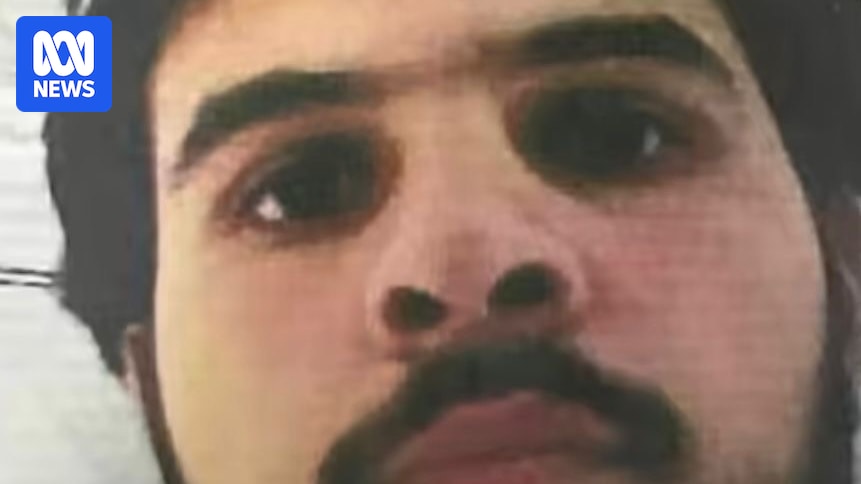
The Bondi gunman accused of killing 15 people conducted “firearms training” with his father in a regional area and recorded a video about their “justification” for the attack, according to documents released by a Sydney court.
Twenty-four-year-old Naveed Akram faces 59 charges including 15 counts of murder and one count of committing a terrorist act over the attack.
His father Sajid was shot dead by police.
A court last week placed an interim suppression order over the police statement of alleged facts, but new orders today paved the way for a redacted version of the document to be released.
It reveals allegations Naveed Akram and his father threw four improvised explosive devices (IED) towards the crowd in Archer Park — where a Jewish event was being held — when they arrived at the scene.
Police images of homemade pipe bombs at the scene. (Supplied: NSW Local Court)
Those devices did not detonate.
One IED was found in the car the gunmen drove from Campsie, where they had rented a property, to Bondi Beach.
An IED in the boot of the car driven by gunmen to Bondi Beach. (Supplied: NSW Local Court)
‘Firearms training in countryside’
In a video mentioned in the alleged facts, Naveed Akram and his father recite “political and religious views” and “appear to summarise their justification for the Bondi terrorist attack”.
The court documents say that on Naveed Akram’s phone, investigators have found “a number of relevant videos”, which show the pair allegedly “adhered to a religiously motivated violent extremism ideology”.
Screenshots of the videos are included in the alleged facts.
In one video, dated late October, the accused and his father are seen “conducting firearms training in a countryside location, suspected to be in NSW” .
“The accused and his father are seen throughout the video firing shotguns and moving in a tactical manner,” the alleged facts state.
Another video shows the men sitting in front of an image of an Islamic State flag with long-arm firearms.
In that footage, Naveed Akram is “recorded appearing to recite, in Arabic, a passage from the Quran”.
The document states: “Following the recitation, both the accused and (his father) speak in English and make a number of statements regarding their motivation for the ‘Bondi attack’ and condemning the acts of ‘Zionists’.”
“In this video, the accused and (his father) recite their political and religious views and appear to summarise their justification for the Bondi terrorist attack.”
Gunmen ‘believed’ to scope park
The document also reveals that on the evening of December 12 — two days before the attack — CCTV footage recorded two males “believed to be the accused and his father” travelling to the vicinity of Archer Park.
They got out of a vehicle and walked along a footbridge, which later became their position during the shooting.
“Police allege that this is evidence of reconnaissance and planning of a terrorist act,” the court documents say.
During the first court mention of the case against Naveed Akram last week, there was an interim suppression order made over the alleged police facts.
But on Monday, Deputy Chief Magistrate Michael Antrum revoked that order and made new orders that allow for the redacted document to be released.
The redactions are over the names of people who were shot during the attack but survived.
The change in orders came after legal argument this morning, during which barrister Dauid Sibtain SC made submissions on behalf of a group of media outlets including the ABC.
A barrister representing the NSW Police Commissioner tendered reports from a psychiatrist within NSW Police, but there was an agreed position about the release of the redacted statement of alleged facts.
Deputy Chief Magistrate Antrum noted the material before him included reference to the risk of re-traumatising victims where information was released, and the onset of post-traumatic stress disorder.
There was also reference to some victims requiring anonymity to assist in their recovery and the potential exacerbation of symptoms where information is released without consent.
However, the new orders contain a so-called “carve out” which means that if injured victims seek to tell their stories publicly, they are entitled to do so without their identities remaining suppressed.
The case will next be mentioned in court in February when the suppression orders will be reviewed.
Loading