
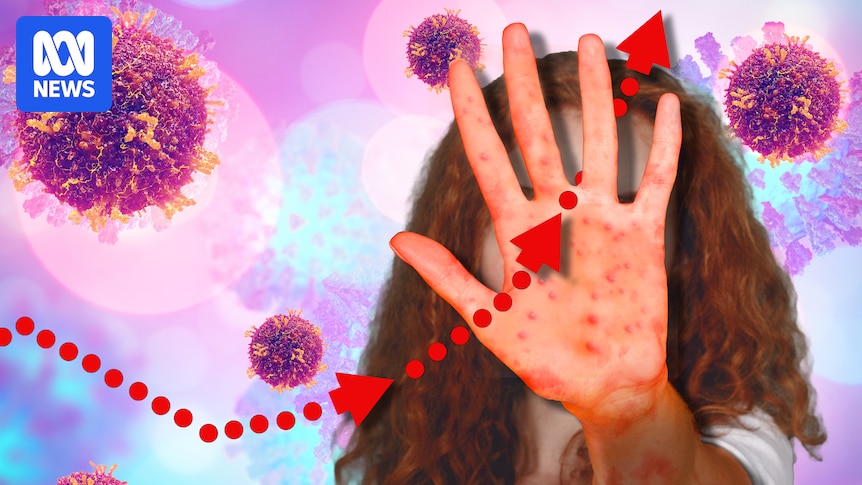
The number of measles cases nationwide is now approaching triple the number of cases reported in 2024 as outbreaks continue around the world.
There have now been 168 cases of measles across Australia in 2025, according to the national disease surveillance system.
In 2024, there were just 57.
In 2023, there were 26 cases, and just seven in 2022. In 2021, there were zero cases reported in the entire year, as the COVID-19 pandemic locked down much of the world.
The rise in numbers, experts tell the ABC, comes amid a global surge in measles outbreaks and a national lagging vaccination rate.
At least 59 countries experienced large-scale outbreaks in 2024, with a quarter of those countries having previously eliminated the “incredibly contagious” disease.
“Measles has been really uncommon in general practice for decades,” Ramya Raman, vice-president of the Royal Australian College of General Practitioners (RACGP), said.
“That’s primarily been because of the highly effective immunisation program and also the fact that we were achieving herd immunity.
“We’re now in a changing environment, and we’re seeing a lot more outbreaks.”
Travel, lagging vaccination sees measles hit pre-pandemic levels
Australia was declared free of measles in 2014, according to the Australian Institute of Health and Welfare (AIHW).
The number of cases dropped into double digits — 74 in total — the following year, before steadily climbing again, reaching 284 annual cases by 2019.
Then the pandemic hit — leading to another drop in cases.
Meru Sheel, an infectious diseases epidemiologist at the University of Sydney’s School of Public Health, called these the “outlier years”.
“During the pandemic, we saw no measles globally,” Dr Sheel said.
“But in 2019, there were 284 [cases], and that was associated with global outbreaks of measles around the world.
“Historically, what we’ve seen in Australia is that most cases are linked to travel.
“It’s usually either people who have travelled overseas themselves or family members of those who may have travelled overseas.”
The increase in travel, combined with a decreasing vaccination rate is now causing a surge in case numbers year on year, according to medical experts.
Early this year, the RACGP noted cases were bouncing back to pre-pandemic levels.
The National Centre for Immunisation Research and Surveillance noted in its latest annual report that there were “concerning and ongoing declines” in childhood vaccination coverage.
“We think perhaps [the rise in measles] is due to the declining vaccination rates globally and that we’re seeing increased international travel,” Dr Raman says.
“The most worrying changes we’ve recently seen are quite large outbreaks overseas as well, particularly in the US and Europe.
“And there have been instances where mortality is arising from measles in places like the USA.”
Measles one of ‘the most contagious diseases known’
Measles is “incredibly” contagious, Dr Raman said.
“In medical terms, we refer to something known as the R number.
“Measles has an R number of 12–18, which is actually far higher than many other infections.”
The basic reproduction number — also called R0 — is the amount an infection will spread from one person to another.
If a disease has an R0 of 2, that means one person who has the disease will pass it on to two other people on average.
Early COVID-19 variants had an R0 of 2–3, while the more infectious Omicron variant was around 8.2, according to the Global Infectious Disease Database.
Measles, according to the database, is one of “the most contagious diseases known”.
“The challenge with measles is to stop the transmission first,” Dr Sheel said.
“It has a very long incubation period. That means that once you get exposed … it can be anywhere between 14 to 21 days when the virus is replicating in your body.
“You can spread the infection to others the day before you even [show] symptoms and up to four days after you see the rash.
“That’s why often when you see alerts from NSW Health, Queensland Health, or anyone else … they say there was a measles case at this nightclub or this concert or this temple.”
Dr Sheel said people spread the disease not knowing they were infectious.
“Through vaccination, if there’s an infectious case and everyone around that person is vaccinated, [the disease] can’t find those 18 to 20 people to infect,” she said.
“But say if there are 18 unvaccinated people, they’re all going to get infected, and then they will go and infect others.”
Countries lose measles-free status as global outbreaks continue
Globally, measles cases are surging — with an estimated 11 million infections in 2024, according to the World Health Organization (WHO).
The WHO said that figure was nearly 800,000 higher than the pre-pandemic number.
What should you know about measles? Measles is spread via coughing, sneezing, or close contact with an infected person Symptoms include a prominent rash, a cough, runny nose, white spots inside the cheeks and red or watery eyesThere is no specific treatment for measles — care focuses on relieving symptoms and preventing complications Complications include blindness, diarrhoea, breathing problems and ear infectionsSevere measles can also cause encephalitis — an infection that causes brain swelling and potential brain damage
In 2024, cases increased by 86 per cent in the WHO’s Eastern Mediterranean region, 47 per cent in Europe, and 42 per cent in South-East Asia.
But the organisation also noted that an increase in immunisation in the African region had seen a 40 per cent decline in cases compared with 2019.
“In 2024, annual data … showed that 59 countries in all WHO regions except [the Americas] experienced large or disruptive measles outbreaks,” the WHO report said.
“The year 2024 recorded the highest number [of outbreaks] since the onset of the COVID-19 pandemic and the second highest since 2003.
“The resurgence of outbreaks and a global decrease in resources for strengthening immunisation and surveillance systems threaten the sustainability of elimination efforts.
“Several countries are now at risk of losing their elimination status.”
The United States — which first achieved elimination status in 2000 — is now facing growing outbreaks and at least three confirmed deaths.
The US Centers for Disease Control and Prevention (CDC) has reported 1,828 measles cases as of December 2.
This marks the highest number of cases in 25 years and surpasses the previous worst year on record, 2019.
Canada lost its measles-free status in November, with more than 5,000 cases reported so far this year.
That outbreak spanned multiple provinces and led to the death of two premature infants, according to health officials.
Australia’s vaccination rate below ‘aspirational’ target
To curb infection, measles needs a vaccine coverage of 92–94 per cent of the population, according to the Department of Health.
Australia’s national “aspirational” vaccine coverage target is 95 per cent.
As of August, 91.63 per cent of all children were “fully immunised” by 12 months of age.
Canada loses measles-free status after ongoing outbreaks
At the same time, just 91.38 per cent of children aged 24–27 months had received their MMR vaccine and just 89.76 per cent were “fully immunised”.
The MMR vaccine — measles-mumps-rubella — is recommended for children at 12 months and 18 months of age.
Adults, particularly older Australians, should also check whether they have received two doses of the vaccine, according to Dr Raman.
“The MMR vaccines actually began in the early 1970s, and up until 1989 most people only received one dose of that vaccine,” she said.
“But then studies later showed that a single dose often didn’t provide adequate immunity, so the second dose was introduced to the routine schedule as of 1989.”
People who were immunocompromised, older Australians, and very young children were particularly at risk, she added.
“People who are at risk would then be those who are vaccinated or potentially partially vaccinated.
“Children, particularly those under 12 months, are vulnerable because they’re actually too young for routine vaccinations.
“We need to get the message out that measles is actually highly and incredibly contagious, and it’s far [more so] than many other infections.”