

“For the first time, one of the first times in American history, what we’re seeing here is they’re not talking about only Iranian citizenship,” Rahnama said appearing on Eye for Iran podcast.
“What they’re including in there is being born in Iran.”
Rahnama said the change is being felt by non-citizens already inside the United States who are pursuing legal immigration pathways, including green cards, citizenship, asylum, and work authorization.
He stressed that the shift does not stem from the passage of a new immigration law, but from how existing immigration processes are now being applied.
“What has happened the last month from the last one policy is that the people who are inside the country who have applications pending… those applications are going to be halted now,” he said.
National security
The developments are unfolding alongside President Donald Trump’s expansion of his travel ban, a policy that restricts the entry of foreign nationals from certain countries into the United States.
Iran remains among the countries subject to a full suspension of entry for both immigrant and non-immigrant visas. The proclamation is formally written to apply to foreign nationals outside the United States who do not already hold valid visas and does not revoke visas issued before its effective date.
The Trump administration has defended the expanded restrictions as a national security measure, citing concerns about weak vetting, unreliable records, and corruption in some countries.
The measures are being described by authorities as a pause rather than a denial, but Rahnama warned that for many people, the distinction offers little comfort.
“What’s happening is a pause,” he said. “Basically, your application is not being processed and just sitting in there.”
He said the consequences are particularly acute for Iranians living in the United States on temporary visas, where delays can directly jeopardize legal status.
“If you are on a visa, you probably wouldn’t be able to renew that visa,” Rahnama said. “That simply means that you have to leave the country.”
‘Running out of time’
Rahnama also said the pause is not limited to early-stage cases. Some applications that were already approved, or close to completion, have been reopened or frozen.
“Some of these cases that have already been either approved or in the process of an approval are being revisited,” he said, describing instances in which applicants were removed from naturalization oath ceremonies despite having passed interviews and background checks.
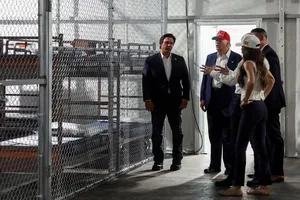 Trump admin’s green card review sparks fears of collective punishment
Concerns over immigration processing inside the United States have also drawn scrutiny on Capitol Hill. More than 100 Democratic lawmakers have sent a letter to the Department of Homeland Security and US Citizenship and Immigration Services condemning the cancellation of naturalization ceremonies and the halting of immigration applications for nationals of countries covered by the travel ban.
The lawmakers cited cases in which individuals were pulled out of oath ceremonies moments before becoming US citizens and demanded transparency about the scope and duration of the pause.
Rahnama said prolonged delays can function as de facto denials for people already living in the United States, even without a formal rejection.
“For some people, that just basically means they’re going to run out of time to be legally present in the US,” he said. “That looks like denial… it would effectively feel like it.”
He added that the broader impact now extends beyond asylum seekers or people attempting to enter the country, increasingly affecting families and individuals who have built their lives in the United States under existing immigration rules.
“Not only the asylum seekers this time are going to be affected,” Rahnama said. “The people inside are going to be heavily affected.”