
A nurse who cared for a very ill businessman in a Dublin hospital could not have envisaged her kindness would later lead to her being left a €25,000 gift in his will concerning a very substantial estate.
It took time to find the nurse, by then back home in the Philippines, where her name was as popular as ‘Mary Murphy’ is here, said Maeve Mullin, director of Finders International Ireland (FII). Another woman with the same name initially claimed to be the nurse but was caught out when asked to name the Dublin hospital. The correct nurse was eventually traced and warmly remembered her former patient, said Ms Mullin.
When dealing with the estate of another wealthy businessman, the company was engaged by solicitors after an unknown woman turned up at his funeral, claiming to be his daughter. It emerged the woman was born abroad, and the deceased man was not named as her father on her birth certificate.
Tracing beneficiaries of estates at the request of solicitors, executors or administrators accounts for much of the daily work of Ms Mullin, a probate genealogist, and her 13-member team at the Dublin-based office of FII. They are also engaged by local authorities to track down owners of derelict properties being sought for compulsory acquisition.
They use all the publicly available records at their disposal to flesh out a family tree and find people. “We’re very lucky to have www.irishgenealogy.ie,” Ms Mullin said. The website can be used to access records of births, marriages and deaths. Other tools include gravestone inscriptions and burial and newspaper records.
Men are easier to trace because their surname remains unchanged, but many women, on marriage, change their name to that of their husband, noted Ms Mullin. Much of the firm’s research outside Ireland centres on the UK, the US, Canada and Australia, but it has extended to more unlikely locations such as Botswana.
If a person dies single and apparently childless, without a will, and any siblings have predeceased them, the estate goes to their extended family. If there is any information suggesting the deceased may have had a child at some point, that child inherits all and the solicitor must be satisfied no child is entitled before any distribution of the estate.
Most estates the company deals with are valued about €200,000 to €300,000 and often involve many beneficiaries, perhaps reflecting a time when Irish people had large families. “We’ve had cases with over 100 beneficiaries.”
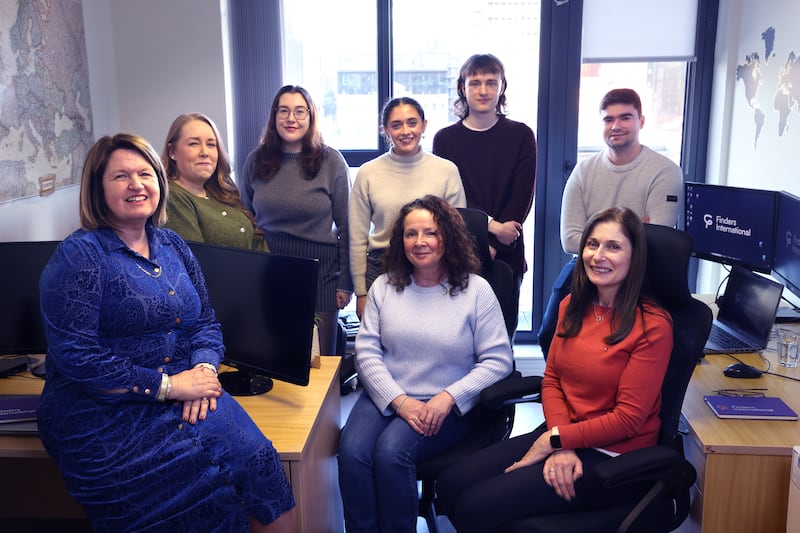 Maeve Mullin (left) of Finders International, with staff Aoife Long, Megan McAuley, Rayne McDonnell, Stephen Kennedy, Liam Cox, and (front) Elena Smyth and Lorna Fleming at their office in Dublin. Photograph: Dara Mac Dónaill
Although modern Irish families tend to be smaller, the growing number of blended families, and families not based on marriage, poses new challenges in tracing beneficiaries. “It is more difficult to ensure there are no children to a relationship rather than to a marriage.”
“We’re seeing the changing history of Ireland as well,” said Ms Mullin. “We’re seeing people dying in Poland, but their beneficiaries are in Ireland, or dying here and their beneficiaries are in Poland.”
When engaging with solicitors about the company’s work, Ms Mullin stresses the importance of ensuring they have the “full picture” in probate cases.
Many cases they take on involve intestacy, where a will has either not been made or cannot be found. That can often lead to complex and difficult situations and is time consuming, Ms Mullin said.
Her risk-mitigation checklist for solicitors includes ensuring unknown beneficiaries are not omitted, that unentitled beneficiaries are not included in error, and double-checking information from the client and family members.
One client told her solicitor, when dealing with the estate of her uncle who died intestate, she had two siblings but it turned out she had nine siblings and the number of potential beneficiaries of the estate was more than 20, not three. The client complained the undisclosed siblings had not visited her uncle when he was ill, but that is not a legal basis for excluding them as beneficiaries.
Omissions, Ms Mullin said, can be unintentional, perhaps because a client may have incorrect family tree information.
[ ‘I’ve heard people say, you know more about my family than I do’Opens in new window ]
When the correct information is established, it can come as “a shock”. Ms Mullin’s team could not initially find a birth record for a client’s deceased father and eventually discovered he was the son, not a sibling, of the eldest girl at home and the couple he called “Mammy and Daddy” were his grandparents. It was not unusual in Ireland decades ago where, if a daughter became pregnant, her parents pretended her child was theirs, Ms Mullin said. The team’s discovery meant the client’s solicitor had to inform her that her legal entitlements were affected.
In an era of internet scams, it can prove difficult to persuade beneficiaries the contact is legitimate. The preference, said Ms Mullin, is to write to people – but sometimes the only contact details may be an email address or via sites such as LinkedIn.
People in the US tend to be “very, very cautious”, she said. “We tend to find they have already been scammed. We just persevere, we point them to our website, our team, we give them as much information as possible.”
Despite their best efforts, the trail can run dry. “Maybe someone went to the US in 1910, they had a very popular Irish name, they were possibly not using their correct date of birth and they just disappear, with no record of marriage or death,” she said.
An insurance policy can be taken out against that individual or their descendants later turning up and asking for their share of the inheritance, which protects the solicitor’s client and the executor or administrator.
Ms Mullin said the company provides “a very important service”.
“A lot of people have received inheritances they would not otherwise have received but for the work we do. In England, Irish people don’t want their few bob to go to the government there. They should have made a will, they didn’t, but at least our work means it comes back to their Irish family. People really should make a will and decide themselves what they want to be done with their money.”