
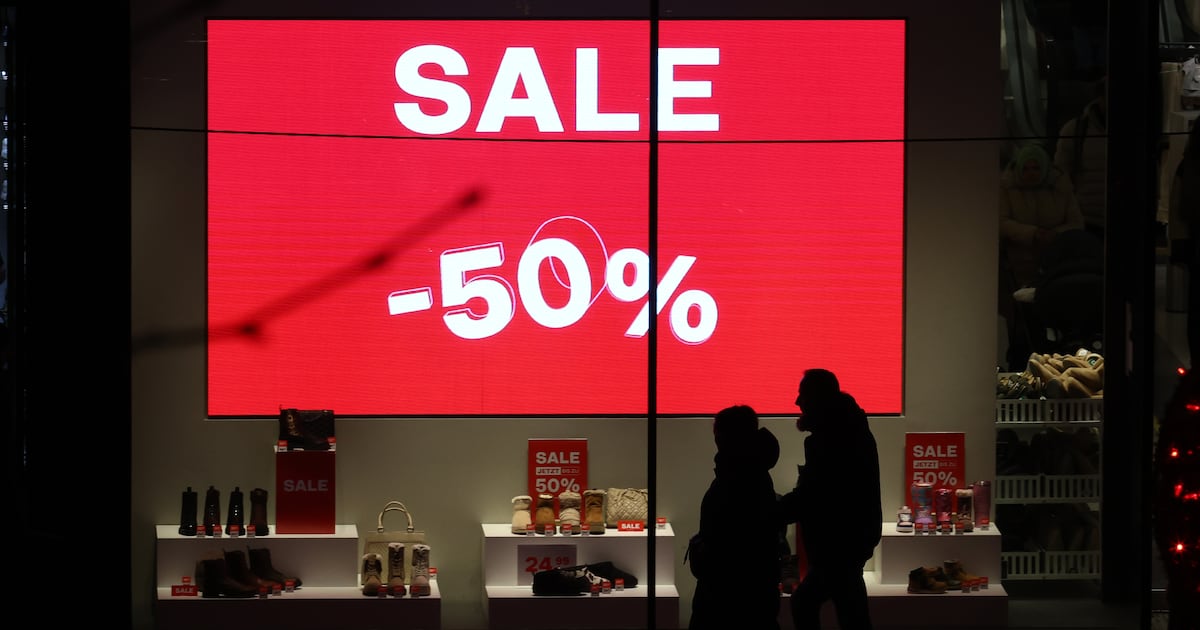
For many keen shoppers, the winter sales stand tall above all the other discount opportunities that present themselves over the course of an Irish retailing year. They retain an allure that appears to be almost magical and magnetic.
That is why there will have been queues – albeit small ones – outside the likes of Brown Thomas and Arnotts before dawn’s early light this morning as people, wrapped up against the cold, waited patiently for the shops to start selling again after a hiatus that lasted barely a day and a half.
The Irish Times has joined these people every St Stephen’s Day for more than a decade and has noticed the queues getting smaller and the reasons more opaque for people hauling themselves out of bed too early on what should be a day of rest to go shopping.
When asked why they do it, the most determined of shoppers rarely – if ever – say they are in the queue to buy a specific big-ticket item they have spotted for sale at a heavy discount.
More often than not, they are out and about because they like the craic of the communal shopping experience and because it is a way to spend time with friends and family outside of the Christmas cocoons of their homes.
The absence of headline items selling at massive discounts serving as a huge draw might be considered a reflection of the changing face of discounting in Ireland, not least because many shops are stuck in what can seem like a perpetual sales loop.
A large amount of retailers went into sales well before Christmas, having just come out of the Black Friday sales four weeks earlier. Then there were the mid-season sales, the summer sales, the previous mid-season sales and the winter sales of 2024/25.
[ Winter sales: Do they still offer value in the era of year-round discounts?Opens in new window ]
On some levels then, it seems as if Irish shoppers have never had it so good, but retail consultant Eddie Shanahan is not convinced anyone is really benefiting from all the discounting on the table. He thinks it might be time for everyone – retailers and consumers – to reimagine how shopping actually works.
“Once upon a time, there were two sale periods, the summer sales and then the sales after Christmas, but now there seems to be a sale every time we have a bank holiday,” he says. “If you challenge the retailers about this, they’ll say: ‘Oh, well, everyone else is doing it’. But for me the big question is, what’s happening to their margins. We know that it is expensive to do business as a retailer, with costs going up and wages going up, so I’m constantly amazed that we have a sale period just after Halloween at a time when the consumer is actually in the humour to buy, and then we go straight into the Christmas sales.”
He says the changing nature of how discounts operate in Ireland mean that often what is on offer is no longer just excess stock that retailers need to shift before the spring/summer season starts, with at least some of what is in offer in many shops bought in specially to be sold at a discount.
“Some shops will have over-bought, or made mistakes in their buying and bought the wrong things that the consumers didn’t want. And then, in other cases, you will have manufacturers who have merchandise on their hands that they didn’t sell through their wholesale channels or direct to consumers, and they’re offering that at a reduced price.”
Shanahan notes that the people joining queues outside shops ahead of the winter sales should ask themselves some hard questions.
“The first thing they should ask themselves is if they really need it? And are they really getting a bargain? And if you’re in the fashion space, are you buying last season’s fashion, or even the season before that?”
He suggests that in an era of ultra-fast fashion and at a time when – according to some reports – there are enough garments in Irish closets to clothe the next six generations of Irish people – that people should be looking to “buy less and buy better. But that needs buy-in from everybody in the marketplace. It needs buy-in from the retailers, the makers, and the consumers – all three must be aligned.
“I think we have to look at how we actually manage the supply into the marketplace. Retailers need to buy sharper, makers need to be much more focused on what they put into the market, and consumers must be prepared to pay a little more in the short term for long-term value.”
‘Be prepared when you go into a store to be enticed by the music, by the atmosphere, by the displays, by the visual merchandising, all of those things that entice you to spend’
— Damian O’Reilly, TU Dublin
Shanahan accepts that when consumers expect retailers to hold sales multiple times a year, it can be hard for shops to resist, but he says they should “just hold their nerve and say they are going to make their full margin on a smaller amount of stock. And in any event, I’m not sure that consumers aren’t beginning to get weary of all of these constant sales.”
Ultimately, he suggests, the big picture “is one of sustainability, and that is right across the board from fashion to homewares and electronic goods and so on. The real need is for an education programme focusing on how best to achieve sustainability and pushing the idea of buying less, but buying better. What’s needed now is a rebalancing of how we think about our purchases, because we can’t go on buying mountains of clothes and electronics and dumping them in Africa.”
When asked what makes for a good sales purchase, he stresses that people should not be looking at the percentage discounts or even the bottom line. “Price and value are not the same thing, and cost per wear and how long something lasts is very important. Retailers need to remember that cutting the cost is not the only instrument in their promotional toolkit, and they should be talking about their ethos, and sustainability, creating an experience and telling the story of the product, showing people how to care for it, how to create a trans-seasonal wardrobe.”
Damian O’Reilly, a TU Dublin academic specialising in retail management, says that for the canniest of shoppers, the sales actually start long before the shop doors open. “People are off for a few days around Christmas and they will be sitting there having had their Christmas dinner looking at things on their laptops. That is the starting point, and the journey has become very important. People will see bargains online and will get them into the shops.”
Like Shanahan, O’Reilly says the nature of sales has changed. “The days of having sales to get rid of excess stock are gone,” he suggests. “Retail forecasting systems, especially with AI, have become very, very sensitive to changes, and can adjust orders very quickly. Forecasting has become a fine art, and that means that there isn’t as much waste as there was previously when, if there was a weather change, retailers couldn’t sell overcoats if it was unseasonably warm, and so on. Companies are buying stuff in for sales. They look at liquidation stock months earlier or have stock made for them, specifically, that’s going to go into a sale.”
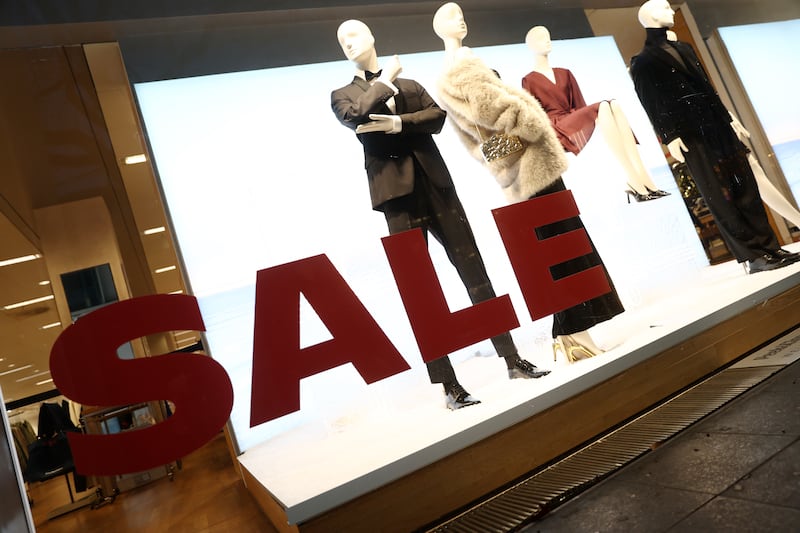 Shops have to make sure price-reduction boasts are easily identifiable as referring to the relevant goods, and that they are clearly visible and easy for consumers to read. Photograph: Maryam Majd/Getty
The reason why they are doing that is, he says, because we expect them to do that. “Sales are ubiquitous and if you don’t have a sale, you’re not in the game. You have got to have a sale, and you got to have bargains available to the consumer. We’ve trained ourselves over the last 10 or 15 years, going back to the recession, to shop when things are on sale. So if it is not on sale, people almost automatically ask the shop assistants when is it going on sale, and they come back then.”
Retailers make a lot of money from impulse buyers during sales windows, and O’Reilly says shoppers have to protect themselves against that impulse. “I would suggest in sales that people should be very careful with their money and always have the idea of ‘caveat emptor’ at the back of your mind. You’ve got to ask if you can actually afford it – does your wallet extend to buying another product?”
‘The good news for sales shoppers is that even if they lose the run of themselves over the days and weeks ahead, they won’t lose any of the hard won rights they have as consumers’
He says it is key to avoid feelings of Fomo. “You should have your budget in place and know what you’re going to spend and be aware that when you are in a shop, you are going to be tempted by other offers. Be prepared when you go into a store to be enticed by the music, by the atmosphere, by the displays, by the visual merchandising, all of those things that entice you to spend. The longer you’re in the store, the propensity to spend more is higher.” He suggests people spend in cash, rather than tapping. “That way, you know what you’re spending and you know how much money you’ve got to spend, and you won’t go over your limit.”
He also suggests that people stop and think before adding something to their basket, and don’t allow themselves to be swayed by the “when it’s gone, it’s gone” pitch. “Try something on, go away, think about it, see if you can afford it, and if you really want to, go back and try it on again. Resist that urge to make an impulse decision, even for 10 or 15 minutes. And then go back and make your decision. And if it’s gone, it’s fate telling you it wasn’t meant to be. And if you are buying a big-ticket item, do your work before you go to the shop. Look online to get prices and alternatives, so you will be less influenced by salespeople who try to sell you something, or [by] the visual merchandising.”
The rights you have and don’t have during sales
The good news for sales shoppers is that even if they lose the run of themselves over the days and weeks ahead, they won’t lose any of the hard won rights they have as consumers, with the rules that determine how sales work being set in stone.
Under those rules, retailers have to give some specific information when boasting about discounts, with the key one being the “prior price”. Gone are the days when shops could wilfully mislead people with promises of wild discounts. For the last three years or so all the discounts have to be real, and if they are not, retailers could face possible court action.
[ Post-Christmas sales: How to bag a bargain and know your consumer rightsOpens in new window ]
When advertising sales, shops are obliged to show the prior price of an item, with that price defined as the lowest price applied to an item in the 30 days before the sale price being applied.
Shops also have to make sure price-reduction boasts are easily identifiable as referring to the relevant goods, and that they are clearly visible and easy for consumers to read.
If, over the course of a sales period, there are more reductions in prices, the prior price retailers show has to be that same lowest price before the first of the sale price reductions is applied. If, for instance, a product was selling at €100 and then went into a sale at €50 before being further discounted to €30, the “prior price” remains €100, not €50.
While we are on the topic of promotional material and signs spotted on shop floors during sales periods, it is worth noting that signs such as “No money refunded” or “Sale goods not exchanged” are meaningless and could even be in breach of the law unless they are accompanied by a disclaimer which says “This does not effect your statutory rights”.
Away from pricing, consumers have the same rights when shopping in sales as they do when they are shopping at other times of the year, so they have they right to a refund, a repair or replacement [the three Rs] if an item is faulty or not as described.
It makes no difference if you get something that is discounted by a massive margin – it has to be of an acceptable standard, fit for its intended purpose, and as advertised. If it is not, you will be entitled to one of the three Rs referenced above.
Bear in mind that if you are returning something because it is flawed, you will need proof of purchase, and while that can take many forms, including a credit-card receipt, by far the easiest way to get redress is to have a store receipt.
‘We have said this before and will say it again – if the price on the shelf and at the till don’t match, the retailer is not obliged to sell it to you at the lower price’
It is important to note that it is the shop – not you yourself – who gets to decide whether you get a refund, repair or a replacement, except in some limited circumstances. That is a key point, serving as a reminder that there is no point going into a shop all guns blazing and demanding a full cash refund if something you bought it not up to standard. They don’t have to give that to you, so there is no point screaming the place down and demanding your rights.
You cannot be made to deal directly with a manufacturer if there is a problem with a product. Your contract is with the retailer, and if they try and send you off to the manufacturer, then you should stand your ground. That is unless you actually want to deal directly with the maker – as a consumer you have the right to explore that avenue too.
We have said this before and will say it again – if the price on the shelf and at the till don’t match, the retailer is not obliged to sell it to you at the lower price. The price on the shelf is what is known as an invitation to treat and is not a legally binding contract. Things can get mixed up during sales periods and price tags can be erroneous.
Remember that if you have buyer’s remorse and want to exchange or return something bought in a sale simply because you don’t like it any more, the shop is under absolutely no obligation to entertain you, and the rules they have at other times of the year – such as offering credit notes or replacements – might not apply.
To be fair to them, they have probably worked hard to shift the stock – and the last thing they want is for you to bring it back.
Five-point sales checklist to save you moneyDo you need or really want the product – and can you afford it? If you can answer yes to all three, then shop away. But if you don’t need it, don’t really want it and will struggle to pay for it, then it is not a real bargain at all. Have you done your homework in advance? Do you know what you are going into the sales to buy, and do you know how much it normally costs and where you might be able to get it cheaper? Even if you haven’t done your homework in advance, a quick google of whatever product it is you are considering buying while you are standing on the shop-floor might save you a few bob.Are you an impulse shopper? Are you buying this thing because you have been told it comes with a massive discount? If so, you might want to just walk away. A three-piece leopard print suit is – in all likelihood – going to be a terrible purchase even if you are getting it at a 95 per cent discount.Can you time your shopping well? While we often question the wisdom of the folk who get out of bed before dawn on St Stephen’s Day to get to the sales, there is a lot to be said for shopping early in the morning, when there are fewer people around. The worst time to be a savvy shopper is at about 3pm on the early days of any sale. The place will be bedlam, and you will be stressed. And a stressed shopper is rarely a smart one. It is an obvious point, but if you want to make the most of the sales, concentrate on high-value, big-ticket items. The percentage discount is worth more on the more expensive stuff. Also, focus on quality over quantity. You are better off buying one expensive but enduring item than five cheaper ones that won’t last.