
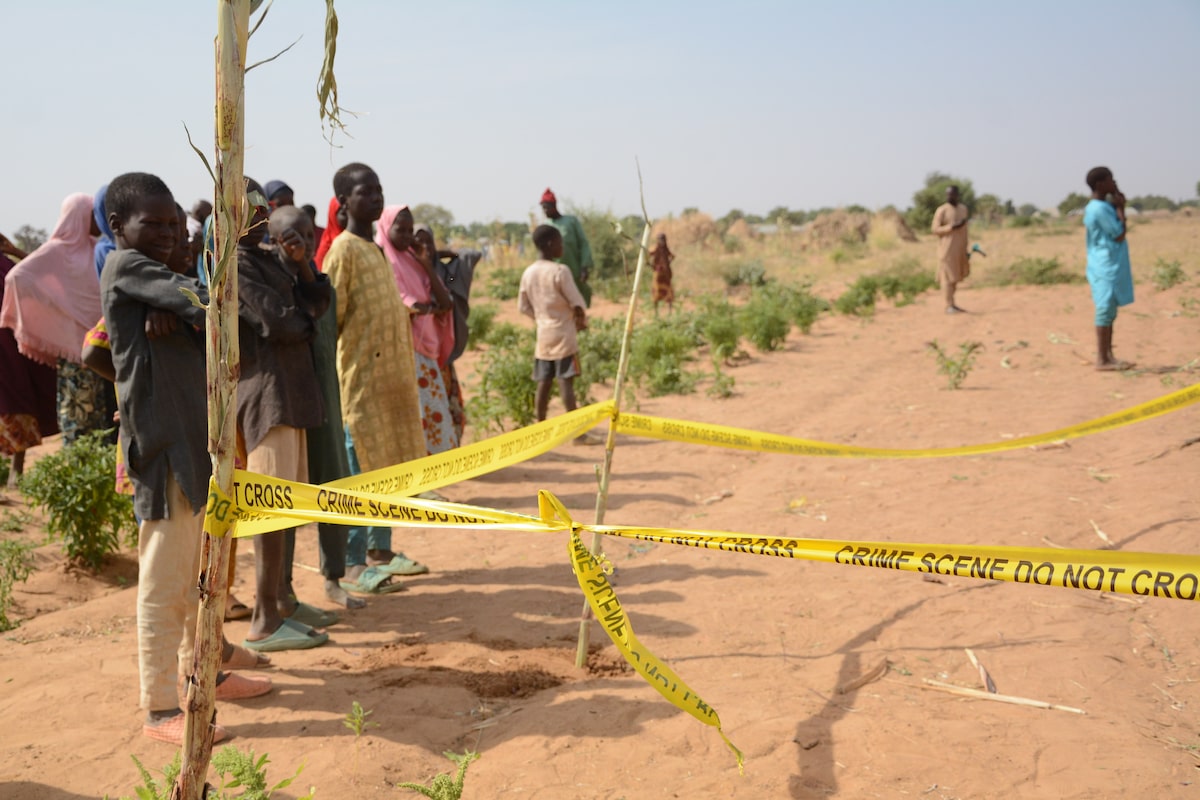
People stand behind crime scene tape at the site of a U.S. air strike in Jabo, Nigeria, Dec. 26, 2025.Tunde Omolehin/The Associated Press
Nigerian leaders have disputed U.S. President Donald Trump’s claim that a U.S. missile attack on Christmas Day was intended to protect Christians in the religiously divided West African country.
Mr. Trump announced on Thursday night that the United States had fired missiles at sites in northwestern Nigeria. He said on Truth Social that the “powerful and deadly strike” was aimed at Islamic State terrorists who have been “targeting and viciously killing, primarily, innocent Christians, at levels not seen for many years, and even centuries!”
The U.S. military’s Africa Command said its initial assessment had concluded that the missile strikes had killed “multiple ISIS terrorists” in the group’s camps in Sokoto, a mainly Muslim state in northwestern Nigeria.
The Pentagon released a video showing a missile launch from a U.S. battleship, while Mr. Trump said he wished a merry Christmas to “dead terrorists.”
The United States carried out a strike against Islamic State militants in northwest Nigeria, U.S. President Donald Trump and the U.S. military said on Thursday, claiming the group had been targeting Christians in the region.
Reuters
But the Nigerian Ministry of Foreign Affairs issued a statement denying that the missile strikes were specifically designed to protect Christians. The strikes were a joint operation by the two countries aimed at protecting “all citizens, irrespective of faith or ethnicity,” the ministry said.
Speaking on Friday on local television, Nigerian Foreign Minister Yusuf Maitama Tuggar said the military action “is not targeting any religion, nor is it simply in the name of one religion or the other.”
The Nigerian government will work with any international partner that is committed to fighting terrorism, regardless of “who the victims are, whether they are Muslims or Christians,” he said.
Terrorism in Nigeria is “not a religious conflict,” Mr. Tuggar added later in a social-media post. “Simplistic labels don’t solve complex threats.”
Mr. Trump has been threatening to attack Nigerian targets since November, when he began insisting that Christians in the country were “facing an existential threat.” He said his administration would attack with “guns a-blazing” if the Nigerian government failed to protect Christians.
Mr. Trump appeared to be responding to a months-long campaign by Christian groups and Republican politicians, who alleged that Christians were being killed at the rate of one per hour in Nigeria and could be completely wiped out. Nigeria’s population, the biggest in Africa, is roughly divided in half between a largely Christian south and a mainly Muslim north.
Nigerian analysts said the U.S. missile strikes appeared to target places where the main threats were ordinary bandits – rather than Islamist radicals – and where most of the victims were Muslims, rather than Christians.
“The U.S. labeling the strikes as targeting ISIS shows either a lack of understanding of regional dynamics or a deliberate attempt to fit its Christian genocide narrative for the American public,” independent Nigerian governance researcher Malik Samuel said on social media.
For many years, most terrorist attacks in Nigeria have occurred in the country’s northeastern region, where the Islamist militant group Boko Haram has long operated, rather than in northwestern regions such as Sokoto.
At least one of the U.S. missiles landed harmlessly in unoccupied farmland, in a district where terrorists do not operate, according to witnesses quoted by Daily Trust, a Nigerian newspaper that covers the country’s north.
The report described a loud explosion and a ball of fire in Jabo district, part of Sokoto state. The explosion caused panic but no injuries, it said.
It quoted witnesses saying they were puzzled by the U.S. missile strike because the district had not suffered any insecurity, even bandit attacks, for the past two years.
Some Nigerian opposition politicians said the U.S. missile strikes were a threat to the country’s sovereignty. They noted that the attack was first disclosed by Mr. Trump, who did not wait for the Nigerian government to announce the news.
“The country has been reduced to a bystander while its sovereignty is violated under the direction of U.S. President Trump,” said Omoyele Sowore, founder of a prominent Nigerian media outlet and leader of African Action Congress, a left-wing Nigerian political party.
“It is evident that the strikes were carried out without the genuine authority or informed consent of the weaklings masquerading as government,” he said in a statement.
Nigerian officials denied the charge. They said the Trump administration had received intelligence reports from the Nigerian government and obtained the government’s approval before launching the missile strikes. More attacks could be launched in the future, they said.
“You can call it a new phase of an old conflict,” Mr. Tuggar said. “For us, it’s something that’s been ongoing.”
A damaged building after U.S. forces had launched a strike that President Donald Trump says was against Islamic State militants, on Dec. 25, 2025 in Offa, Kwara State, Nigeria.Abdullahi Dare Akogun/Reuters
In the first Pentagon social-media announcement on the missile strikes, the U.S. Africa Command said the attack was launched “at the request of Nigerian authorities.” It misspelled Sokoto state as “Soboto.”
An hour later, it deleted the statement and issued a new one, correcting the misspelled name and saying that the attack was conducted “at the direction of the President of the United States and the Secretary of War, and in coordination with Nigerian authorities.”
Ryan Cummings, director of Africa-focused risk management consultancy Signal Risk, said the U.S. missile strikes might produce some short-term successes but would make it easier for Islamist groups to recruit and radicalize Nigerians in the longer term. The strikes could “further deepen fault lines between Christian and Muslim Nigerians who will have opposing views on U.S. intervention,” he said on Friday.