
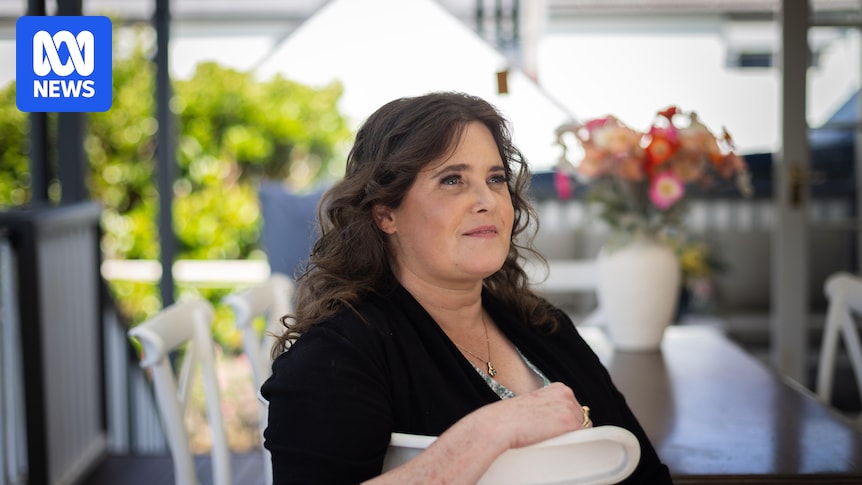
It sounds like a fairy tale. A beautiful young woman gives her heart away and goes on to marry the man of her dreams.
Lucinda Winnem’s extraordinary true story is a little-known piece of medical history.
On a winter’s night in 2005, 24-year-old Lucinda became the first Australian woman to undergo a triple heart-lung-liver transplant at The Prince Charles Hospital in Brisbane.
At that stage, she was one of fewer than 20 people worldwide to have undergone the surgery.
A childhood photo of Lucinda in the early 1980s.(Supplied: Lucinda Simpson)
The triple organ transplant was lifesaving, not just for Lucinda but for another woman, a stranger, who was waiting for a donor heart.
After being born with cystic fibrosis — a genetic condition that causes severe damage to the lungs, digestive system and other organs — Lucinda needed new lungs and a liver.
But because it’s technically easier for the surgeons, and less risky for the patient, to replace the heart, lungs and liver as a bloc — a bit like swapping the entire engine of a car in one go, rather than changing individual parts — she also received a new heart that night.
Her strong and healthy heart, which was unaffected by the cystic fibrosis, was then transplanted into someone else, in what is known as a domino transplant.
When she was a baby Lucinda’s father noticed she tasted of salt when he kissed her forehead – a sign of cystic fibrosis.(Supplied: Lucinda Simpson)
When she was a baby Lucinda’s father noticed she tasted of salt when he kissed her forehead — a sign of cystic fibrosis. (Supplied: Lucinda Simpson)
As a child in the 1980s, Lucinda’s parents were told she might not live beyond her 5th birthday.(Supplied: Lucinda Simpson)
As a child in the 1980s, Lucinda’s parents were told she might not live beyond her 5th birthday. (Supplied: Lucinda Simpson)
Lucinda with her parents at her 13th birthday — an age doctors warned her parents she may not reach.(Supplied: Lucinda Simpson)
Lucinda with her parents at her 13th birthday — an age doctors warned her parents she may not reach. (Supplied: Lucinda Simpson)
After being diagnosed with cystic fibrosis in the early 1980s Lucinda defied early expectations.(Supplied: Lucinda Simpson)
After being diagnosed with cystic fibrosis in the early 1980s, Lucinda defied early expectations. (Supplied: Lucinda Simpson)
She remains one of the few living heart donors walking the planet — a concept most people associate with science fiction.
“It’s really humbling to know that you’ve received such an incredible gift from someone that’s put a lot of forethought into what happens if they die,” she says, forever grateful to her donor. “But then, to be able to give someone the same gift … but still be alive yourself, it’s just really lovely.
“It’s a nice feeling to know that you’ve given back to someone who is just as desperate as you were.”
Sixteen weeks after her transplant, in a quaint stone chapel with stained glass windows at Mt Nathan in the Gold Coast hinterland, Lucinda married Damon Simpson, the man who had stayed by her side through her significant health challenges.
In a nod to Cinderella without the glass slipper, they met in 2003, bumping into each other at a Gold Coast shopping centre — Lucinda was window shopping, looking at shoes, and Damon was staring at the ground as he walked.
“When we met, I just knew that there was something,” Damon says, his voice choking with emotion. “We were meant to be together.”
Lucinda said her wedding was a celebration of marriage and life.(ABC News: Luke Bowden)
A few weeks into their relationship, Lucinda nervously told Damon she would soon need an organ transplant. She knew by his reply “he’s a keeper”.
“Even if you had no arms or legs and you were just a head, I’d buy you awesome hats for Christmas,” he told her at the time, deadpan.
Ten months later, on Lucinda’s 24th birthday, he proposed.
Among the 65 closest family and friends who attended their wedding were three of the doctors who cared for her during her 12-hour transplant operation and its aftermath — surgeon John Dunning and transplant medicine physicians, Peter Hopkins and Keith McNeil.
The medical specialists were the first people Lucinda saw, sitting in a wooden pew at the back of the church, as she entered through the chapel’s arched doors a few minutes past 4pm, on a muggy spring day.
Lucinda and Damon Simpson on their wedding day in October 2002 with three of the doctors who cared for her during her 12-hour transplant operation and its aftermath.(Supplied: Lucinda Simpson)
Tears — and her mascara — started to flow as she thought of how much it meant to her to have the men who helped save her life with her on her wedding day.
“Aside from having a celebration of marriage, it was a celebration of life,” Lucinda says.
Professor McNeil, who now works for SA Health as the Commissioner for Excellence and Innovation in Adelaide, still has a photo of all three doctors with Lucinda and her new husband after the nuptials, in an album at home.
“I’m sure I had a little tear in my eye,” he says, recalling that day. “It’s hard not to when you see what people go through with the courage to be able to get them to that point. It’s indescribable, really.
“We’ve helped people do lots of interesting things after their transplants — flying jet planes, climb Mount Kilimanjaro, traipse up and down the Andes — that you wouldn’t normally think a patient with a transplant would be able to do.
“And for Lucinda, getting married … having a life like that, is fulfilling her dreams.” Professor Keith McNeil was part of the team that performed Lucinda’s 12-hour transplant operation.(ABC News: Mark Leonardi)
Even as an experienced physician, the process can still leave Professor McNeil marvelling at the possibilities transplant medicine has created.
He recalls one memorable experience at Royal Papworth Hospital, a specialist heart and lung hospital in Cambridge, England, where he worked in the 1990s. One day while having lunch with his wife, Sharyn, he pointed to a young woman and an older man sitting nearby and said to his wife: ‘He’s got her heart.’
“It was like: how can that possibly be the case?'” Professor McNeil recalls, adding the idea of a living heart donor is “a notion that most people struggle to get their head around.”
Lucinda was planning her October 27, 2005, wedding when she got the call that would save her life.
She had just hours to prepare herself mentally, saying she felt numb, rather than anxious going into the operation.
Lucinda, Damon, and Angus Simpson(ABC News: Luke Bowden)
“You don’t feel excited, you don’t feel scared,” she says.
“You just sort of feel nothing really — and you just anticipate — we’ll get this done.”
Cardio-thoracic surgeon John Dunning, who worked with a team of surgeons to perform the transplant, says Lucinda “stands out in my memory as an outstanding individual, an outstanding success story”.
He recalls her operation starting late into the night and going beyond the early hours of the morning.
“Coffee’s a good friend,” he says with a laugh from St Augustine in Florida, where he still works as a surgeon.
“Those long operations, it’s a little bit like driving a car for a very long time.
“There are moments of intense concentration like when you get to a junction. But there are other moments when you’re on automatic pilot.”
He worked with a liver transplant team during the operation.
“We’re able to give each other spells and breaks and look after each other,” Professor Dunning says.
“It is really a long physical event, it’s through the night, you’ve done a day’s work often before you get to the transplant.
“It’s energy sapping.”
Lucinda was able to breathe properly again after her gruelling transplant operation.(Supplied: Lucinda Simpson)
Professor Dunning’s memory of that night has faded with time, but Lucinda recalls being told he operated as American Latin rock band Santana played on CD.
What the surgeon has never forgotten is the grace and cheerfulness his patient showed as she prepared for her transplant and in the aftermath.
“She just struck me … as the most wonderful individual,” he says, his face beaming at the memory of his patient.
“She was so positive despite all the adversity that she’d had to deal with as a result of cystic fibrosis.”
Her illness has not robbed Lucinda of a sense of humour.
A legacy of her operation is a faded J-shaped scar, prompting her to joke Professor Dunning had carved his first initial into her chest.
The marathon triple transplant operation at The Prince Charles Hospital took around 12 hours.(Supplied: Lucinda Simpson)
Lucinda credits her mum Kaylene Winnem with helping her stay upbeat throughout her illness and in the lead up to her transplant.
“She was a major part of my life and positivity,” she says. “Mum has always been the light in my life even when times seemed dark. She always told me I could do anything I put my mind to.
“I still have that determination in every aspect of my life.”
Her parents waited anxiously at the hospital with Damon and some very close family friends Lucinda had grown up with as Professor Dunning operated.
As a teenager Lucinda was told she would need a lung transplant in her 20s.(Supplied: Lucinda Simpson)
At the time, the surgeon hoped he could improve her quality of life and life expectancy, never contemplating what her world would look like two decades hence.
“I think most of us would expect to be able to do a transplant with an outcome, a good outcome, for a patient of maybe 10 years, maybe a little bit longer,” Professor Dunning says.
But here she is, 20 years after her historic transplant, living her best life in a home evoking a gingerbread house at Mt Tamborine, in the lush Gold Coast hinterland.
Damon, 53, is still by her side, and they have a seven-year-old son, Angus, an adored little boy who has just finished his first year of school, loves karate and has “loads of friends”. Fox terriers Cinder and Oscar complete the family.
Lucinda, Damon and Angus watch their dogs Cinder and Oscar play in the backyard of their home in Tamborine Mountain.(ABC News: Luke Bowden)
Lucinda’s doctors know of no other case in the world where a woman with a heart-lung-liver transplant has given birth.
The 45-year-old is revelling in motherhood and family life, defying many medical predictions of her life-span.
“I’ve had opportunities to go back to work, I’ve had an opportunity to have a child. And obviously, to marry my husband,” she says.
“So, it’s basically a normal life. It’s been an incredible journey.”
Lucinda, who works part-time for a Mt Tamborine accountant, was about 12 months old when she was diagnosed with cystic fibrosis.
A selection of medications Lucinda has to take daily.(ABC News: Luke Bowden)
Her father Jim Winnem had noted that when he kissed his daughter on the forehead, she tasted salty — a symptom that’s long been associated with cystic fibrosis.
Early references to children believed to have cystic fibrosis date back to the Middle Ages, when folklore warned: “Woe to the child who tastes salty from a kiss on the brow, for he is cursed and soon will die”.
The condition was not formally identified and named until 1938 when pioneering American pathologist Dr Dorothy Hansine Andersen described cystic fibrosis as a disease during autopsies on children.
When Lucinda was diagnosed, her parents were told the likelihood of her surviving to five “is pretty low”.
After her fifth birthday, doctors told them she “might be gone by 13”.
In her teens, she was told she would probably need a transplant by her mid-twenties.
Her health was deteriorating as her relationship with Damon grew stronger.
Lucinda and Damon met when they bumped into each other at the shops and soon became inseparable.(Supplied: Lucinda Simpson)
“It was really hard to breathe, just doing everyday activities like vacuuming, cooking, cleaning, working,” she says.
“If you think of a two-litre milk container, basically I was breathing 30mls instead of 2000mls.”
The sensation has been described as like putting a peg on your nose and trying to run up a flight of stairs while breathing through a straw.
Being able to breathe at full capacity was the first thing Lucinda noticed after her transplant.
“It was just an incredible feeling to … have fresh air in your lungs,” she recalls.
Twenty years after her triple organ transplant, the 45-year-old has defied expectations. (ABC News: Luke Bowden)
Long before her transplant and meeting Damon, Lucinda asked her medical teams about the possibility of having children.
The answer was always the same — no.
After she met Damon, the response did not change.
“We were told by one of the nurses at the old Southport Hospital that we wouldn’t have children,” Damon says.
Resigned to their fate, the couple had gone so far as getting Blue Cards to be foster parents, thinking they would be unable to have children of their own.
“But the thought of the real parents taking back the baby, or the child, would have been heartbreaking,” Damon says.
Lucinda Simpson arranging the medications she takes each day. (ABC News: Luke Bowden)
Lucinda waited until about five years post her transplant before broaching the issue again with her respiratory physician at the Prince Charles Hospital, Professor Peter Hopkins, one of the men who had attended her wedding.
This time, instead of being faced with a closed door, she was met with hope.
In 2013, Professor Hopkins, the Queensland Lung Transplant Service director, referred Lucinda and Damon to the obstetric medicine team at the Royal Brisbane and Women’s Hospital for pre-conception counselling. Their journey to parenthood would take another five years.
Lucinda had to first change her immunosuppressant drugs before falling pregnant.
Professor Peter Hopkins, Director of the Queensland Lung Transplant Service at The Prince Charles Hospital, in Brisbane.(ABC News: Janelle Miles)
“There are some drugs that we use which are prohibited in pregnant women and so before they attempt to become pregnant, we change their medication,” Professor Hopkins says.
“That can be a little bit risky.
“Thankfully, with Lucinda, that transition happened without any problems and once we were convinced that she was stable and all of her three organs were functioning well, then we said: ‘Proceed.'”
It helped that Lucinda has always strictly followed her medication regimen. She still takes about 150 tablets a week.
“She’s always looked after herself, taken her medication on time, had the blood tests when we’ve recommended and really just had a healthy lifestyle, eaten well, exercised regularly, that’s really been what she’s been about throughout this whole journey,” Professor Hopkins says.
“But in pregnancy, in particular, it’s important to do all those things even more so and she was exemplary at that. She is a wonderful patient, so appreciative of the health care that she receives.
“She’s motivated, she takes really good care of herself, and I think she has every good reason to think she’ll continue to do well.”
Lucinda is one of seven successful pregnancies among women cared for by the Queensland Lung Transplant Service, which celebrates 30 years in 2026 since the state’s first lung transplant.
More than 650 lung transplants have been done since that first one in 1996 at The Prince Charles Hospital.
Lucinda is believed to be the only woman in the world to have a baby after a lung, heart and liver transplant.(Supplied: Lucinda Simpson)
Professor Hopkins says 77 per cent of the service’s patients were still alive five years after lung transplantation.
“Internationally, that number is 60 per cent so we’re really getting exceptional results,” he says.
Lucinda is one of eight heart-lung-liver transplants performed in Queensland since the first in 2003 and the only woman to go on to have a baby.
Loading…
She describes her pregnancy as “flawless” until 27 weeks, when she developed symptoms of pre-eclampsia, which causes high blood pressure.
Scans showed she also had placental insufficiency.
“He wasn’t getting enough food from the placenta,” Lucinda explains. “It was getting to a very dangerous point where we had to get him out or potentially lose both of us.”
A photo of Angus Simpson on a bookshelf.(ABC News: Luke Bowden)
Angus Campbell Simpson, the baby Lucinda and Damon thought they could never have, was born by emergency caesarean section 12 weeks early at the Royal Brisbane and Women’s Hospital in April 2018.
He weighed just 832 grams.
Sydney student’s feat ahead of HSC exams after health challenges
“If you imagine a little soft drink can with arms and legs, that’s about how small he was … very tiny, very fragile,” Lucinda remembers.
“He’s a little fighter, a bit like his mum. He definitely wanted to be here.
“That was a very special time … bonding with him.”
Angus spent two months in the hospital’s neonatal intensive care unit and another month in special care before being allowed home.
Amid the inevitable stresses of parenthood, Lucinda finds time every day to reflect on the gratitude she feels to have the opportunity to be a mum.
“It’s been an incredible journey, and I feel really blessed,” she says.
Angus and Damon Simpson playing videogames.(ABC News: Luke Bowden)
“I think how did I grow him inside me and how is he here now? I’m incredibly lucky.”
The Simpsons also regularly reflect on the priceless gift of a stranger and the selflessness of a grieving family that has allowed Lucinda to live.
“Somebody passed away, we understand that, and we think about it all the time,” Damon says.
“She got the gift of life, she was able to give the gift of life, and then we were able to create life all from one donor. It’s amazing to think about.”
Lucinda also ponders the life of the woman who received her heart 20 years ago.
“Send me a letter,” she says, with a smile.
“I’d love to know how you’re going.”
To sign onto the Australian Organ Donor Registry visit donatelife.gov.au