
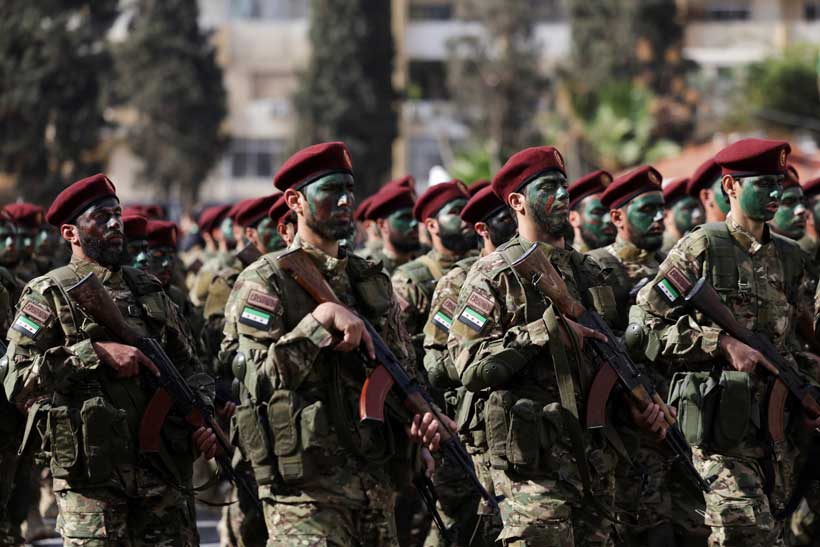
The post-revolutionary period in Syria has been a subject of regional security discussions, with one of the most complex governance and security issues in the contemporary Middle East. One of the most critical unresolved questions is the relationship between the Syrian Democratic Forces (SDF) and the Syrian central government, which awaits redesign in the new order. While both actions emerged from the conflict with different sources of legitimacy and territorial control, the sustainability of Syria’s post-conflict order depends on whether this conflict develops through conflict or through reconciliation. This article argues that instead of addressing the issue as a binary choice between autonomy and centralization, a zero-sum approach will deepen fragmentation and insecurity. A viable post-revolutionary solution requires a pragmatic reassessment of the authority of the area-state and a review of security and local governance arrangements while preserving Syria’s territorial integrity and addressing the realities on the ground.
Strategic Context: From Military Benefit to Political Obligation
In the Syrian civil war, which began in 2011, the SDF initially functioned as a non-state actor fighting ISIS with the military support of the US CENTCOM. However, after the change, the new order of non-state actors was sidelined. The SDF, which had previously emerged as a proxy force, remained as a political entity in the middle of the restructuring of Syria and the reorganization at the center. In fact, Washington gave a clear signal of this in July 2025. US Ambassador to Ankara and Special Representative for Syria, Tom Barak, stated, “The SDF is the YPG and the PKK. We have no obligation to them to establish an independent state,” indicating that the SDF had no place in the new order. For Damascus, the existence of autonomous regions challenged its monopoly on violence in the region. In March 2025, an agreement was reached between the Shara government and the SDF, which envisioned the integration of SDF forces into the new Syrian army. However, the implementation process stalled due to unresolved issues for both sides. For the SDF, relying solely on military force without political institutionalization risked isolation, loss of legitimacy, and ultimately marginalization. This forces both actors to continue reconsidering their long-term goals beyond their immediate power programming.
The SDF’s Strategic Dilemma: From De Facto Control to Political Sustainability
Analyses show that the SDF faces a critical transition problem. Military control and international partnerships—particularly with the United States—have provided short-term security guarantees, but the SDF’s place in post-conflict reconstruction is unclear. In this context, it should be stated that US support is conditional during the proxy war, because geography and circumstances are what are permanent.
The ability to transform from de facto control to a politically sustainable force format requires, first and foremost, a negotiated dialogue that prioritizes the SDF’s narratives of autonomy and is a crucial element. Federalism, or complete decentralization, is not a politically sustainable policy that can be achieved in the short term, considering the centralizing doctrine provided by Damascus. A more viable approach is to advocate for functional decentralization: local administrative authority, cultural recognition, and participation in diverse national decision-making can be discussed in this context. Secondly, prioritizing the institutionalization of civilian governance is crucial. The connections within SDF-controlled areas are based on military discipline, voluntary service provision, legal availability, and representative local meetings. In this sense, demonstrating civilian governance structures risks the SDF being perceived as a purely structural entity rather than a legitimate political participant.
Finally, it is necessary to state that the fragility of integration will be created through the flexibility of extreme resistance to international actors. Because the SDF’s structure involves conflict on the ground, military struggle, and an externally supported local autonomous force, integration with the state experience of the controlling state will be difficult; therefore, it is the party that must compromise with Damascus, however difficult it may be.
The Limitation of the Syrian Scope: Incapable Sovereignty
The Syrian government’s perspective is that the post-revolutionary period presents both an opportunity and a limitation. While re-establishing sovereignty is the primary goal, it possesses the ability to exercise absolute control over all information. The security formations that accompany rapid and challenging reintegration efforts inevitably carry the risk of local resistance and renewed instability.
A firm demand for the disarmament or disbandment of the SDF during the war would likely backfire. Armed integration has been successful in growing in fragmented forms, with conditional and political incentives. In this context, following the announcement on December 18th that an initial agreement had been reached with Damascus authorities to integrate three SDF units in northeastern Syria into the army, it is known that the newly formed Syrian state signed the agreement to prevent the resurgence of insurgent dynamics, as this is in its strategic interest. At this point, the Syrian state can act by implementing limited but concrete administrative reforms and confidence-building measures. While comprehensive constitutional restructuring is politically sensitive, selective decentralization, particularly in the areas of municipal administration, budget allocation, and cultural rights, can reduce tensions without weakening official sovereignty.
Security Integration: A Key Variable
Security integration constitutes the most sensitive dimension of SDF-state relations. International experience shows that abrupt disbandment of armed groups rarely yields positive results. This can destabilize the situation. Instead, phased integration models that combine shared security mechanisms, local policing arrangements, and ultimately integration into national forces offer more lasting results. In the case of Syria, a transitional framework could include maintaining local security units under nominal state authority, along with gradual professionalization and standardization. Such arrangements would reduce fear of collective punishment among the local population while allowing Damascus to gradually expand its institutional control.
The Role of International Actors
While the future of SDF-state relations is primarily an internal matter, international actors have a facilitating role. In this context, ignoring the concerns of Türkiye, the country with the longest border with Syria, would significantly deepen the issue. On December 15, 2025, Turkish Foreign Minister Hakan Fidan, accompanied by Minister of National Defense Yaşar Güler and Head of the National Intelligence Organization (MİT) İbrahim Kalın, met with the interim president of Syria, Ahmed al-Shara. Foreign Minister Hakan Fidan stated that his meetings with Syrian officials focused on the integration of the SDF into the new Syrian army, Israeli military interventions, and the fight against ISIS. Ankara, besides being a party to the Syrian war and as both a NATO and UN member, has consistently reacted negatively to Washington’s cooperation with the SDF, especially during periods of tension in the region, and has stated at every opportunity that the SDF, an offshoot of the YPG and PKK, is a terrorist organization, just like its sources. Ultimately, after the formation of the interim government, the SDF, lacking support as stated by US Middle East Envoy Tom Bajrak, has failed to achieve its goals and is now overlooking the international benefits of sitting down at the table with al-Shara.
Conclusion
The post-revolution phase in Syria requires moving away from a zero-sum approach. In this respect, a pragmatic framework based on gradual integration, functional decentralization, and mutual guarantees can provide the most realistic foundation for post-conflict governance.
For the SDF, political sustainability should prioritize participation rather than isolation. In this sense, acting under the sovereign and legitimate plans of the Syrian state would be quite wise. Ultimately, the SDF ceasing to be an obstacle to Syria’s stability, unity, and prosperity is crucial for the stability of the newly established order.