
He was accompanied by a friend, Isaak Tuiva, who continues to help him each day.
Initially, Scott could only move his eyes, and his tears showed he could hear and understand what was going on around him.
Sister Demelza Scott, who lives in Australia, says her family told her her brother was braindead, and she should rush to Whangārei before they turned off his life support.
But Demelza was surprised to arrive at Whangārei Hospital to see her older brother staring back at her, seemingly able to understand what was happening.
“He was right there – we could tell he was trying to say ‘don’t you dare give up on me’.”
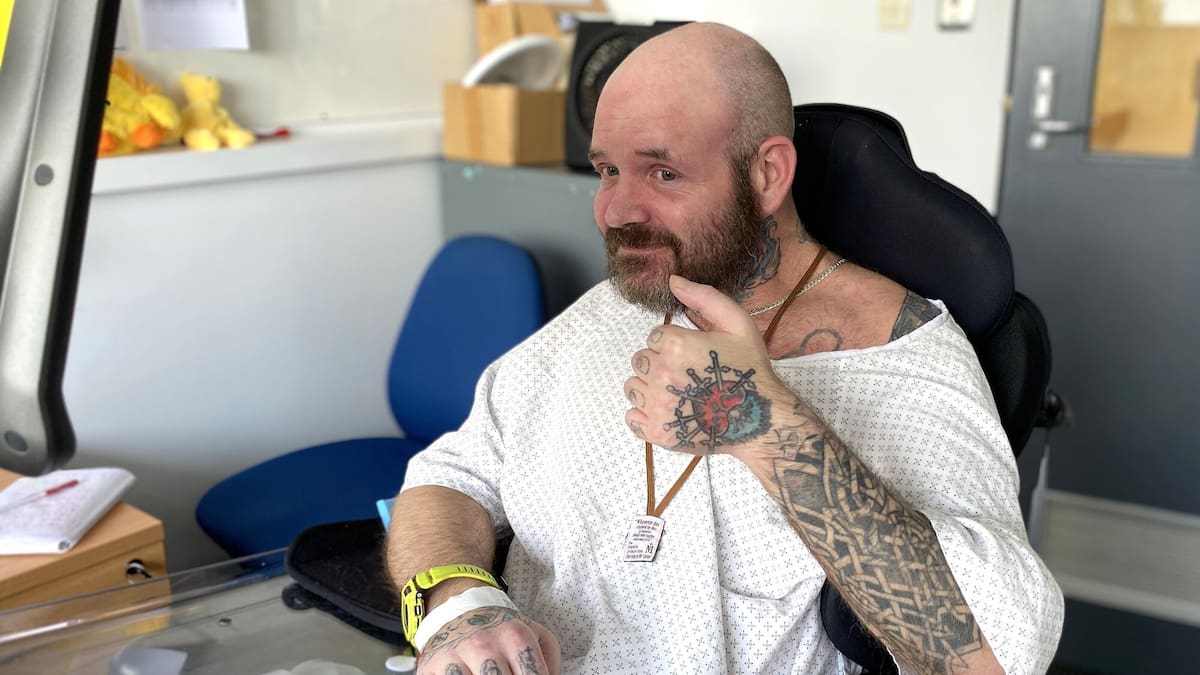
Ryan Scott, 41, is now able to move one hand and use a computer to talk with the control of his eyes, but his recovery from locked-in syndrome still has a long way to go. Photo / Denise Piper
At this stage, Scott could only move his eyes up and down or blink, so they worked out a system: looking up to mean “yes” and closing his eyes to mean “no”.
He was asked, three days in a row, if he wanted to survive and he communicated “yes” each time.
When asked what motivates him, Scott reflects on his Catholic faith and points upwards.
He admits at one point, he thought he would be called to heaven by his maker: “If that was His will then I would be happy with that, but it wasn’t, so here I am.”
Scott says he is lucky to have the support of friends, who he met through St Francis Xavier Church, Calvary Chapel and Christian fitness and MMA classes, Lions Den Ministries.
Battle over ongoing rehabilitation continues
Scott has since made impressive progress, defying his diagnosis.
His intubation was removed and he began breathing on his own, then started moving his head. He now has full movement of his head, can move one hand and is able to say a few words.
Ryan Scott says no one used to second-guess him because he was a big, muscly guy who knew what he wanted. The stubbornness has remained.
But his future beyond the walls of Whangārei Hospital is uncertain because there is no specialist stroke rehabilitation centre in New Zealand offering the one-on-one care he needs.
This would have been different if he was a spinal or brain injury patient.
“There should be support for people like me and there’s not,” Scott says. “The system would be happier if I chose death instead of life, no matter how it looks.”
Scott says his condition is rare.
“I’m the only one that has what I’m facing, so nobody’s got experience with it, not even the hospital, which makes it fun.”
The team at Whangārei Hospital is committed to supporting Scott with his ongoing care, rehabilitation and recovery journey, Pimm says.
“We’re really pleased that Ryan has made steady progress. With a stroke like Ryan has experienced, it is unlikely he will recover full movement. However, recovery can continue for some time after the stroke and it is very difficult to say what function will be regained.”
Given the nature of Scott’s condition, Pimm says it is likely he will need ongoing care and rehabilitation, which is a challenge in Northland.
“We will work with Ryan and his whānau to identify the right long-term care, wraparound support and rehabilitation programme for him.”
Funding another challenge for Ryan and whānau
Ryan Scott, 41, used to regularly go to the gym and work as a building contractor but all that was taken away in an instant when he had a stroke.
While Scott is battling to recover, funding for his care is another battle, Demelza says.
Scott is eligible for support through the Ministry of Social Development’s Disability Support Services (DSS), deputy chief executive Anne Shaw says.
Northland Needs Assessment and Service Co-ordination provider NorthAble has assessed his situation and is working to confirm a place where he can rehabilitate safely, she says.
But Demelza is concerned Scott won’t have enough funding to cover both his day-to-day care and his ongoing therapy.
She has started a Givealittle page to help raise money for his speech therapy, physical therapy, occupational therapy, wheelchair and mobility aids, communication aids, medicines and tube feeds, braces, clothing, and travel costs.
Despite the frustrations, Scott is determined to prove his diagnosis wrong.
“I know there is more to come,” he says.
He would ultimately like to help others in his situation in Whangārei, with a faith-based centre.
“I want to build a monastery-type rehab eventually,” he says.
Scott’s progress ‘a miracle’, friends say
Ryan is relying on friends to help him through this difficult time, who say he is an inspiration.
Tuiva says it was hard seeing his friend go from fit and strong to being unable to move.
“At the very start, it was hard because we didn’t know if he was going to live or die. He couldn’t communicate, and we were just praying with him every day.”
But Tuiva says Scott’s determination to live turned the situation around.
“After that moment when he said he wanted to live, it was really inspiring. In your own head, you think, ‘I don’t know what I would choose’.
“To have your eyes as your only communication and to still keep going because of faith, it’s inspiring – there’s no other word for it.”
While there have been ups and downs, Tuiva says it has been good to watch his friend’s improvements.
“His progress has been a miracle up to this point.”
Denise Piper is a news reporter for the Northern Advocate, focusing on health and business. She has more than 20 years in journalism and is passionate about covering stories that make a difference.