
At no point did the police see the four men interact with one another.
In fact, it’s possible the Mexicans were unaware their fellow countrymen even existed.
There was only one thing the men had in common: their separate flights had been booked using the same email addresses and phone numbers that Customs had seen before.
The previous year, in January 2023, two other Mexican men had used those same details to book flights to New Zealand and Customs had flagged their travel plans as suspicious.
The pair were placed under surveillance in a covert investigation, codenamed Operation Settler, and police later busted one of the men with 14kg of methamphetamine and $360,000 cash.
The duo were described as a “cell” of a transnational organised crime group.
“These organised crime groups are constantly targeting New Zealand and, on many occasions, they are inserting their own people into the country,” Detective Superintendent Greg Williams said at the time.
“Once established here, they are importing illicit drugs, establishing supply lines to domestic markets and then moving their profits out of the country.”
About $360,000 cash and 14kg of methamphetamine were seized from a Mexican cartel’s cell in Auckland. Photo / NZ Police
When the identical emails and phone numbers were used to book separate flights for four men into New Zealand the following year, Customs again flagged their travel plans as suspicious.
A new covert investigation, Operation Fix, was started and the police closely monitored their movements between May and July 2024.
The problem was nothing was happening. The Mexican nationals seemed to be killing time in their accommodation and this was frustrating for police, given the time and manpower needed for the surveillance efforts.
The breakthrough finally happened on July 26, 2024.
A ship from Mexico had docked at Port of Tauranga with two containers declared as scrap metal, raising eyebrows among Customs officials.
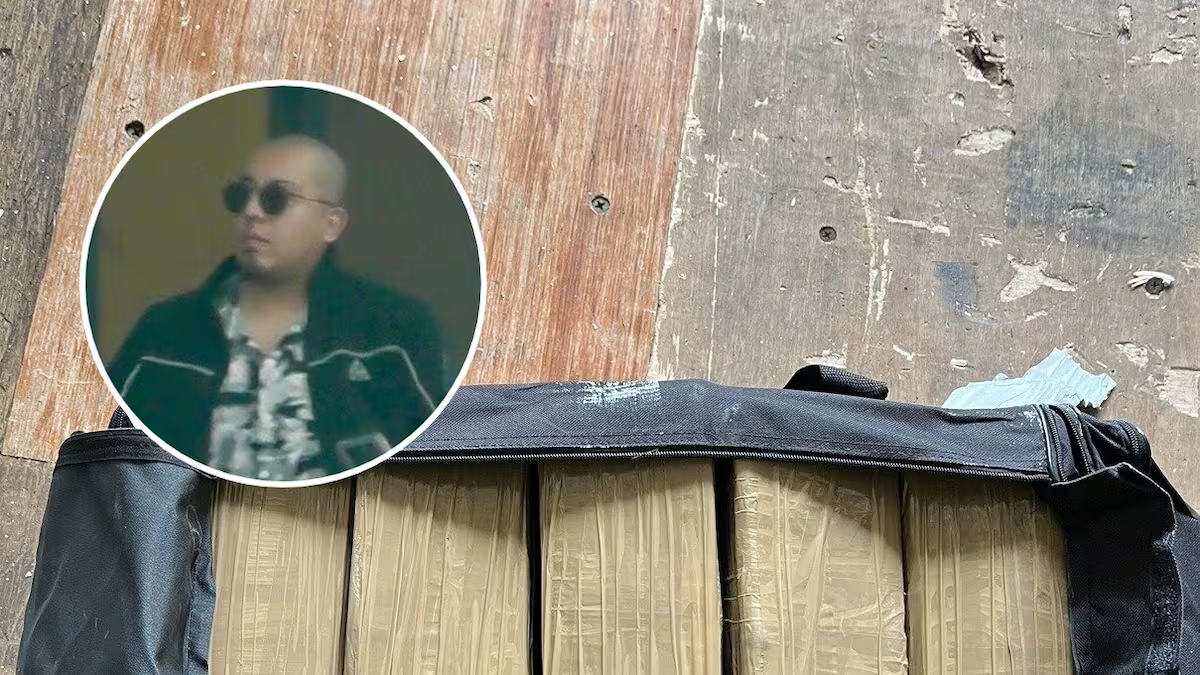
Hidden among the tonnes of metal parts were seven black duffel bags holding a total of 134kg of methamphetamine. Another 40kg of the Class A drug were concealed inside two metal objects.
Customs staff also found multiple tracking devices, such as Apple AirTags, scattered among the Mexican meth worth an estimated $63 million.
There was a cellphone number listed for the person who wanted to buy the scrap metal from the importer.
Police were able to trace the number to the sale of a burner phone at a JB Hi-Fi store in Auckland.
Operation Fix found 174kg of methamphetamine hidden inside a shipping container of scrap metal in July 2024. The drugs had been imported from Mexico
Security camera footage revealed the buyer was Julio Cesar Gonzalez-Reyes.
The 32-year-old was one of the four Mexicans under surveillance by Operation Fix.
About a week after the 174kg of meth was discovered in the scrap metal, Gonzalez-Reyes was arrested at Auckland Airport.
He was trying to flee the country on a one-way ticket to Hong Kong.
Encrypted messages on his phone provided more incriminating evidence.
Each day, Gonzalez-Reyes would provide detailed reports of his movements and daily expenditure to his overseas-based handler, Randy1, and received instructions.
On one occasion, he had been ordered to meet a drug dealer in Auckland to receive a 5kg package of methamphetamine.
This deal was necessary because the “scrap metal” meth shipment had yet to arrive in New Zealand and the Mexican group probably needed product to fulfil orders.
Gonzalez-Reyes met the supplier, Sosefo Aisea Makalio, outside a dumpling restaurant near the corner of Queen St and Mayoral Drive in downtown Auckland.
After the meeting, Gonzalez-Reyes was caught on security cameras walking in Queen St carrying a red reusable shopping bag.
Once safely back at his accommodation, he sent photographs of the methamphetamine to Randy1 to confirm the deal was done. The drugs were then placed inside a blue suitcase.
Later, when Gonzalez-Reyes was arrested at the airport, police also raided another inner-city apartment.
Alexander Eliot Cota-Obeso, one of the four Mexican suspects, was living at the Vincent St property and police found the blue suitcase with 5kg of methamphetamine inside.
Police later searched one of Makalio’s cars at his Panmure home and found a Louis Vuitton bag with a loaded Glock pistol and more than $5000 cash.
Operation Fix found a loaded Glock pistol inside a drug dealer’s Louis Vuitton bag. Photo / NZ Police
He has since pleaded guilty to unlawful possession of a pistol and possession and supply of a Class A drug.
But Makalio will argue he supplied the Mexicans with less than the 5kg alleged by the Crown.
Gonzalez-Reyes pleaded guilty to importing methamphetamine, supplying the drug and participating in an organised criminal group. He was sentenced to 12 years’ imprisonment.
Cota-Obeso and another Mexican, Juan Moreno-Quijada, have pleaded guilty to participating in an organised criminal group and possession of meth. They will be sentenced in March.
Ivan Duarte-Ruiz, who was in New Zealand as an English-language student, pleaded guilty to participating in an organised criminal group.
As the least culpable of the quartet, Duarte-Ruiz was deported immediately because of the time he had already spent in custody.
Mexican national Julio Cesar Gonzalez-Reyes was the main target in Operation Fix. He was sentenced to 12 years’ jail for importing 174kg of methamphetamine and supplying the Class A drug. Photo / Supplied
In recent years, Mexico has emerged as one of the main countries that methamphetamine smuggled into New Zealand is sourced from.
This is because a kilogram of meth, which might cost a few thousand dollars in Mexico, can command $80,000 to $150,000 in New Zealand, depending on market conditions.
These profits attracted the attention of global organised crime groups such as Mexican cartels, Australian outlaw motorcycle gangs such as the Comancheros, plus Asian drug syndicates.
“These groups and individuals are bringing new expertise, access to global networks and a greater willingness to use intimidation, firearms and other violence, and coercion to achieve their ends,” a group of expert advisers told the Government in 2025.
As a result of the influx of cheaper methamphetamine, the amount consumed each week in New Zealand doubled in 2024.
Jared Savage covers crime and justice issues, with a particular interest in organised crime. He joined the Herald in 2006 and has won a dozen journalism awards in that time, including twice being named Reporter of the Year. He is also the author of Gangland, Gangster’s Paradise and Underworld.