

NEW YORK — In one of his first acts in office on Thursday, New York City Mayor Zohran Mamdani revoked the city’s implementation of an antisemitism definition that includes some forms of Israel criticism, in a sweeping rejection of his predecessor’s executive orders.
The mass revocation of those executive orders also canceled other pro-Israel measures taken by the former mayor, Eric Adams.
Mamdani, a far-left anti-Zionist, took office with the start of the new year, replacing Adams’s staunchly pro-Israel administration.
In one of Mamdani’s first moves as mayor, he issued an executive order that revoked all executive orders Adams implemented since September 26, 2024, when Adams was indicted for corruption. The corruption charges were later dismissed amid allegations of shady dealings between Adams and the Justice Department of US President Donald Trump.
Mamdani’s campaign said the revocations would ensure “a fresh start for the incoming administration.”
Get The Times of Israel’s Daily Edition
by email and never miss our top stories
By signing up, you agree to the terms
Mamdani’s sweeping revocation covers Adams’s implementation of the International Holocaust Remembrance Alliance (IHRA) definition of antisemitism, which says that some forms of Israel criticism are antisemitic.
The definition has been adopted by a broad range of national and local governments worldwide as well as other institutions. It has also drawn opposition from those who say its inclusion of some forms of criticism of Israel chills legitimate political speech.
Adams ordered city agencies to use the IHRA definition in June.

New York City Mayor Zohran Mamdani visits Nadege Romulus (right) in her apartment on Clarkson Avenue in the Prospect Lefferts Garden neighborhood of Brooklyn, in New York City, on January 1, 2026. (Dave Sanders/The New York Times, Pool via AP)
The IHRA definition could have posed a problem for Mamdani because the definition says that denying the Jewish people the right to self-determination is discriminatory. Mamdani has repeatedly refused to recognize Israel’s right to exist as a Jewish state.
The definition also says it is antisemitic to claim “that the existence of a State of Israel is a racist endeavor.”
Mamdani’s executive order also nullified an order that opposed the campaign to boycott Israel. Mamdani is a longtime supporter of the Boycott, Divestment and Sanctions (BDS) movement targeting Israel.
Another order that has been revoked instructed the NYPD to reassess how it handles protests at houses of worship, a move Adams took after a vitriolic demonstration outside a synagogue, although a subsequent executive order from Mamdani included similar instructions to police.
Adams’s New York City-Israel Economic Council, a group set up in May to bolster business ties, was established by a declaration of intent.
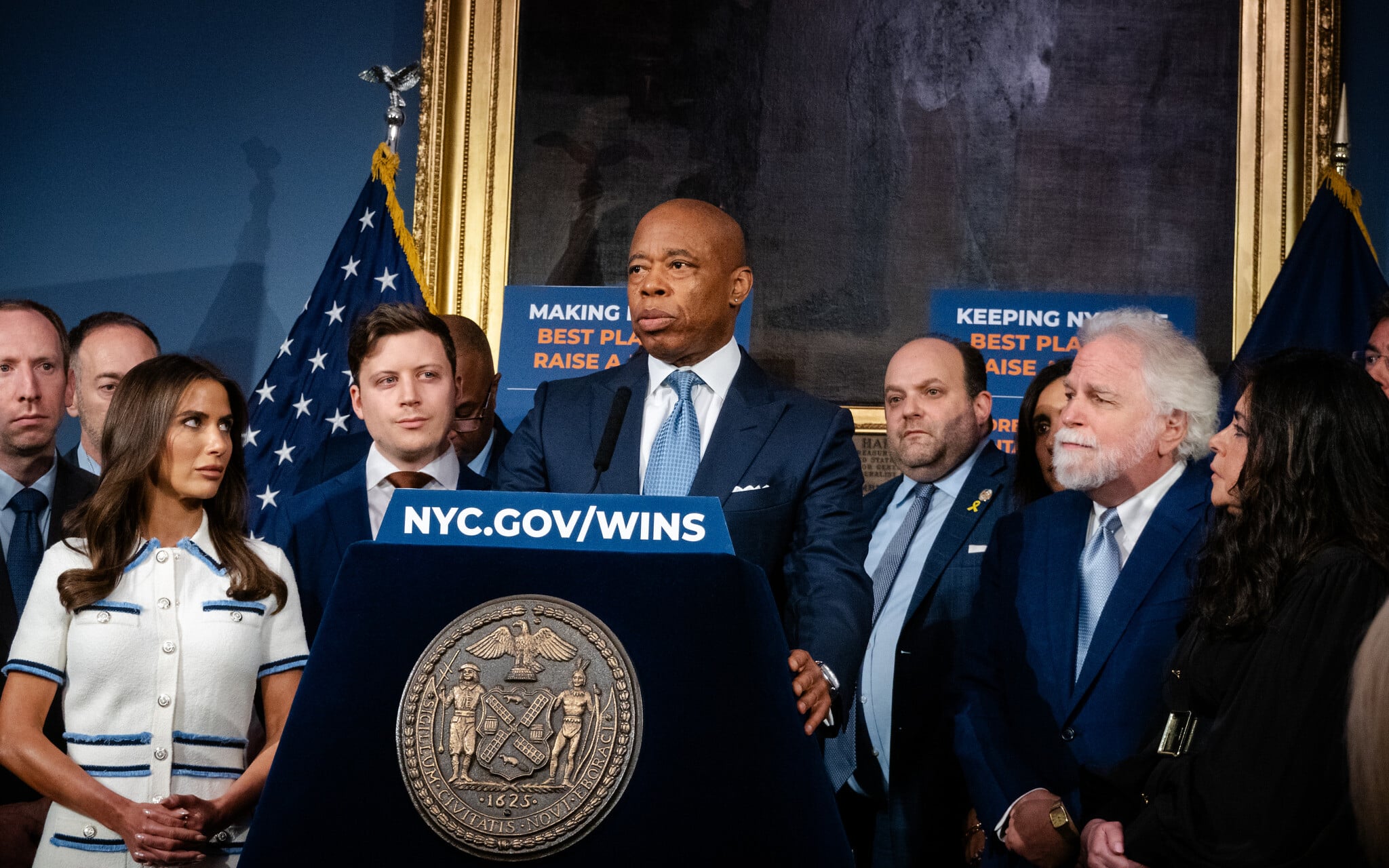
New York City Mayor Eric Adams announces the creation of an antisemitism task force in City Hall, New York City, May 13, 2025. (Luke Tress/Times of Israel)
Mamdani did not axe the Office to Combat Antisemitism, which Adams established in May.
Mamdani’s Executive Order No. 2, outlining the mayor’s office structure and operations, stated that the antisemitism office will remain in place. The order included a description of the office’s responsibilities, which appeared similar to how it operated under Adams.
The director of the office, Rabbi Moshe Davis, a close aide to Adams, said on Wednesday that he had not received any word from the Mamdani team and it was unclear if he would remain in his position. Mamdani’s spokesperson did not respond to a request for information about the office last week.
It was also unclear how the office would define antisemitism. The decision is consequential because it could influence how and whether anti-Zionist speech is tolerated in city agencies, including the NYPD, the Office for the Prevention of Hate Crimes, and the school system.
Mamdani has condemned classic expressions of antisemitism, such as swastika graffiti and tropes about Jewish greed, while defending or espousing anti-Zionist rhetoric that the mainstream Jewish community finds discriminatory.
Last week, a report from the Anti-Defamation League surveying ties between Mamdani appointees and anti-Zionist groups included among its findings that one appointee had said that Zionists are worse than Nazis.
In response to the report, Mamdani said, “We must distinguish between antisemitism and criticism of the Israeli government, and the ADL’s report oftentimes ignores this distinction, and in doing so, it draws attention away from the very real crisis of antisemitism.”
Is The Times of Israel important to you?
If so, we have a year-end request.
Every day during the past two years of war and rising global antisemitism, our journalists kept you abreast of the most important developments that merit your attention. Millions of people rely on ToI for fact-based coverage of Israel and the Jewish world.
We care about Israel – and we know you do too. So as 2025 draws to a close, we have an ask: show your appreciation for our work by joining The Times of Israel Community, an exclusive group for readers like you who appreciate and financially support our work.
Already a member? Sign in to stop seeing this
You appreciate our journalism

You clearly find our careful reporting valuable, in a time when facts are often distorted and news coverage often lacks context.
Your support is essential to continue our work. We want to continue delivering the professional journalism you value, even as the demands on our newsroom have grown dramatically since October 7.
So today, please consider joining our reader support group, The Times of Israel Community. For as little as $6 a month you’ll become our partners while enjoying The Times of Israel AD-FREE, as well as accessing exclusive content available only to Times of Israel Community members.
Thank you,
David Horovitz, Founding Editor of The Times of Israel