
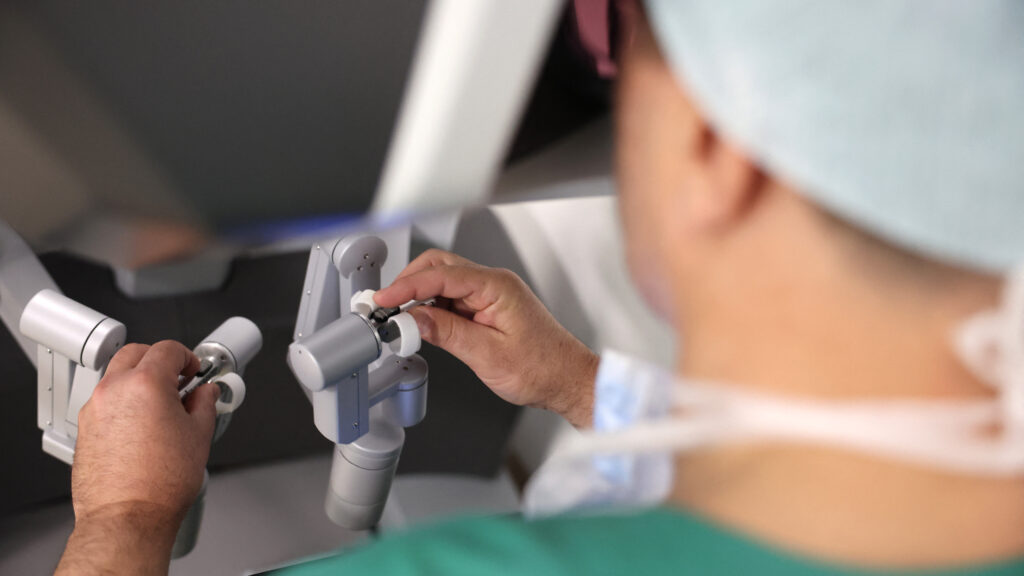
In 2026, Medtronic plans to launch a new robot to compete with a legacy market leader. This new robot is reportedly cheaper both in startup and sustained costs. That’s a welcome direction for any new medical technology, but it ignores a problem that hospitals, especially rural ones, face relating to technology and physician training.
Sometimes, rational decisions made in isolation lead to irrational outcomes for everyone involved. This is the lesson of the prisoner’s dilemma, a classic game theory puzzle demonstrating how cooperation and self-interest often clash. In the puzzle, two prisoners are each offered a deal: Inform on the other and go free, or stay silent and face a lighter sentence together. Fearing betrayal, both inform and both lose.
Hospitals today face a similar dilemma. To attract and retain physicians, hospitals invest in expensive technologies like the robot, not because they improve patient outcomes but because physicians have become reliant on them. This self-interested behavior, driven by how we train doctors, leads to a system where costs rise, rural hospitals fall behind, and the public pays the price.
Federal funding for graduate medical education (GME), established in 1965 through Medicare, was designed to offset hospital costs associated with training physicians. GME underpins the transformation of medical school graduates into practicing specialists — such as internists, psychiatrists, and obstetrician-gynecologists — and acts as the bottleneck in physician workforce development. Hospitals can use high-tech tools like surgical robots to attract medical students and residents.
These technologies are not always associated with better clinical outcomes, nor are they always cost-effective. Once physicians are trained on them, however, they can become dependent on them. Hospitals without such equipment find it difficult to recruit or retain these physicians, creating a dilemma: Hospitals feel compelled to invest in technology not because it improves outcomes, but because it has become a prerequisite for attracting talent.


STAT Plus: Every doctor needs a basic level of AI literacy
That all hospitals do not have or even need the same technology sets up the prisoner’s dilemma. Hospitals — the “prisoners” — might have made self-interested decisions limiting investment in technology that is seldom used, not clearly associated with improved patient outcomes, or not associated with delivering cost-effective care. Acting collaboratively, hospitals might otherwise devise strategies where such resources (and training on how to use them) would be concentrated in locations where the technology could have the greatest benefit at the lowest cost.
However, rationally, each hospital can expect that a one-sided decision restricting its technology investments to uses with proven benefit puts it at a disadvantage for recruiting or retaining physicians.
In surgical care, a 2019 study of 73 Michigan hospitals found that unused robot time strongly predicted whether general surgeons adopted robotic surgery, not because it was better, but because it was available. This echoes the flawed logic behind building more roads to reduce traffic. In reality, more capacity simply fuels more use. As use of robotic surgery grows, surgeons reliant on the technology pressure hospitals to invest further, diverting resources from other services that are more urgent or effective for improving community health. A vicious cycle arises where more technology leads to more dependence, higher spending, and ultimately, a higher cost borne by patients. Hospitals may be the “prisoners” in the dilemma, but the “punishment” is borne by the public.
These dynamics are especially problematic in rural areas. Rural hospitals receive minimal GME funding, despite serving populations that rely heavily on Medicaid and Medicare. Because these government payers reimburse at lower rates, rural hospitals cannot offset the cost of expensive low-value technology with higher commercial payments.
Yet without that technology, they struggle to attract newly trained physicians conditioned by GME programs to depend on it. The lack of rural physician training programs deepens the problem, as physicians tend to practice where they train, leaving rural areas even more strained to attract and retain physicians. Ultimately, rural hospitals are trapped in a system that does not train doctors in a rural context, creating instead physicians dependent on technology that they cannot afford.
To fix this, we must rethink how GME funding is allocated. Instead of concentrating dollars in already well-resourced urban centers, funding should be redirected to programs located in areas where the dollars can have the greatest impact. Medical schools and residency programs must redesign curricula and standards emphasizing skills relevant across all clinical settings, including resource-limited environments like rural hospitals.
Isolation and mistrust lead to the prisoner’s dilemma. In the case of national GME programming, we can avoid a harsh sentence by acknowledging these unintentional but very real realities and addressing them together.
James L. Whiteside, M.D., serves as the chair of the Department of Obstetrics and Gynecology at the East Carolina University Brody School of Medicine. His research focuses on population health outcomes and surgical approaches within the field of obstetrics and gynecology. Dmitry Tumin, Ph.D., serves as research professor of pediatrics at the East Carolina University Brody School of Medicine. His research encompasses a diverse range of topics related to population health outcomes. The opinions expressed in this piece are solely the authors’ and do not necessarily reflect the views of East Carolina University or the Brody School of Medicine.