
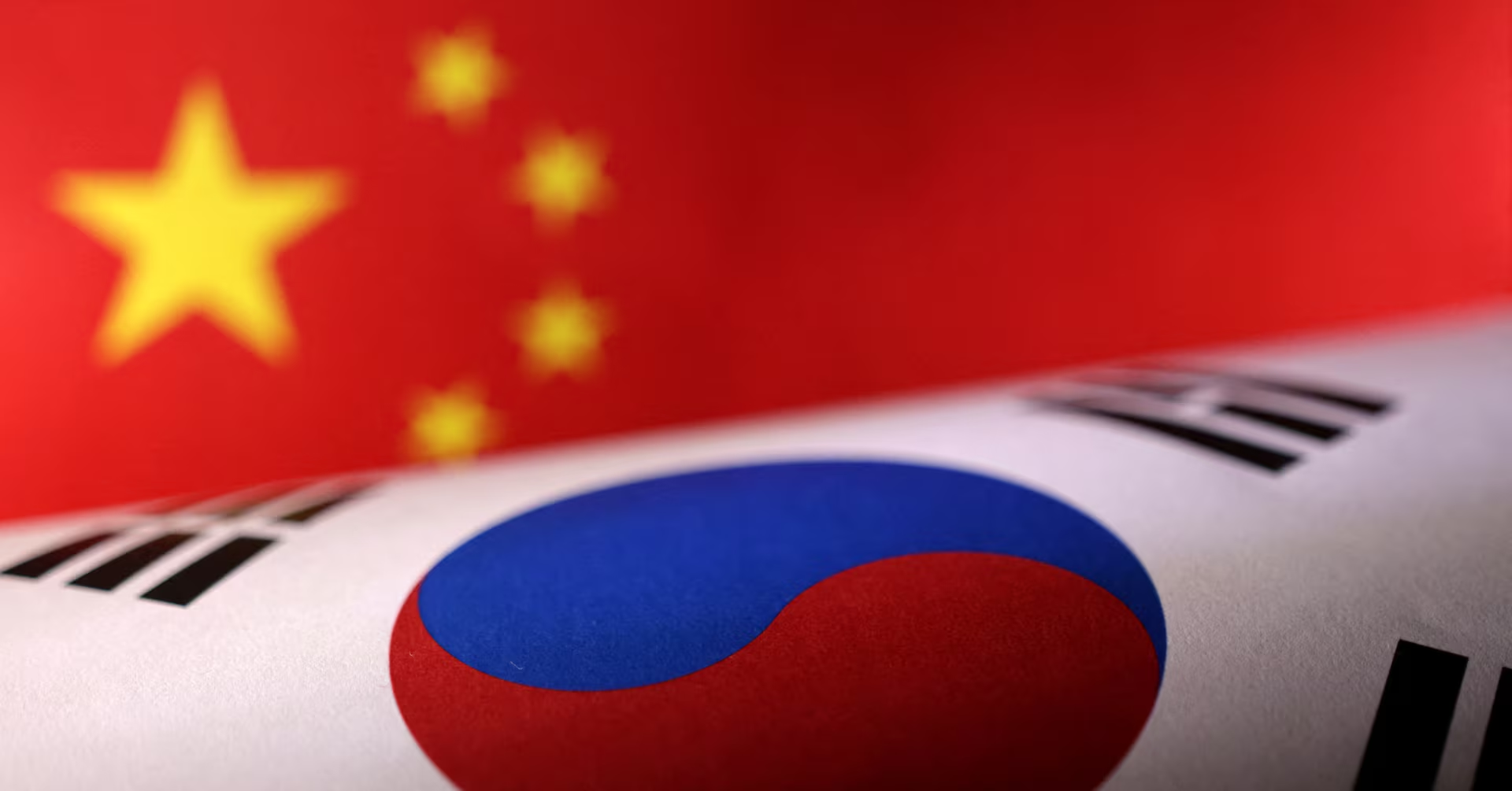
Xi’s invitation aims to deepen ties before Lee’s Japan visitSouth Korea seeks balance amid US alliance and North Korea challengesLee’s visit to address tech, supply chains
SEOUL/BEIJING, Jan 2 (Reuters) – China’s President Xi Jinping will host South Korean President Lee Jae Myung on a state visit starting on Sunday, as Beijing looks to strengthen ties with Seoul amidst rising tensions with Japan over Taiwan.
Relations between China and Japan hit the lowest point in years after Japanese Prime Minister Sanae Takaichi suggested in November that Tokyo could take military action if Beijing attacked Taiwan.
Sign up here.
Lee’s visit will mark his second meeting with Xi in just two months, an unusually short interval that, analysts say, signals China’s keen interest in boosting economic collaboration and tourism.
And the timing of the invitation for a state visit – Lee’s first to China since taking office in June – is also a calculated move to deepen bilateral relations particularly before the South Korean leader visits Japan, they say.
“China wants to emphasize South Korea’s importance slightly more than before,” said Kang Jun-young, professor of political economics at Hankuk University of Foreign Studies.
“China appears to have strategically decided that it would be better to have (Lee) visit China before South Korea holds a summit with Japan again,” he added.
XI ‘A TRULY GREAT’ LEADER, LEE SAYSAhead of the trip, Lee gave an interview with China’s CCTV on Friday, praising Xi.
“I think he’s a truly great, visionary leader,” Lee said. “He has driven China’s economic growth and technology development in a very short period of time … and he’s leading the country very steadily despite a complicated geopolitical environment.”
There are many areas where two neighbors can cooperate, Lee said, including cutting-edge industries such as artificial intelligence.
“For our relationship, the most important thing would be building economic cooperation that benefits both,” Lee said.
The Lee administration has said it aims to “restore” ties with Beijing, acknowledging China is South Korea’s largest trading partner.
The pivot follows strained relations with China under Lee’s predecessor Yoon Suk Yeol, due to his closer alignment with Washington and Tokyo, as well as criticism of China’s handling of Taiwan.
Now, South Korea is trying to maintain a balance but leaning towards cooperation with China to avoid being forced into any troubles that would threaten the Asian industrial powerhouse.
Lee said in December he would not take sides in the diplomatic dispute between China and Japan.
US ALLIANCE AND NORTH KOREAStill, China and South Korea face complex issues as China challenges the U.S. – South Korea’s major ally in the region – and as nuclear-armed North Korea remains unpredictable.
China is North Korea’s primary ally and economic lifeline.
Shin Beom-chul, a former South Korean vice defence minister and now a senior research fellow at the Sejong Institute, said Xi and Lee might discuss some contentious issues such as efforts to modernise the South Korea-U.S. alliance.
Currently, about 28,500 U.S. troops are based in South Korea to counter any threat from North Korea.
U.S. officials a plan to make those forces more flexible to respond to other threats, such as defending Taiwan and checking China’s growing military reach.
“Korea is not simply responding to threats on the peninsula,” General Xavier Brunson, commander of U.S. Forces Korea, said at a forum on December 29.
“Korea sits at the crossroads of broader regional dynamics that shape the balance of power across Northeast Asia,” he said.
Wi Sung-lac, Lee’s security adviser, said South Korea would also try to reassure China that its plans to build nuclear-powered submarines were aimed only at deterring North Korea.
Lee’s agenda with Xi includes persuading China to facilitate dialogue with North Korea, experts said, at a time when North Korea has dismissed Lee’s outreach.
TECH, SUPPLY CHAINSLee’s visit to Beijing is also expected to address cooperation in areas including critical minerals, supply chain and green industries, his office said earlier.
Seoul sources nearly half of its supply of rare earth minerals, critical to semiconductor manufacturing, from China. Beijing also accounts for a third of Seoul’s annual chip exports, the largest market by far.
Last month, South Korean Industry Minister Kim Jung-kwan and Chinese Commerce Minister Wang Wentao agreed to work towards stable rare earth supplies, South Korea said.
Additional reporting by Brenda Goh, Hyunjoo Jin, Writing by Ju-min Park; Editing by Raju Gopalakrishnan and Joe Bavier
Our Standards: The Thomson Reuters Trust Principles., opens new tab