
Secretary of State Marco Rubio is signalling that the U.S. will leave Venezuela’s authoritarian regime in place for the time being, so long as it complies with Washington’s demands to crack down on drug trafficking and make changes to its oil industry.
A day after the U.S. attacked the South American country and captured its leader, it remained unclear both how exactly Venezuela would be run and what U.S. President Donald Trump’s dramatic escalation in foreign interventionism would mean for his America First administration.
But Mr. Rubio suggested that a “transition to democracy” for Venezuela – or a role for its opposition leaders – would have to wait, and that he would instead deal with President Nicolás Maduro’s subordinates, who appear to remain in control in Caracas.
“We are dealing with the immediate reality. The immediate reality is that unfortunately, and sadly, but unfortunately, the vast majority of the opposition is no longer present inside of Venezuela,” he said on NBC’s Meet the Press Sunday. “We have short-term things that have to be addressed right away.”
Venezuela’s interim government united behind Maduro, officials say
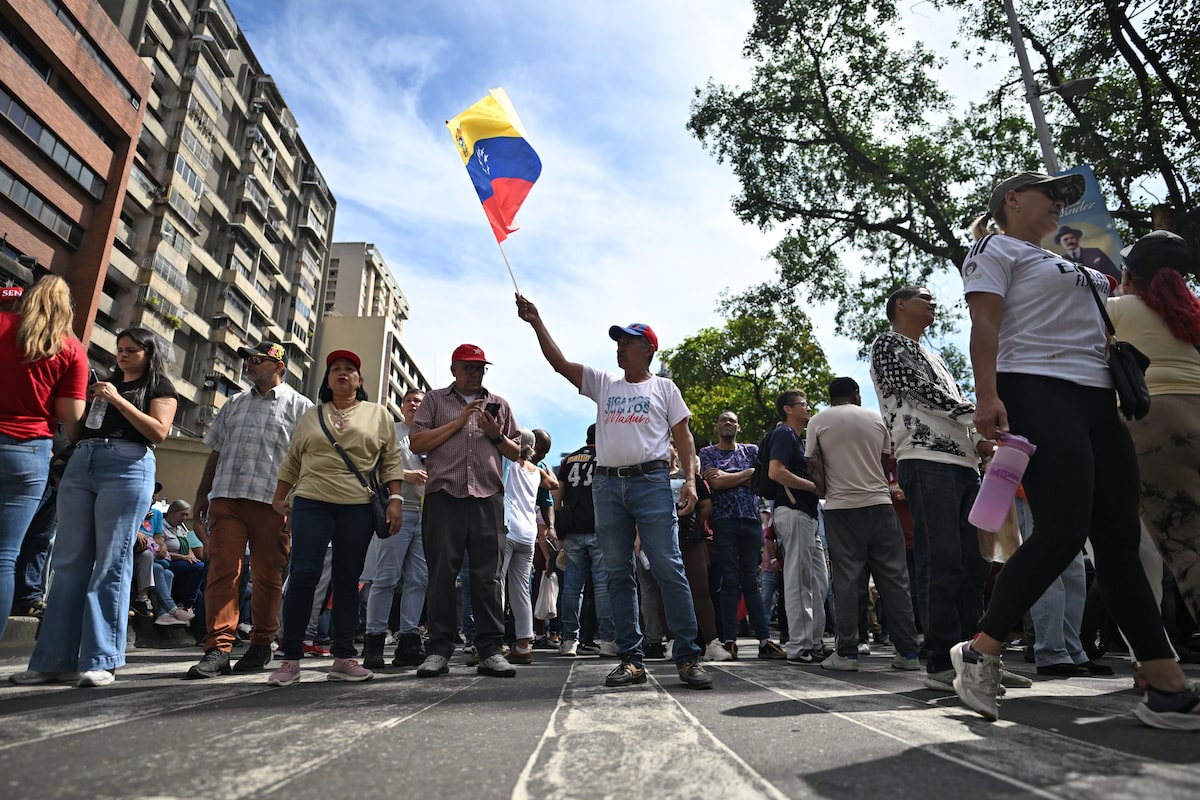
Venezuelans wonder who’s in charge as Trump and Maduro’s successor contradict each other
He warned, however, that Venezuela’s leaders would now have to follow orders from the U.S. “No more drug trafficking,” he said. “And no more using the oil industry to enrich all our adversaries” instead of Venezuelans or the U.S.
Venezuela’s top court has confirmed that Mr. Maduro’s Vice-President, Delcy Rodríguez, would assume his powers. On Saturday, she had delivered a televised speech in which she insisted that Venezuela would not become “the colony of another empire.” But Mr. Trump earlier suggested that the U.S. would “run” Venezuela through her, using Mr. Rubio, a bilingual Cuban-American, as go-between.
“She’s essentially willing to do what we think is necessary to make Venezuela great again,” Mr. Trump said.
Venezuela’s toppled leader Nicolas Maduro was in a New York detention centre on Sunday after President Donald Trump ordered an audacious raid to capture him, saying the U.S. would take control of the oil-producing nation.
Reuters
On Sunday, Mr. Trump did not immediately provide any more details on the arrangement or on his assertion the previous day that U.S. oil companies would take over Venezuela’s energy infrastructure. Shortly before 9:30 a.m. ET, he left his Mar-a-Lago estate in Florida to golf at one of his nearby properties. He was scheduled to return to the White House in the evening.
The previous day, Mr. Trump had seemingly dismissed a role for the Venezuelan opposition, saying that its main leader, María Corina Machado, “doesn’t have the support within or the respect within the country.” Mr. Rubio on Sunday was more conciliatory, saying he had known Ms. Machado a long time and she was “fantastic.”
In a statement, Ms. Machado, who won last year’s Nobel Peace Prize after Mr. Trump openly campaigned for it to go to him, called for Edmundo González to be immediately installed as Venezuela’s president. Mr. González ran in a 2024 election after Mr. Maduro barred Ms. Machado’s candidacy. Mr. González is generally believed to have won the vote before Mr. Maduro falsified the result to hold onto power.
“The freedom of all political prisoners is our immediate priority. I ask all heads of state and government and all democrats around the world to support us in this decisive hour,” she wrote on X.
After his apprehension, Mr. Maduro appeared briefly in a recorded perp walk at U.S. Drug Enforcement Agency headquarters in New York on Saturday evening. Handcuffed and wearing a black hoodie, hat and sweatpants, he greeted people in the room in both Spanish and English. “Happy New Year,” he said. He is charged with drug trafficking, terrorism and weapons offences in U.S. federal court.
Some close to Mr. Trump pushed him to continue his bid for American dominance. Katie Miller, a MAGA media personality and former administration official married to top White House adviser Stephen Miller, posted on X: “SOON” over a map of Greenland covered with the U.S. flag.
A self-governing territory of Denmark, Greenland has repeatedly rejected Mr. Trump’s annexation overtures.
“We expect full respect for the territorial integrity of the Kingdom of Denmark,” the country’s ambassador to the U.S., Jesper Moller Sorensen, tweeted on Sunday. He reminded the U.S. that Greenland is a NATO ally of the U.S.’s and that Denmark is already working with the U.S. to ensure Arctic security.
Marjorie Taylor Greene, the far-right Georgia congresswoman who was once one of Mr. Trump’s top allies, attacked the President for reneging on his previous policy of keeping the U.S. out of foreign military entanglements.
Video of Venezuelan President Nicolás Maduro in custody in New York shared by the White House
Reuters
“Americans’ disgust with our own government’s never-ending military aggression and support of foreign wars is justified because we are forced to pay for it,” she tweeted. “This is what many in MAGA thought they voted to end. Boy were we wrong.”
She also drew parallels between Mr. Trump’s decision to attack Venezuela and Russia’s invasion of Ukraine, and China’s threats to Taiwan. “Is it only ok if we do it?”
Ms. Greene has previously fallen out with Mr. Trump over his insistence on cutting health-care funding and initial refusal to release government files on child sex trafficker Jeffrey Epstein.
Democratic Senator Raphael Warnock also pointed out that Mr. Trump had once “promised to get us out of foreign wars” and called on “an increasingly feckless Congress to finally act and put this reckless President in check.”
Mr. Warnock cited the case of Juan Orlando Hernández, the conservative former president of Honduras who was pardoned by Mr. Trump last year after he was sentenced to 45 years in a U.S. prison on charges of cocaine trafficking.
“The recent attack on a sovereign nation in our own hemisphere is also without a good explanation,” Mr. Warnock said. “In fact, this huge escalation with no clear strategy risks bringing more violence and instability to a nation of 28 million people, potentially causing more drug trafficking and more migration to the United States.”
The attack in Venezuela is only the latest indication that Mr. Trump is moving toward a more-bellicose foreign policy.
After the 2024 election, he called for the annexations of Canada, Greenland and the Panama Canal Zone, and has also mused about launching military strikes in Mexico against drug cartels.
Earlier this year, he took part in Israel’s war with Iran in order to bomb Tehran’s nuclear facilities, a move that generated unease among some of his isolationist political allies in the U.S.