
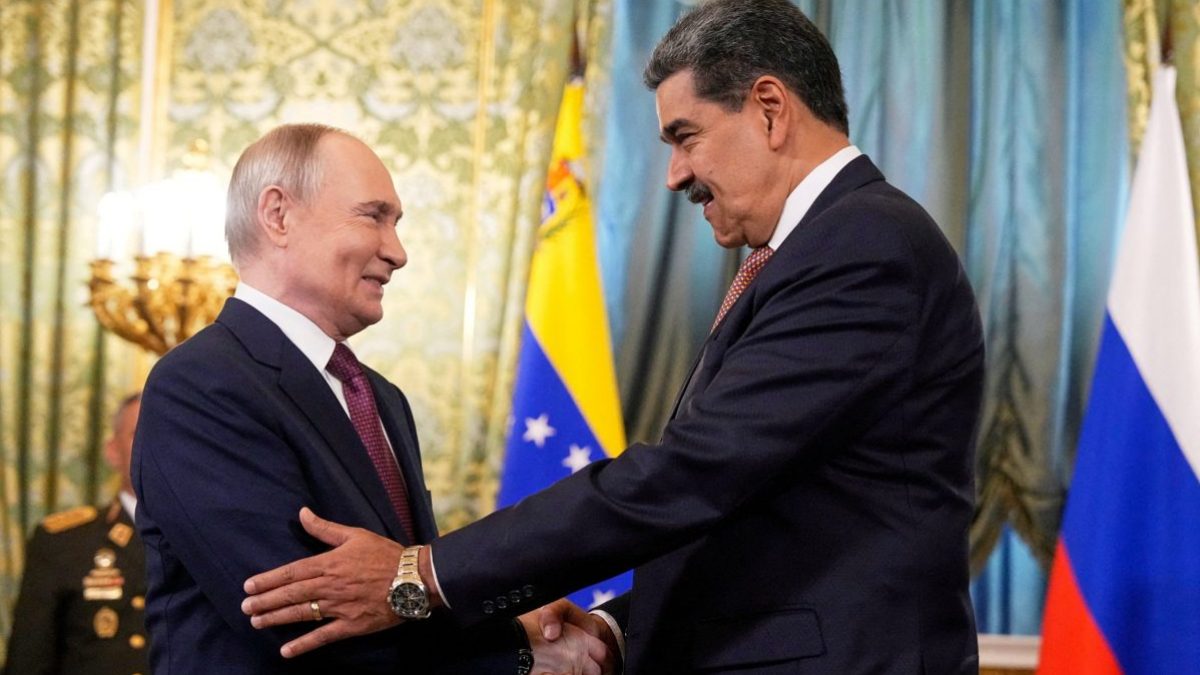
Intelligence sources, academics and political figures fear the US may have emboldened Moscow and Beijing
Washington’s overnight raid on Caracas, along with the capture of Venezuela’s leader Nicolás Maduro, has offered a shuddering declaration that the rules once forged by the United States no longer apply.
As Maduro and his wife Cilia Flores were shipped to New York in their pyjamas on narco-terrorism charges, US missiles rained down on Venezuelan military bases.
Donald Trump labelled the operation an “extraordinary success” and vowed to “run the country” until there is a “proper” transition of power – but he did not attempt to justify his actions as being within the bounds of international law.
The US President claimed Maduro had been violating the “core principles of American foreign policy” by hosting foreign nations, building an arsenal of offensive weaponry and allowing state-sponsored drug trafficking.
In the backrooms of the Pentagon, however, members of the US intelligence community were picking up the pieces. One CIA source described the operation as the final unmasking of Trump’s authoritarian power.
“The hubris and recklessness is just astounding,” they told The i Paper. “[It] seems like the nail in the coffin of the post-Cold War order.”
Steven Cash, a former CIA official who held several roles in US intelligence until last year, agreed: “This moment exposes the collapse of a long-standing bargain: that expanded executive power would be exercised by leaders who respect law, institutions, and international norms.
“When that faith disappears, so does the constitutional balance that protects us at home and abroad.”
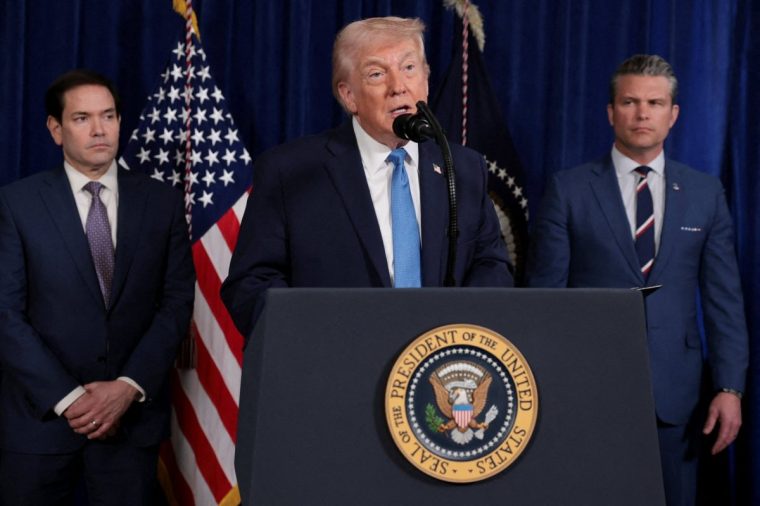 Trump, flanked by Secretary of State Marco Rubio, left, and Secretary of War Pete Hegseth, speaks during a press conference following the US strikes on Venezuela (Photo: Jonathan Ernst)
Academics, European diplomats and intelligence sources believe Washington’s steady drift away from co-operating with international law has accelerated into a sprint.
While Trump’s raid on Venezuela threatens to anger China and Russia, which have significant interests in the country, it also risks fuelling other conflicts if the US President is seen to be leading by example, according to one Whitehall security source. “Putin will be angry in that any political or commercial relationship he was building with Maduro will probably be damaged beyond early repair. Xi will probably feel the same,” the insider said.
“Most interesting is whether Putin sees this as a manifestation of the US’s endorsement of dominance by the great powers in spheres of influence. Putin may take this as evidence that the US will in the end turn a blind eye to adventurism in Europe including continuing his assault on Ukraine. Xi might reach a similar conclusion in relation to Asia.”
This fear was mirrored by Dame Emily Thornberry, Labour chair of the Commons Foreign Affairs Committee. She said the emerging belief that global powers can “do what they want” in their “sphere of influence” – in the case of Trump and the US, in the Western Hemisphere – sent a dangerous message to the leaders of Russia and China.
“Surely, Taiwan is part of China’s sphere of influence, and so therefore if the US does not have to abide by international law then why can’t China just walk into Taiwan?” Thornberry told The i Paper. “And the same with Russia and Ukraine. What’s to stop Russia saying, ‘This is in our sphere of influence, so why is everybody moaning about what we’re doing.’”
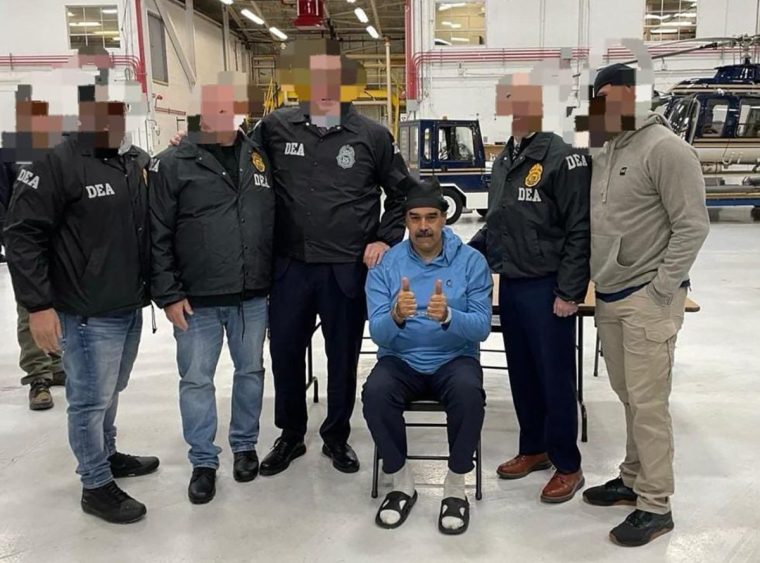 Nicolás Maduro gives a thumb-up after his arrival at New York Stewart International Airport (Photo: X)
Thornberry’s stance differs from that of Sir Keir Starmer, who has so far avoided criticising Trump’s actions, saying the UK “sheds no tears” over the end of Maduro’s regime. In parliamentary elections in 2015, Maduro lost his majority but refused to stand down, relying on the secret police, and persecution of rivals to maintain power.
Trump’s justification for the military demi-coup of a sovereign neighbour is twofold: labelling Maduro and his wife as narco-terrorists and charging them with weapon and drug offences in New York, and recalling the Monroe Doctrine – a 200-year-old US notion used to divide the world into “spheres of influence”.
The US President has hinted at the doctrine’s revival – referring to it as the “Donroe Doctrine” in a press conference following the military operation. He said on Saturday: “Under our new national security strategy, American dominance in the Western Hemisphere will never be questioned again. It won’t happen.”
Angered and emboldened enemies
The White House’s raid on Venezuela was undoubtably a strategic knock to the country’s two main allies, Russia and China. Both have given Venezuela’s socialist government political and military support. Russian equiptment anchors Venezuela’s air defenses and supplies the country’s air force and arms production, and, for a period of time, contractors linked to the Russian mercenary group Wagner formed part of Maduro’s own security detail.
In return, Venezuela has acted as a useful ally in the Western Hemisphere, extraditing members of Ukraine’s military to Russia, and allowing Moscow to use the South American country’s maritime industry to obfuscate and evade sanctions limiting Russia’s clandestine oil trades.
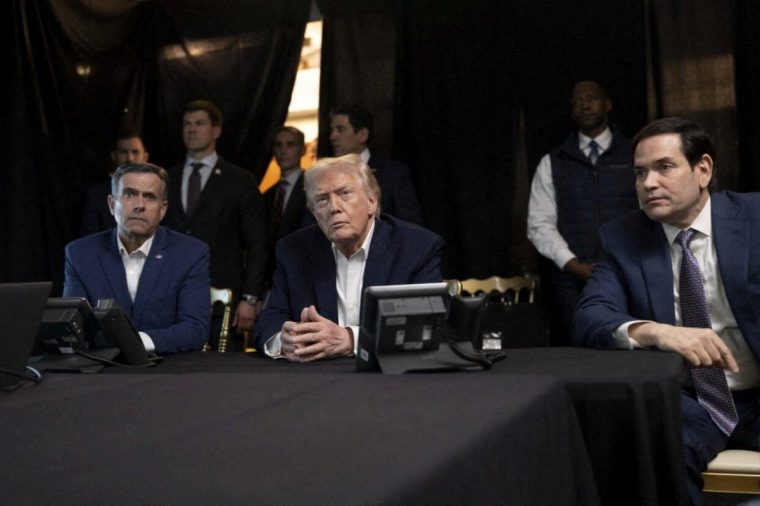 Trump watches the US military operation in Venezuela from Mar-a-Lago in Florida (Photo: @realDonaldTrump via Reuters)
A UK intelligence source warned that Russia may feel required to “do something quite significant” in Ukraine in response to Trump, and added that China could also feel emboldened to invade Taiwan while the US President is distracted by Venezuela.
“China will see this as an absolute opportunity now to say he’s not looking at us,” they said. ”China has also lost a key ally and energy resource and will think they have got to show what China is militarily capable of.”
A European diplomat focusing on threats from China said the geopolitical signal to Beijing from the White House was unmistakable.
“The US message to China is that the Americas are their sphere of influence and China shall stay out,” the diplomat said. Referring to the 1962 Cuban Missile Crisis, they added: “If Venezuela were to ‘westernise’, Washington would have removed a “potential Cuba Crisis-like threat at its doorstep in case of a great-power conflict with China”.
In that sense, the US strikes looked less like a narco-terrorsism operation, and more a calculated warning shot to President Xi. “This can be seen as a ‘kill the chicken to scare the monkey’ move by the US towards China,” the source added.
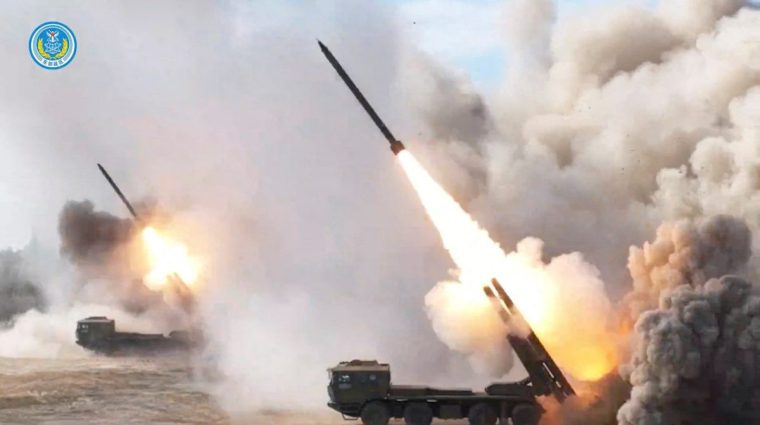 Chinese military equipment is deployed during drills targeting waters south of Taiwan (Photo: Eastern Theatre Command via Reuters)
However, Luca Trenta, an international relations academic at the University of Swansea said the US will no longer be in a position to complain if Russia and China launch further military operations in their own spheres of influence.
He said: “I think the Trump administration misses the point that this approach fundamentally weakens the United States which has historically gained from the ‘order’ it helped establish.
“The US has abandoned any effort to justify its actions through the lens of international law. By all means, these justifications were often implausible or stretched. Certainly, China might also see this as an opportunity. In the past this has not happened, but China today is much more assertive than, say, 2003.”
UK warned in advance?
While the US strikes on Caracas came as a shock to the global community, the UK may have been given a warning of the operation by Washington.
Darren Jones, Chief Secretary to the Prime Minister, said on Sunday that the UK was not notified of America’s plan. He told Sky News: “It was an American operation. The United Kingdom was not involved in any way, we were not informed of it beforehand.”
However, a UK intelligence source told The i Paper that senior figures inside the Ministry of Defence were alert to something “significant” happening in the region before 5 January. The Foreign Office declined to comment in response to this.
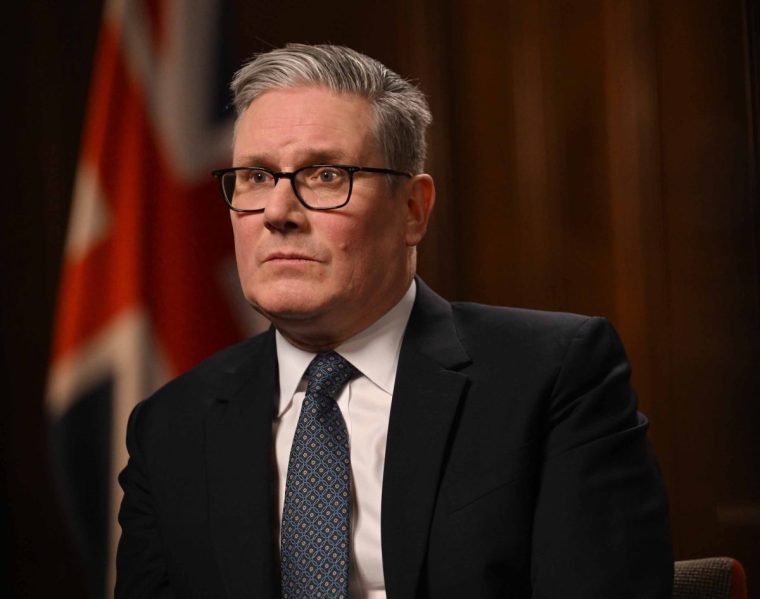 Sir Keir Starmer has avoided criticising Trump’s military actions in Venezuela (Photo: Jeff Overs/BBC)
In the hours after the capturing of Maduro, Starmer was hesitant to say whether he believed the US had breached international law with its actions, insisting he needed to “establish the facts” with his American counterparts before issuing any judgement.
But Emily Thornberry, a Labour MP, said she believed the capture of Maduro was a “breach of international law” because the US cannot claim to be under attack, or facing the threat of imminent attack. She said the UK must join with allies in standing up the US.
“It is worrying because if we’re back in a world where all that matters is what the big boys want then all the smaller or medium sized countries, such as ours, are now under threat,” she told The i Paper.
Your next read
radio_button_checked
LIVE
“It’s really important that we don’t allow this to happen, that we stand up to this. We should be clearer about what’s right and what’s wrong, and I think that our ability to be able to work with the likes of Canada and Germany and France and the European Union needs to be used again on this.”
For the Conservatives, shadow Foreign Secretary Dame Priti Patel said there were questions to be answered about the “political direction of travel” in Venezuela and how it would be administered.
“We believe in democracy, and the question has to be now, these are political questions about what that pathway to democracy is going to be for Venezuela,” she said. “I’m sure these are questions the British Foreign Secretary will ask of her counterpart. I hope those conversations will take place.”