
For over a century, the foundation of the Macedonian kingdom, the homeland of Philip II and Alexander the Great, has been placed in the mid-7th century BCE. This date, repeated in countless history books, has long been treated as a fact. A new interdisciplinary study now challenges that assumption by dating the emergence of the Argead, or Temenid, dynasty considerably later than previously thought.
 Decoration of the Alexander Sarcophagus at the Istanbul Archaeology Museum. Credit: Engin Binbas
A study published in the journal Karanos, which combines the critical reassessment of ancient textual sources and archaeological evidence from burial sites in Lower Macedonia, collectively indicates that the beginnings of the Macedonian kingdom should be dated to about 575 BCE, almost 75 years later than the traditional chronology.
The traditional timeline is based on king lists preserved by much later writers, such as Eusebius of Caesarea, who recorded the names and reign lengths of Macedonian rulers hundreds of years later. Counting back from the death of Alexander the Great in 323 BCE, these lists place the beginnings of the dynasty far earlier than the available evidence can securely support. Although it has long been realized that the earliest rulers named in these lists are likely legendary figures added for political purposes, the new study shows that even once these names have been removed, the conventional dates cannot be supported.
By comparing the purported reign lengths of early Macedonian kings with those of better-documented historical periods, the researchers demonstrate that the early rulers would have had implausibly long reigns. In contrast, later Macedonian kings, ruling under much more stable conditions, ruled on average for much shorter periods. Applying realistic reign lengths shifts the foundation of the dynasty decisively into the early 6th century BCE.
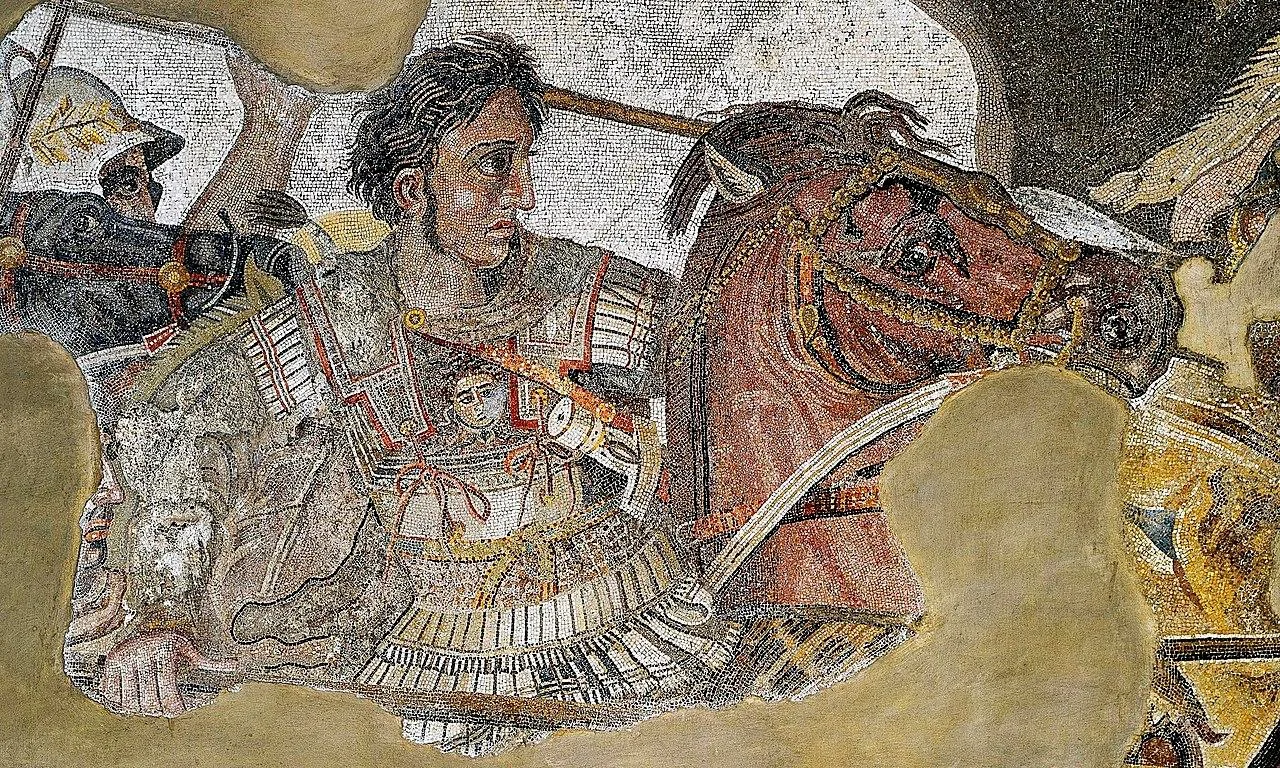 Alexander Mosaic (detail), From House of the Faun, Pompeii. Public domain
This chronology is compellingly confirmed by the archaeological data. A systematic analysis of funerary practices reveals no evidence for an organized kingdom in Lower Macedonia during the 7th century BCE. The burial record of the period demonstrates continuity with earlier Iron Age traditions and displays only limited social differentiation. In c. 570 BCE, however, burial practices changed simultaneously across the region. Graves became richer and more standardized, gold and imported goods appeared in great numbers, and clear evidence for inherited social status emerged even among children.
The most ostentatious tombs from this period are concentrated at key sites, such as Vergina (ancient Aigai), where elite male and female burials were placed in separate areas. This sudden transformation is interpreted by archaeologists as evidence of the rise of a new political elite and the consolidation of regional power.
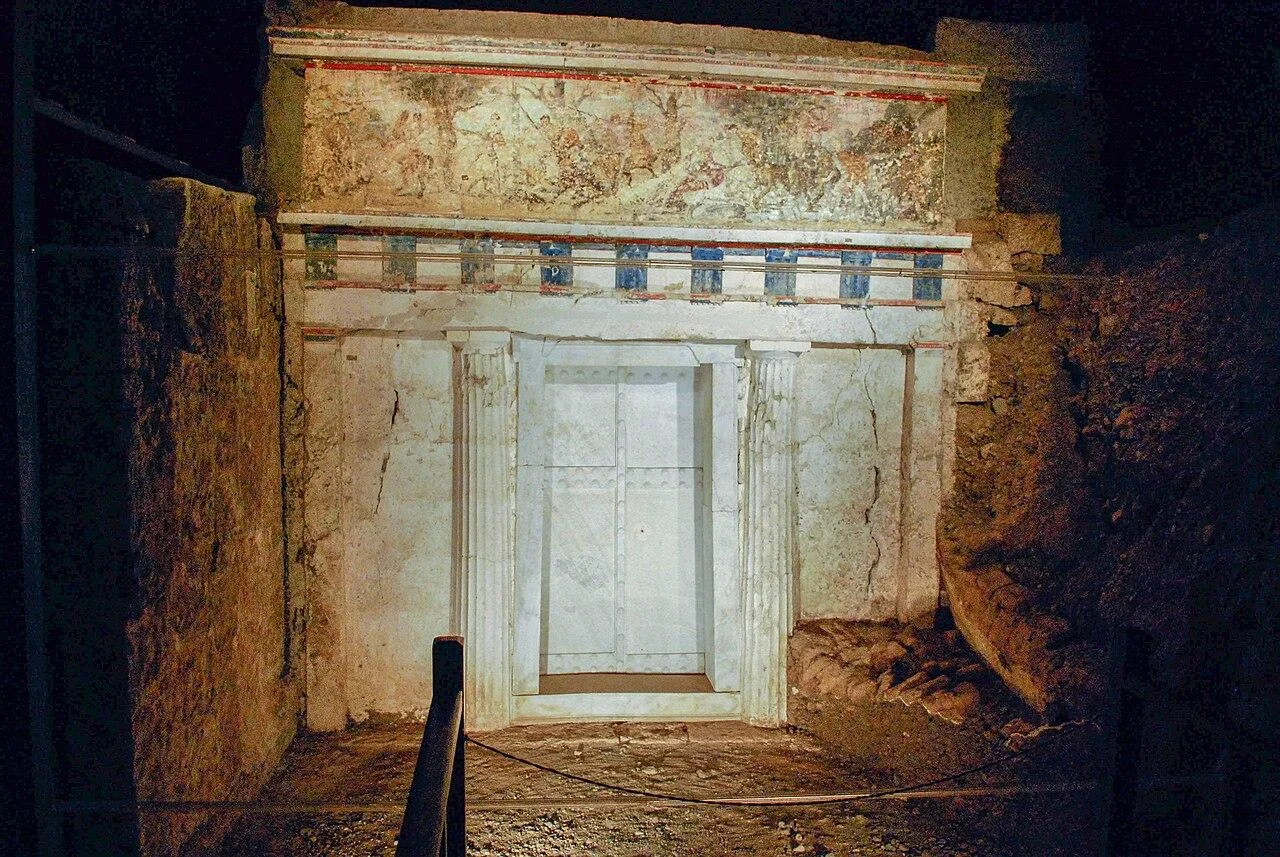 Facade of the tomb in Vergina, Greece, previously attributed to Philip II of Macedon, father of Alexander the Great. The door is made of marble and follows the Doric order. Credit: Sarah Murray, CC BY-SA 2.0
Rather than a fully developed state, the early Macedonian kingdom seems to have functioned as a complex chiefdom, based on lineage, prestige, and the control of resources. Through textual criticism combined with material evidence, the study places the rise of Alexander the Great’s dynasty firmly in the mid-6th century BCE. This has prompted a major reassessment of how and when power first formed in northern Greece.
More information: Saripanidi, V., & Greenwalt, W. S. (2025). When was the Argead/Temenid Dynasty founded? Karanos. Bulletin of Ancient Macedonian Studies, 8, 31–46. doi:10.5565/rev/karanos.168