
Key Takeaways
Western media moved from burying Iran’s uprising to minimizing it and amplifying regime talking points once silence became untenable.
Senior journalists for the likes of the BBC and Channel 4 News offered risible excuses for the coverage gap, even as Iranian activists publicly dismantled those justifications in real time online.
Iran fits a pattern exposed since October 7: narrative management, moral asymmetry, and deference toward Islamist power.
The anti-regime protests that have swept across Iran over the past two weeks represent the most serious challenge yet to the theocratic system imposed after the 1979 revolution, a system that has endured for decades and is now ruled by Ayatollah Ali Khamenei.
Analysts say these protests differ fundamentally from previous unrest. The Islamic Republic is weaker than at any point in recent memory. Its regional proxies, including Hezbollah and Hamas, have been degraded; the economy is collapsing under sanctions and corruption; and, unlike during previous unrest, demonstrators are openly aligning themselves with the exiled Crown Prince Reza Pahlavi.
Whether or not the protesters ultimately succeed in toppling their oppressors remains to be seen. But they have already achieved something else, something far beyond Iran’s borders.
They have exposed the dishonesty, laziness, and moral cowardice of much of the Western media.
The demonstrations began in late December in Tehran, when merchants and traders went on strike over Iran’s dire economic conditions. Within hours, protests spread. Today, they have been recorded in at least 180 cities, involving millions of Iranians.
Human rights groups inside the country report that hundreds of protesters have been shot dead by regime forces. Thousands more have been arrested. A near-total internet blackout has been imposed both to prevent protesters from organizing and images of the crackdown from reaching the outside world.
Young and old. Men and women. Students, workers, mothers, fathers. Iranians from every walk of life are risking their lives to confront an Islamist regime that has ruled through repression, executions, and fear.
Yet for nearly two weeks, the Western media either buried the story or, worse, reframed it using the regime’s own talking points.
The Burial
The first failure was silence. Days into the protests, as HonestReporting and others noted, major international outlets devoted little to no serious coverage to events that could reshape the Middle East.
From The New York Times to the BBC, coverage was sparse and evasive. When the protests were mentioned at all, their explicitly anti-regime nature was often omitted. Demonstrations were reframed as vague cost-of-living protests, despite protesters chanting openly for the end of clerical rule.
1/
Western media coverage of Iran’s escalating nationwide protests has been strikingly limited and cautious – despite widespread anti-regime demands across dozens of cities.
Why the reluctance, when evidence is abundant? 🧵⬇️ pic.twitter.com/PWF9hgsdI3
— HonestReporting (@HonestReporting) January 3, 2026
As one Iranian activist explained: “Separating these protests into ‘political’ or ‘economic’ is misleading. Almost everyone understands that the political structure of the Islamic Republic has produced the economic collapse.”
Worse still, when journalists were challenged about their lack of coverage, several offered excuses that bordered on the absurd.
BBC World Affairs Editor John Simpson claimed that social media footage must be carefully verified before reputable outlets could use it – a striking assertion given the same outlets’ willingness to publish unverified material from Gaza for months on end.

Channel 4 International Editor Lindsey Hilsum echoed the line, arguing that Iran is objectively difficult to cover because foreign journalists cannot enter the country.
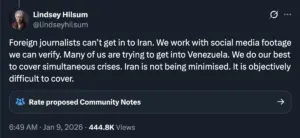
We were expected to forget that these same journalists spent years publishing casualty figures, video footage, and testimony from a Hamas-run enclave, often without meaningful verification, attribution, or editorial caution.
The Reframe
When criticism became impossible to ignore, coverage did finally increase.
But instead of centering Iranian protesters and the regime’s brutality, many outlets simply pivoted to laundering Tehran’s propaganda.
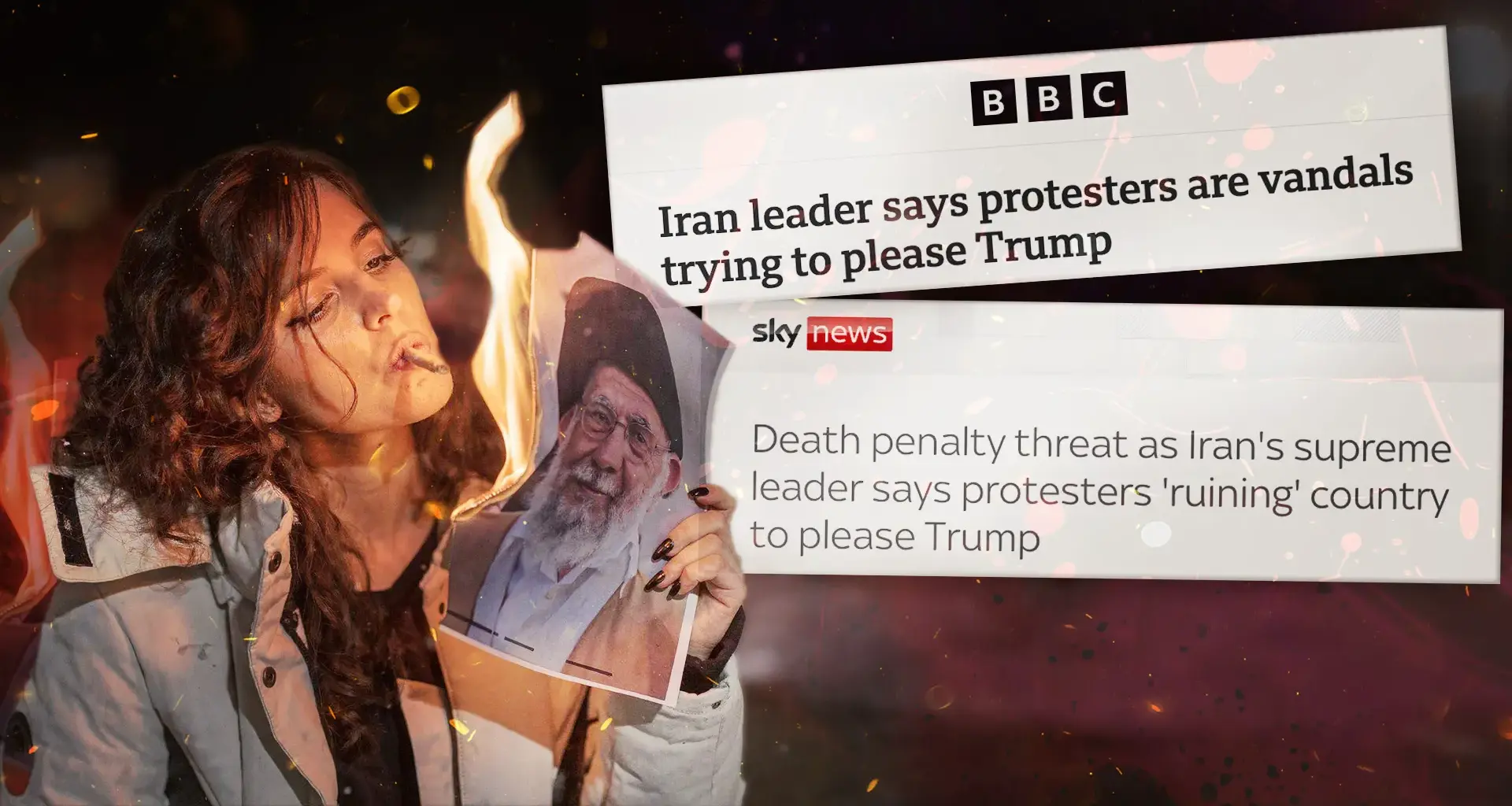
The BBC and NBC News ran headlines amplifying Khamenei’s claim that protesters were vandals trying to please Trump.
Sky News led with Iranian state media allegations blaming Israel and the United States for the violence.
BREAKING: Western media finally report on protests in Iran…
…by printing regime propaganda blaming Israel. https://t.co/oFWfqObIFi
— HonestReporting (@HonestReporting) January 9, 2026
CNN, even while acknowledging deaths, repeatedly emphasized its inability to independently verify activist reports – a caveat that might carry weight if the network had not spent the past two years publishing Hamas-run casualty figures from Gaza with minimal skepticism or attribution.
In short: when Islamists speak, they are treated as sources. When Iranians speak, they are reduced to claims.
More importantly, this hasn’t gone unnoticed. Iranian dissidents and activists are openly calling out Western media outlets on social media, expressing disgust at how the media amplifies regime narratives while sidelining the voices of those risking their lives for freedom.
1/
The anti-regime protests in Iran didn’t just expose the brutality of the Islamic Republic.
They exposed the Western media.
As Iranians risk their lives to overthrow a regime that exports terror and repression, major outlets either ignored the story or worse, laundered regime… pic.twitter.com/mITW38nm1s
— HonestReporting (@HonestReporting) January 11, 2026
From Gaza to Tehran: A Pattern
This failure did not begin with Iran.
October 7, 2023 – Hamas’ massacre of Israeli civilians – triggered a chain of events that exposed just how deeply compromised much of the Western press has become.
In Gaza, reporters have repeatedly minimized Hamas’ crimes, sanitized Islamist ideology, and reframed a genocidal terror organization as a resistance movement.
Iran has now completed that reckoning.
Here, the media is not merely soft-pedaling a regime’s actions. It is actively casting doubt on victims, amplifying tyrants, and treating the overthrow of an Islamist dictatorship as a story to be managed – not reported.
Across Gaza, Tehran, Beirut, and beyond, Western media outlets have repeatedly found themselves on the same side as the world’s most brutal Islamist regimes, whether consciously or through moral inertia.
If the Iranian regime falls, the world will rightly remember the bravery of those who risked their lives for change. It should also remember the cowardice of much of the Western media. Iranian courage must stand as the media’s shame.
Liked this article? Follow HonestReporting on Twitter, Facebook, Instagram and TikTok to see even more posts and videos debunking news bias and smears, as well as other content explaining what’s really going on in Israel and the region. Get updates direct to your phone. Join our WhatsApp and Telegram channels!