
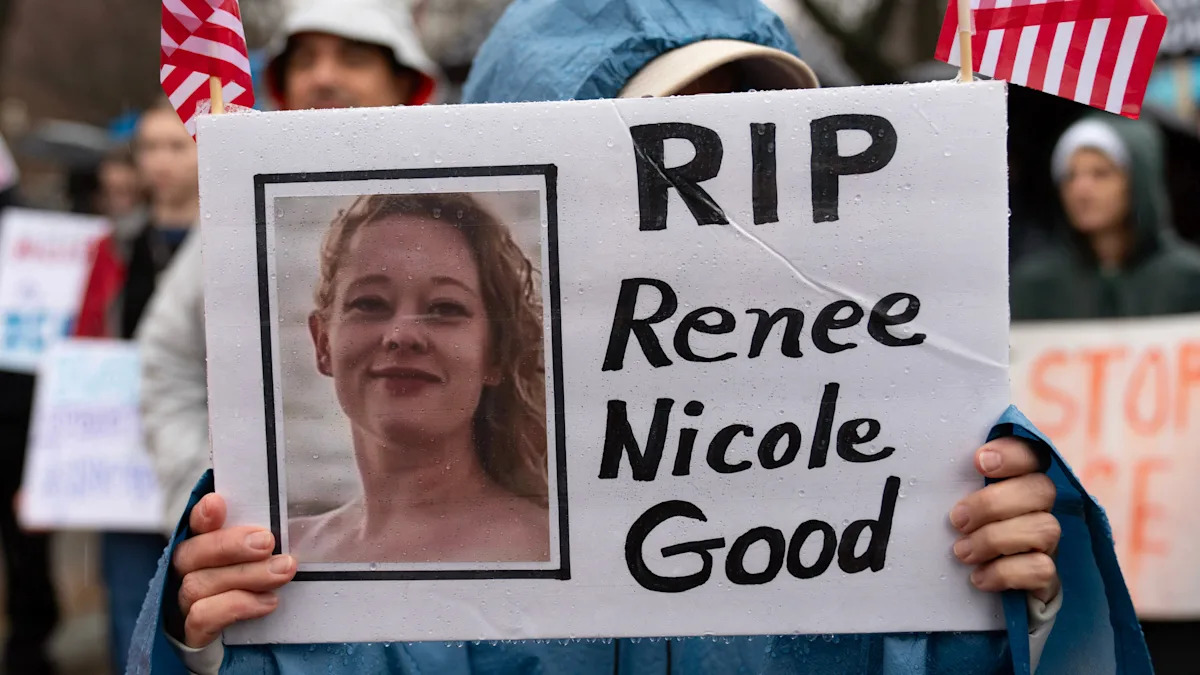
In the days since Renee Nicole Good was shot and killed in Minneapolis by an Immigration and Customs Enforcement agent, federal officials have argued that Good’s death was “a tragedy of her own making,” as Vice President JD Vance put it.
“The woman driving the car was very disorderly, obstructing and resisting,” President Trump claimed on social media. “Then [she] violently, willfully, and viciously ran over the ICE Officer, who seems to have shot her in self defense.”
But most Americans disagree, according to a new Yahoo/YouGov poll.
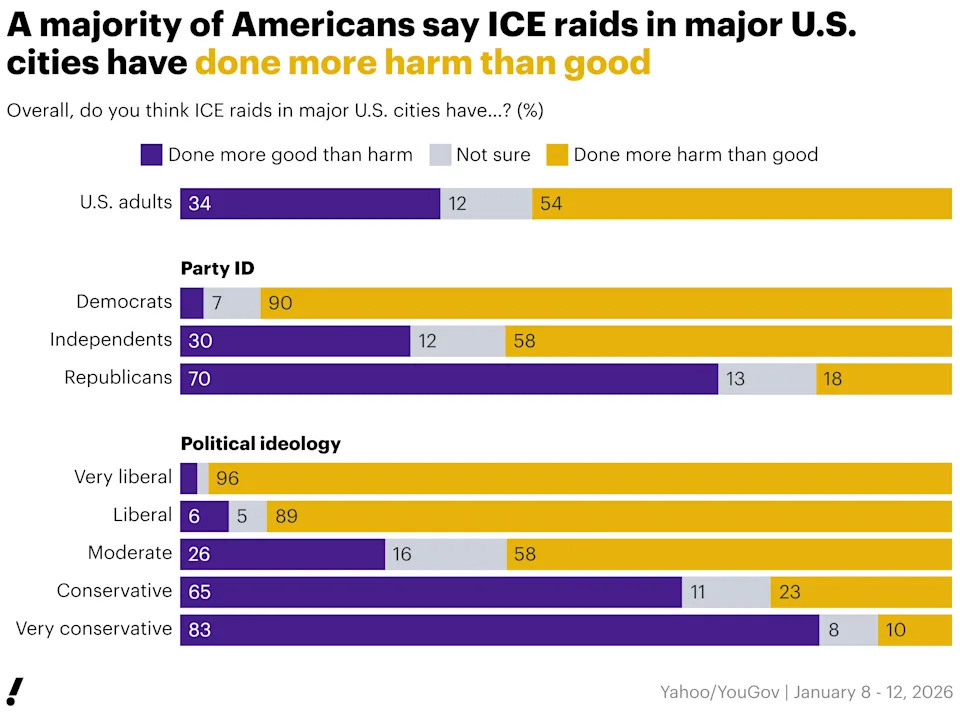
The survey of 1,709 U.S. adults, which was conducted from Jan. 8 to Jan. 12, finds that only slightly more than a quarter (27%) think last week’s shooting was “justified.” Nearly twice as many Americans — a 52% majority — say the shooting was not justified.
.
Likewise, just 27% of Americans accept the administration’s version of events: that Good “was trying to kill the ICE officer” and that the officer “acted in self-defense.” Far more (48%) say that Good “was not trying to kill the ICE officer” and that the officer “acted recklessly.”
There is even less support (24%) for the idea that Good committed “an act of domestic terrorism” before she was shot, as Homeland Security Secretary Kristi Noem has repeatedly alleged.
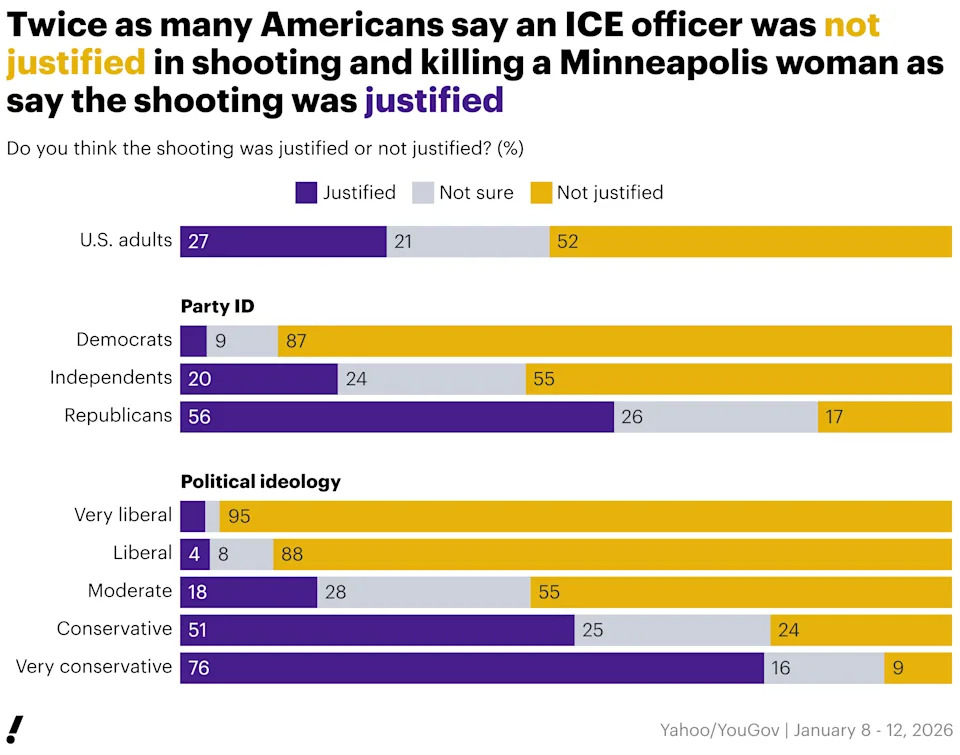
And Americans are now much more likely to believe the recent ICE raids in major U.S. cities are doing “more harm than good” (54%) than to believe the opposite (34%).
Nearly two-thirds of Americans have watched videos of the shooting
Multiple news outlets, including the Associated Press, have identified Jonathan Ross as the ICE agent who shot and killed Good, a 37-year-old mother of three. Eyewitness video shows that Good’s vehicle was parked horizontally across the right lane of a one-way residential street when she encountered a group of ICE agents. One agent demanded that Good get out of the car and grabbed her door handle. Ross, who was standing in front of Good’s car as it began to move, immediately pulled his weapon and fired three shots into the vehicle.
Initial video footage taken from multiple camera angles and analyzed by the New York Times shows that Good’s wheels appeared to be turning away from Ross as he opened fire. A newer cellphone video reportedly taken by Ross supports the Times’s analysis. In it, Good calmly tells Ross, “That’s fine, dude — I’m not mad at you.” She is then seen steering sharply to her right rather than accelerating straight toward the camera.
Noem said last Thursday that the agent “went to the hospital” and “received treatment” after “he was hit by [Good’s] vehicle.” The Trump administration has not shared any details about Ross’s condition since then.
Most Americans are aware of the shooting: Nearly two-thirds (63%) say they’ve heard a lot about it, the largest percentage to say they’ve heard a lot about any news event since the Supreme Court struck down Roe v. Wade in June 2022. And roughly the same number (65%) say they have watched eyewitness video of the incident.
Among Americans who have seen eyewitness video, a full 57% say that Good was not trying to kill Ross; that Ross acted recklessly; and that the shooting was not justified. About one-third of those who’ve seen eyewitness video say the opposite.
Less polarization than usual
On most issues, Republicans support Trump’s position at roughly the same rate that Democrats oppose it. But reactions to the Minneapolis ICE shooting defy the usual pattern of partisan polarization. This explains why a wide majority of Americans disagree with the president and administration officials about what happened — and why only about a quarter agree.
Democrats say the shooting was not justified (87%) rather than justified (3%) by a massive margin. But the Republican response isn’t nearly as clear-cut. Only 56% say the shooting was justified; the rest either think it wasn’t (17%) or say they’re not sure (26%). This asymmetry — near-unanimous opposition to the administration’s argument from Democrats; relatively muted support among Republicans — is consistent across all of the ICE shooting questions.
‘More harm than good’
Last Wednesday’s shooting happened a day after the Department of Homeland Security announced it had dramatically escalated its enforcement efforts in the Twin Cities — triggering “the largest DHS operation ever,” as the department posted on social media.
For months, federal immigration officers have been working to meet the administration’s new quota of 3,000 arrests per day, up from 1,000 previously. As a result, they have been raiding major U.S. cities and increasingly rounding up noncriminals in public places, as top White House aide Stephen Miller — the architect of Trump’s immigration agenda — instructed them to do in May, according to the Wall Street Journal.
Rather than “develop target lists of immigrants suspected of being in the U.S. illegally, a longstanding practice,” the Journal reported,” Miller told agents to target “Home Depot, where day laborers typically gather for hire, or 7-Eleven convenience stores.”
.
This shift has not proved to be popular — and last week’s ICE shooting has not helped. The new Yahoo/YouGov poll shows that 54% of Americans now have an unfavorable view of the agency, up from 51% in July and September; since September, ICE’s unfavorable rating has jumped by 7 percentage points among Democrats (from 83% to 90%) and by 3 points among Republicans (from 13% to 16%). ICE’s favorability has remained flat at 39%.
Meanwhile, just 37% of Americans approve of ICE’s recent raids in major U.S. cities; 52% disapprove. Most (52%) also disapprove of how Trump is handling immigration overall. These ratings have not changed significantly since September.
But, again, Americans now believe by a 20-point margin that the administration’s recent immigration raids are doing “more harm than good” (54%) instead of “more good than harm” (34%) — and that gap is even wider among the independents (58% to 30%) and Latinos (66% to 24%) who tend to swing elections.
In the wake of last week’s shooting, Americans also see the recent ICE raids as “mostly violent” (42%) rather than “mostly peaceful” (19%). In contrast, more Americans say the protests against these raids have been mostly peaceful (34%) than say they’ve been mostly violent (27%).