
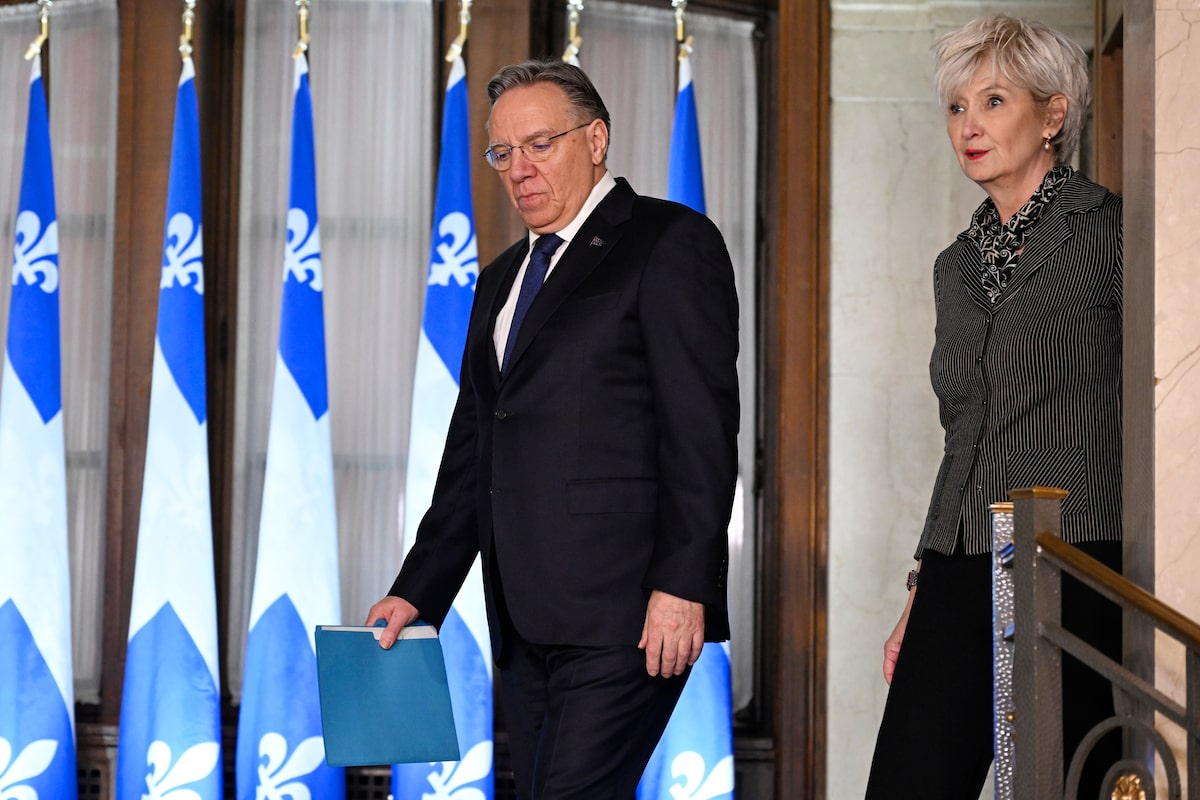
Quebec Premier François Legault and his wife Isabelle Brais walk to a news conference to announce his resignation in Quebec City on Wednesday.Jacques Boissinot/The Canadian Press
Quebec Premier François Legault announced on Wednesday that he would resign, just months before a scheduled provincial election.
In a hastily arranged news conference at the National Assembly in Quebec City, Mr. Legault said he would step aside after nearly eight years in power amidst declining poll numbers.
“Quebeckers want change and, among other things, a change of Premier,” he said.
The announcement shakes up Quebec’s political landscape, and came just weeks after Mr. Legault insisted he would fight on. The Parti Québécois is leading in the polls and promising a third independence referendum, which Mr. Legault opposes.
Legault was unaware of cost overruns at Quebec auto insurer until public scandal, he says
Mr. Legault said he will remain as Premier until his party has chosen a new leader, but largely cast his gaze backward over a long political career in an emotional speech with his wife Isabelle Brais at his side.
By founding the Coalition Avenir Québec in 2011, Mr. Legault disrupted the province’s decades-long back-and-forth between federalists and sovereigntists, arguing that Quebec was a distinct nation but that independence wasn’t a viable solution.
When he won his first of two majority governments in 2018, it broke the Liberal-Parti Québécois duopoly that had governed the province since the 1970s. The upstart party had become a juggernaut, and a “family,” Mr. Legault said.
Mr. Legault’s time as Premier was shaped by outside events, beginning with the COVID-19 pandemic that saw him briefly become the most popular leader in Canada despite higher-than-average death tolls and dramatic policies including a curfew. Many Quebeckers found his news conferences reassuring and praised his handling of the public-health response, as a wave of fellow-feeling swept the province.
“Quebec is a beautiful nation, full of solidarity,” he said on Wednesday, recalling those days.
Quebec Premier François Legault announced his resignation after more than seven years in power. The move triggers a leadership race just months before the fall provincial election.
The Canadian Press
But Mr. Legault also put his nationalist stamp firmly on Quebec, with divisive results. On the language and identity file, he passed two flagship laws that were popular with the province’s francophone majority but left linguistic and religious minorities feeling targeted.
Bill 96 toughened restrictions on the use of English in medium-sized businesses and government services, while Bill 21 banned the wearing of religious symbols for public servants in authority roles, such as teachers.
“Quebeckers must be much more vigilant about the future of their nation and the future of French,” he said on Wednesday. “We will always be vulnerable in North America. We shouldn’t be embarrassed to protect our language and our values.”
Although the recent cost-of-living spike hit Quebeckers hard, Mr. Legault defended his economic record by pointing out his province’s faster GDP growth than Ontario, part of his open fixation with closing the wealth gap with the rest of Canada. He attributed that success to “aggressive” recruitment of investment in the Quebec economy, despite some high-profile failures such as the bankruptcy of Swedish battery-maker Northvolt, which planned to build a $7-billion factory in the province.
On social policy, Mr. Legault gambled on Bill 2, a major overhaul of physician pay designed to encourage or even force family doctors to take on more patients. Quebec has one of the lowest rates of primary care coverage in Canada, but the law provoked howls of protests from doctors before Mr. Legault watered down the legislation in December, 2025, by removing penalties for physicians who failed to meet targets, among other measures. Health minister Christian Dubé promptly resigned, saying the Premier should have maintained a harder line.
Opinion: François Legault’s battle with Quebec doctors could be his last fight
The Premier’s popularity has plummeted since its pandemic high. Poll aggregator Qc125.com has for months indicated that his party is at risk of annihilation, and could lose every one of its seats if an election were held now.
Mr. Legault’s government was badly tarnished last year by a scandal involving cost overruns at the province’s auto insurance board. The Premier began the fall sitting of the provincial legislature with a promise to keep fighting, and insisted he would contest the next election as recently as December.
As Mr. Legault’s fortunes have waned, the Parti Québécois has seen a surge in popularity after having been reduced to just three seats in 2022. The party has now been leading in the polls for the last two years, with Leader Paul St-Pierre Plamondon promising to hold a referendum on independence within a first mandate.
The CAQ is now the second of Quebec’s major political parties in search of a new leader, with just months to go before the next provincial election. Former Quebec Liberal leader Pablo Rodriguez announced his resignation last month amid a campaign-financing scandal. The Liberals are expected to choose their new leader in March.
Questions remain about the CAQ’s viability without the only leader it has ever known. Mr. Legault, a former PQ cabinet minister himself, held together a fragile coalition of disillusioned sovereigntists and conservative federalists that risks coming apart without its founder.
Tributes to Mr. Legault came in from across Canada and across the political spectrum. Ontario Premier Doug Ford thanked his counterpart for his “friendship, leadership and many years of public service,” while Mr. St-Pierre Plamondon of the PQ praised Mr. Legault’s “sincerity” and “sacrifices” to improve the lives of Quebeckers.