
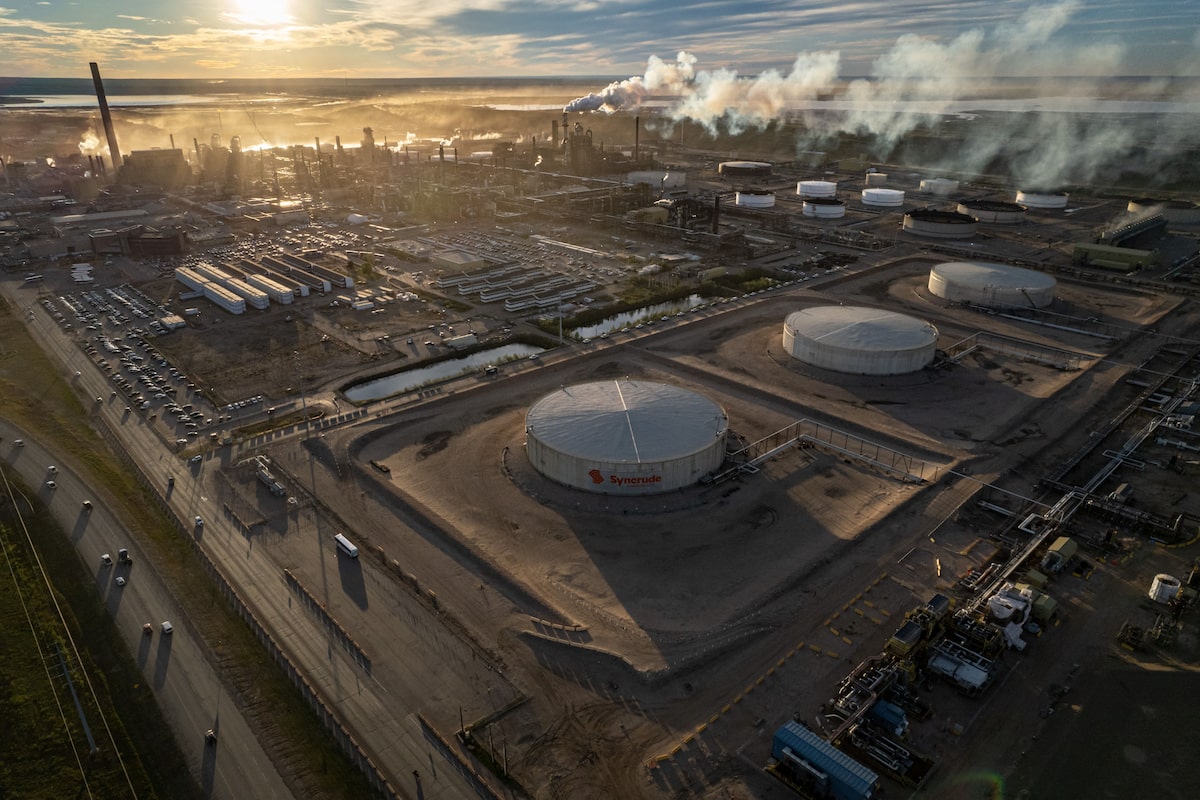
A Syncrude oil sands mining facility near Fort McKay, Alta., in September, 2022. Venezuelan oil is a similar grade to that from Canada’s oil sands.ED JONES/Getty Images
With President Donald Trump doubling down on his promise that U.S. companies will soon pump Venezuelan crude back into the global market, Canada’s oil and gas sector is taking stock of its own advantages amid geopolitical uncertainty.
Oil imports from Canada have become increasingly important to U.S. oil refineries in recent years. In 2023, 60 per cent of U.S. crude oil imports originated in Canada, up from 33 per cent in 2013, according to the U.S. Energy Information Administration. In 2024, the Canada-U.S. energy trade was valued at roughly US$150-billion.
The potential long-term problem for Canada is that Venezuelan oil is a similar grade to that from the oil sands, which makes up the bulk of this country’s exports to the U.S.; it’s thick, heavy, dense crude.
Trump promises ‘total safety’ to oil executives if they invest in Venezuela
At a Jan. 9 meeting with the chief executives of some of the United States’s largest oil companies, Mr. Trump said his administration would decide which of them would be allowed into Venezuela to redevelop reserves.
But the rebuild of Venezuelan fossil-fuel infrastructure will take time. And the U.S. oil and gas sector says that Canada is – and will continue to be – its most important energy trading partner.
A neighbourly relationship
The energy systems of Canada and the U.S. are inextricably linked. Over the past 20 years, heavy crude from the oil sands has virtually replaced supplies once shipped to the U.S. from Venezuela.
“That has been a tremendous asset to the North American energy system,” said Mike Sommers, CEO of the American Petroleum Institute, an oil lobby.
Given that it would take years for Venezuelan crude to potentially re-enter the market, “Canada is going to continue to be an important partner for decades and decades to come,” Mr. Sommers told media Monday during the API’s annual State of the Industry press conference.
“In addition to that, we expect demand is going to continue to increase. So I think that there is going to be room for significant amounts of imported Canadian crude in addition to new barrels coming from Venezuela.”
Prime Minister Mark Carney has played down the risks to Canada’s place in the global market should Mr. Trump’s plan to resuscitate the Venezuelan oil sector succeed.
Mr. Carney last week trumpeted his support for Canada’s oil producers as they struggle with the uncertainty of a U.S. takeover of Venezuela’s oil industry, saying they should be able to dodge the threat because Canadian producers will be competitive over the medium to long term.
Robust reserves, long-life assets
The competitiveness of Canadian oil lies in the size of its reserves and the type of its assets.
Alberta’s oil sands are the single largest source of Canadian supply, hitting around 3.4 million barrels each day in 2025. And that basin is extremely competitive, said Kevin Birn, the chief analyst for Canadian oil markets at S&P Global Energy, an intelligence firm.
Years ago, that wasn’t the case.
Oil sands assets are incredibly expensive to develop. First, there’s the upfront capital – the infrastructure, roads and power lines that need to be built to install the equipment to get oil out of the ground.
The bulk of assets in the oil sands were developed from roughly 2001 to 2020. Because the most significant costs were upfront, the current cost to produce a barrel is relatively low, Mr. Birn said in an interview, averaging between US$22 and US$35 a barrel. Even when oil sands mines are expanded, they are typically developed near existing facilities, negating the need for much new infrastructure.
While it’s true that the oil sands have endured more price volatility than their global peers for the past 20 years – partly because of delays in bringing on adequate pipeline capacity, Mr. Birn said – the volume of their reserves means they will continue to produce for the next 25 to 50 years. Most oil and gas wells typically last between 10 and 15 years.
“This gives Canada an incredible advantage of being very resilient and very cost-competitive globally.”
Canada’s offshore wells are also “some of the most economic assets on the planet,” Mr. Birn said.
Opinion: Venezuelan oil affects Canada only a little. But even a little is too much
Much like the oil sands, they, too, required massive upfront financial commitments. But Mr. Birn points to the Hibernia oil field, which started producing oil in 1997 off the coast of St. John’s. “It was only meant to last 20 years, and it’s still going.”
That the fully depreciated asset continues to produce oil means it has an incredibly low operating cost, he said.
The question of prices
Mr. Trump has said that part of the attraction of boosting Venezuelan barrels is the fact it will lower oil prices, thereby reducing the cost of gasoline for Americans.
Neither U.S. nor Canadian producers will “have a great time” in a low-price environment, Mr. Birn said. But where shale producers south of the border will lose production because they can’t justify the incremental costs to drill in such a market, the opposite is true in the oil sands.
“They’ll actually hit the gas in a low-price environment, because they’re going to go for volume to try to combat the lower price, and that will drive down their operating costs,” he said.
Opinion: Trump’s thirst for Venezuelan crude will hasten the death of oil
Still, the sector is keeping its eye on the geopolitical forces that could roil commodity markets, including events in Venezuela, Russia and Iran.
“Concerns remain around impacts on global supply as well as Canadian energy,” CIBC Capital Markets said in its 2026 outlook this week.
The 30 million to 50 million barrels of Venezuelan crude destined for the U.S. Gulf Coast could add “competitive friction,” it said, adding that any resurgence in supply from the South American country could once again widen the difference between Canadian and U.S. benchmark oil prices.
“While longer-term sentiment remains optimistic,” the near-term outlook continues to be volatile, it said.