


Listen to this article
Estimated 3 minutes
The audio version of this article is generated by AI-based technology. Mispronunciations can occur. We are working with our partners to continually review and improve the results.
Alberta’s markup of wine prices has not been well-received by some in the wine and hospitality industries.
The change, which took effect April 1 last year, saw the Alberta Gaming, Liquor and Cannabis Commission introduce a flat fee of 15 cents per 750 ml bottle of wine, with additional fees on top depending on the bottle’s value.
Stakeholders from Alberta and British Columbia have formed a coalition advocating for the tax to be repealed, pointing to declining wine sales and rising costs faced by local businesses.
“That’s thousands of dollars of revenue that our small businesses need to succeed,” said Jeff Guignard, president and CEO of Wine Growers of British Columbia, during a Wednesday media availability at Calgary wine store Metrovino.
WATCH | B.C. wineries face major sales drop after Alberta hikes wine fee:
B.C. wineries face major sales drop after Alberta hikes wine fee
B.C. wineries say sales to Alberta have dropped by up to 40 per cent after new fees were introduced, despite a trade deal between the provinces that allows Albertans to buy directly from B.C. wine producers. According to the Alberta Hospitality Association, Alberta wine pricing is now the most expensive in North America
Guignard said the industry wasn’t consulted on the change, though the province has said the markup followed input from Alberta liquor manufacturers.
He said the tax jeopardized last year’s interprovincial agreement allowing British Columbia wineries to sell directly to Alberta customers.
“Most of that activity now is at risk because several weeks after that agreement, the Alberta government made up a brand new Alberta wine tax using a Latin word from a dead language that no one uses anymore,” Guignard said, referring to the ad valorem, or value added markup.
“We’re hoping today that the Alberta government will listen to industry, listen to the consumers [and] come up with a better solution here.”
Province says it’s ‘most tax-friendly’ in Canada for wine
“The ad valorem tax is not a new concept and is used by many provinces across Canada,” Service Alberta and Red Tape Reduction Minister Dale Nally said in a statement to CBC News.
Nally said Alberta is “the most tax-friendly and open and free jurisdiction in Canada for alcohol, including wine.”
“Our government’s approach balances affordability, competitiveness for small businesses, and a strong, viable liquor industry.”
Mona Pinder, executive director of the Alberta Hospitality Association, said the tax has only created more challenges for local businesses during a difficult economic situation.
“They’ve seen cost increase for everything, food costs, labour costs, rent, insurance, utilities, everything,” she said.
“It’s an industry where the margins are actually very thin, and now they’ve become razor thin. So the industry can just not thrive with another unpredictable and added cost.”
According to the province, the final markup applied to a $20 bottle of wine in other provinces, including other taxes and fees, would be significantly higher elsewhere in Canada.
“Our government’s ad valorem tax applies to about 16 per cent of wines sold, and after taxes a $20 bottle of wine at invoice price is up to 87 per cent more expensive in other provinces compared to Alberta,” Nally said.
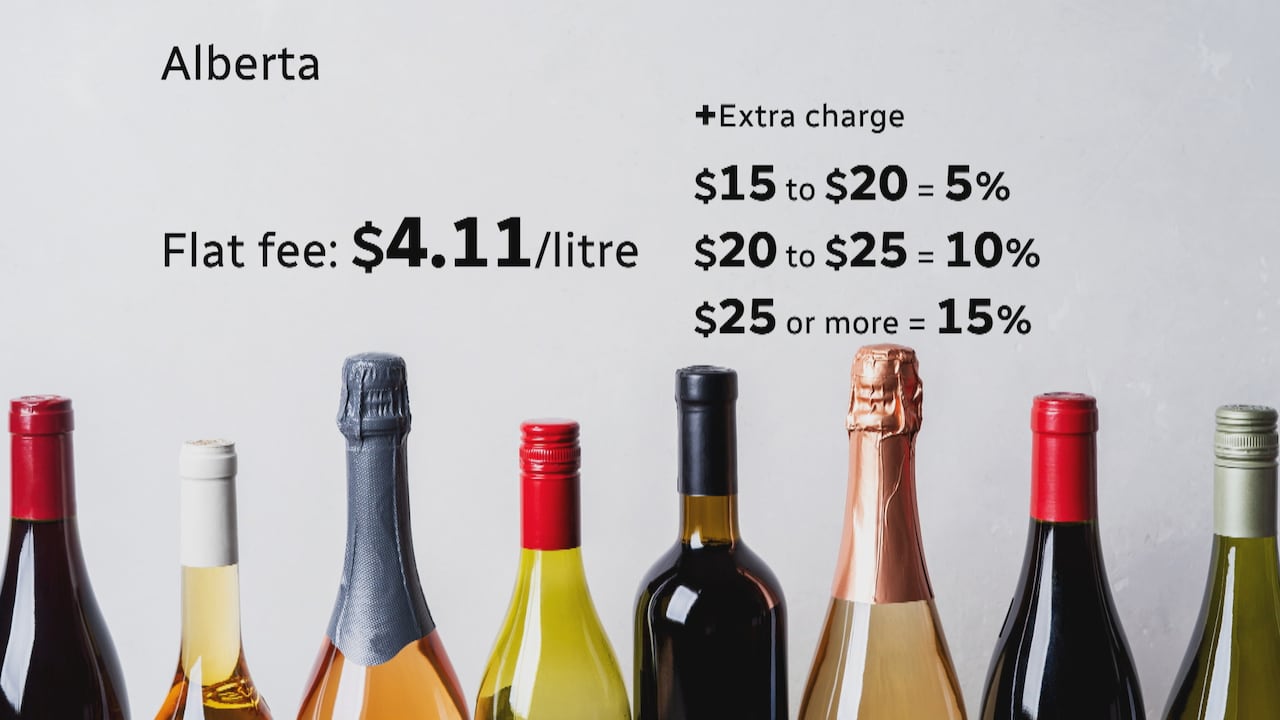 The Alberta government increased its flat fee on wine, while also introducing an additional price-based tax on wines that sell for more than $15 per litre ($11.25 per 750 millilitres bottle). (CBC News Graphics)
But even the smallest price markups have devastating impacts, according to Mark von Schellwitz, outgoing vice-president for Western Canada with Restaurants Canada.
“As the months have progressed here, we’re seeing this impact play out with all our restauranteurs,” he said.
According to a provincial spokesperson, the ad valorem tax generated an estimated $6.4 million from April 1 to December 31 last year. It’s expected to generate about $9 million in the fiscal year.