
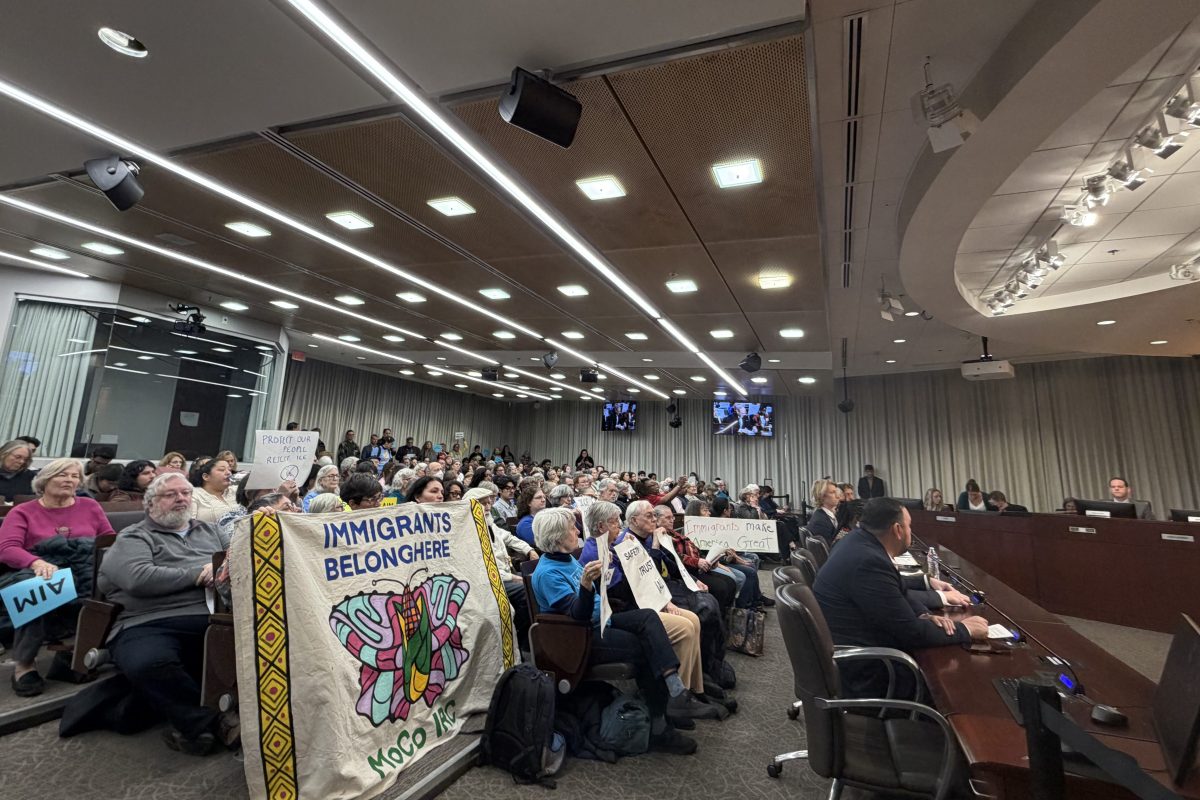
Holding signs with slogans such as “Immigrants Make America Great,” “Reject ICE” and “MoCo Welcomes Everyone,” community members packed the Montgomery County Council hearing room in Rockville on Tuesday afternoon in overwhelming support of a bill to codify county protections for immigrants.
Some who spoke at the hearing, such as Seneca Valley High School senior Mark Anthony Briseno, said they were motivated by personal experiences with family separation. A handful were faith leaders guided by teachings about loving the stranger and healing the world.
Still others were spurred on by recent events – namely, the Jan. 7 killing of 37-year-old Renee Good, who was shot by a U.S. Immigration and Customs Enforcement (ICE) agent during an operation in Minneapolis, Minnesota.
“Why are people who are just living their lives, working, and caring for their families treated as less than human beings?” asked Briseno, who said his undocumented father was detained by ICE last month at a Home Depot in Silver Spring.
“I shouldn’t have to live in fear that my mother could be taken next, or that my friends’ parents could disappear tomorrow,” Briseno continued. “We deserve to feel safe in our own communities.”
Proposed by council President Natali Fani‑González (D-Dist. 6), the Trust Act would enshrine into law the county’s longstanding policies of limiting cooperation with federal immigration enforcement efforts and extending county government services and opportunities to all residents regardless of citizenship or immigration status.
The bill would also prohibit the county from entering into formal agreements with ICE, prevent county employees from allowing federal immigration officials to access county buildings without a warrant and require the county to promptly delete any information it is required to collect about a person’s citizenship or immigration status.
Fani‑González, who came to the U.S. from Venezuela as a teenager, has spoken openly about her own deportation proceeding years ago, prior to her becoming a U.S. citizen.
“If I had to go through what I went through today, I would not be here,” she said during a council meeting last year.
During a December press conference unveiling the Trust Act, Fani‑González said the measure would promote public safety by restoring community trust in the county government agencies even as many have come to fear interactions with the federal government.
Unlike in other jurisdictions such as neighboring Frederick County, law enforcement agencies in Montgomery County do not have any standing agreements allowing their officers to assist federal immigration enforcement agents with their duties.
But county residents have nonetheless been reluctant to engage with local law enforcement for fear of attracting ICE attention, county officials have said. The issue was pervasive enough that county police last year implemented changes to ballistic vests, hoping to make their officers more easily identifiable.
DaVida Rowley, chair of the Montgomery County Community Action Board, said during Tuesday’s hearing that immigration concerns have also deterred community members from interacting with county government outside law enforcement. The board is the governing body for the county’s federally designated anti-poverty agency.
“We’re continuing to hear from staff and from families that they’re living in fear – scared to apply for services, scared to send their children to school, and in some cases scared to leave their homes altogether,” Rowley said, adding that the bill would encourage community members to seek out the support they need from the county.
Prabu Selvam, an emergency room physician and a Democratic candidate for County Council at-large, said during Tuesday’s hearing that he has repeatedly seen “the devastating consequences of when immigrant families are too afraid to seek care until it’s too late.”
“I’m hopeful that with this legislation, we will finally see families feel safer accessing county public health facilities or receiving health care in county buildings,” Selvam said.
Gabriella Rivera, a member of the Montgomery County Immigrant Rights Collective, told the council she has feared family separation since her early childhood.
“In a time of need, our community should be able to feel like they can go to county officials and not be afraid,” Rivera said. “There should be a clear distinction and separation between immigration enforcement and the county government.”
Not everyone who attended Tuesday’s hearing was in favor of the Trust Act. Of the three dozen people who signed up to speak, two – Amy Waychoff and Stacey Sauter, both members of the Montgomery County Republican Central Committee – opposed the bill, citing concerns about crime and the cost of providing county services to undocumented people.
Tuesday’s public hearing was mainly a formality – the Trust Act already has the support of the full 11-member council, as well as County Executive Marc Elrich and county police Chief Marc Yamada.
The council’s Public Safety and Government Operations committees are scheduled to hold a joint work session on the bill on Jan. 28, with a full council vote to take place on a later date. An expedited bill, the Trust Act would become law immediately upon Elrich’s signature.