
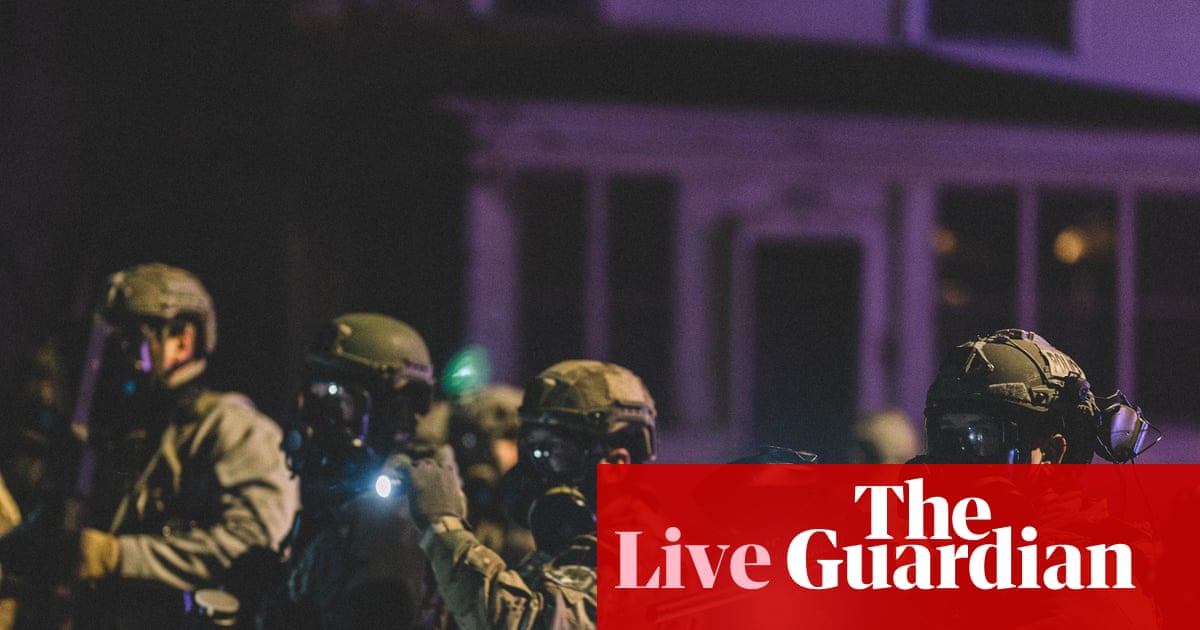
Trump threatens to invoke insurrection act as protests continue in Minneapolis
Donald Trump has threatened to invoke the Insurrection Act as protests against federal immigration agents continue in Minneapolis.
In a post on Truth Social today, Trump said he would institute the centuries-old, seldom used law – that allows the president to use the military domestically to suppress an invasion or rebellion – if “the corrupt politicians of Minnesota don’t obey the law and stop the professional agitators and insurrectionists from attacking the Patriots of I.C.E., who are only trying to do their job”.
On Wednesday, a federal officer shot a man in the leg during an enforcement operation in north Minneapolis, sparking further protests in the city, just a week after the fatal shooting of Renee Nicole Good.
Trump said that by implementing the act he would “quickly put an end to the travesty that is taking place in that once great State”.
Key events
Show key events only
Please turn on JavaScript to use this feature
Richard Luscombe
The US military has seized another oil tanker at sea in support of Donald Trump’s sanctions against Venezuela, military officials announced Thursday.
Veronica, a crude oil tanker that marine records suggest is sailing under a Guyanese flag, was boarded in a pre-dawn action by US marines and sailors, the US Southern Command said in a post on social media.
The operation was conducted in cooperation with the Coast Guard, homeland security department and justice department, the post said. It included blurry, black-and-white aerial footage appearing to show service members descending on to the tanker’s deck from a helicopter.
It is the sixth known boarding and seizure by the US military of a foreign-flagged oil tanker in support of Trump’s clamping down on the Venezuelan oil industry since the capture of the country’s president, Nicolás Maduro, in Caracas and subsequent removal to the US earlier this month.
As tensions rise in Minneapolis and protests over the use of force by federal immigration agents continue, my colleague, Maanvi Singh, is on the ground.
She reports that at a news conference at Minneapolis City Hall on Wednesday night, police chief Brian O’Hara said protesters were “engaging in unlawful behavior” and urged everyone who had gathered at the shooting scene in north Minneapolis to leave.
The Minneapolis mayor Jacob Frey, said: “I’ve seen conduct from ICE that is disgusting and intolerable.” But he urged protesters out Wednesday night to go home. “We cannot counter Donald Trump’s chaos with our own brand of chaos … Anyone who is taking the bait tonight, stop,” he said. “You are not helping the undocumented immigrants in our city.”
Updated at 10.01 EST
Trump has routinely threatened to invoke the Insurrection Act, most recently in Portland, Oregon last October.
The president also threatened to invoke the act in June when California governor Gavin Newsom sued Trump to block the use of military forces to accompany federal immigration enforcement in Los Angeles, calling it an “illegal deployment”.
In 2020, Trump asked governors of several states to deploy their national guard troops to Washington DC to quell protests that arose after George Floyd was killed by a Minneapolis police officer. Many of the governors agreed, sending troops to the federal district.
At the time, Trump also threatened to invoke the act for protests following Floyd’s death but never actually did so.
While campaigning in 2024, the president also promised to deploy the national guard to help carry out his immigration enforcement goals.
A reminder that the most recent use of the Insurrection Act was in 1992, when George HW Bush used the law to respond to the deadly riots in Los Angeles, after the four white police officers filmed beating the Black motorist Rodney King were acquitted.
ShareTrump threatens to invoke insurrection act as protests continue in Minneapolis
Donald Trump has threatened to invoke the Insurrection Act as protests against federal immigration agents continue in Minneapolis.
In a post on Truth Social today, Trump said he would institute the centuries-old, seldom used law – that allows the president to use the military domestically to suppress an invasion or rebellion – if “the corrupt politicians of Minnesota don’t obey the law and stop the professional agitators and insurrectionists from attacking the Patriots of I.C.E., who are only trying to do their job”.
On Wednesday, a federal officer shot a man in the leg during an enforcement operation in north Minneapolis, sparking further protests in the city, just a week after the fatal shooting of Renee Nicole Good.
Trump said that by implementing the act he would “quickly put an end to the travesty that is taking place in that once great State”.
Also today, we’ll hear from press secretary Karoline Leavitt when she holds a White House briefing at 1pm ET.
Donald Trump is in Washington today. He’s due to meet with Mariá Corina Machado – Venezuela’s opposition leader – at 12:3opm ET. At the moment that’s closed to the press but we’ll let you know if that changes and bring you the latest.
Later, Trump is set to host the champions of the 2025 Stanley Cup, the Florida Panthers, at the White House. We’ll be watching to get his reaction to the news of the day.
Renaming the Department of Defense the Department of War could cost US taxpayers as much as $125m depending on how broadly and quickly the change is made, according to an analysis released Wednesday from the Congressional Budget Office.
Donald Trump signed an executive order in September that authorized the Department of War as a secondary title for the Pentagon. At the time, Trump said the switch was intended to signal to the world that the US was a force to be reckoned with, and he complained that the Department of Defense’s name was “woke”.
Indeed, the order came as the military began its campaign of deadly airstrikes against alleged drug-carrying boats in South America. Since then, a stunning military operation has captured ousted Venezuelan president Nicolás Maduro and the Trump administration has threatened military action in places from Iran to Greenland.
Congress has to formally approve a new name for the department, and it has shown no serious interest in doing so. Nevertheless, Pete Hegseth, the US defense secretary, embraced the rebrand and proceeded to use it immediately on several signs after Trump’s order.
He had employees remove the large gold letters that spelled “Secretary of Defense” outside his office and replaced the sign on his door to read “Secretary of War”. The Pentagon’s website also went from “defense.gov” to “war.gov” the same day the executive order was signed.
Pentagon officials said then that they could not offer a cost estimate for the name change because they expected costs to fluctuate. They promised a clearer estimate later.
ShareTrump celebrates judge’s decision to allow ICE to continue operations in Minnesota
President Trump has posted on social media in support of yesterday’s decision from a Minnesota judge to refused to issue a restraining order to halt ICE operations across the state, citing the need for further evidence.
Writing on his own Truth Social website, Trump referred to Judge Kate Menendez as “highly respected” and said the state of Minnesota was “highly politically corrupt”.
He wrote:
A highly respected judge declined to block I.C.E. operations in the very politically corrupt State of Minnesota. I.C.E. will therefore be allowed to continue its highly successful operation of removing some of the most violent and vicious criminals anywhere in the World, many of them murderers, from the State. The great patriots of Law Enforcement will continue to make our Country safe. RECORD LOW CRIME NUMBERS!!!
The decision from Menendez came after Minnesota’s decision earlier this week to sue the homeland security secretary, Kristi Noem, and other federal officials over their involvement in a surge of Immigration and Customs Enforcement (ICE) operations across the state.
Speaking about her decision, Menendez said:
I think the issues are really important and I don’t want to suggest by not acting immediately one way or the other that I think they are unimportant … To the contrary, I understand this is important to everybody.
The plaintiffs petitioned the court for a temporary restraining order, arguing that ICE’s immigration sweeps are infringing on constitutional rights and that a brief suspension would allow legal teams to fully develop their arguments.
Meanwhile, government attorneys pushed back, asserting that there is no justification for pausing the operations because the state has not substantiated its allegations. The government has until 19 January to respond while Minnesota’s state lawyers have until 22 January.
Tom Burgis
One day during his first term, Donald Trump summoned a top aide to discuss a new idea. “Trump called me down to the Oval Office,” John Bolton, national security adviser in 2018, told the Guardian. “He said a prominent businessman had just suggested the US buy Greenland.”
It was an extraordinary proposal. And it originated from a longtime friend of the president who would go on to acquire business interests in the Danish territory.
The businessman, Bolton learned, was Ronald Lauder. Heir to a makeup fortune – the global cosmetics brand Estée Lauder – he had known Trump, a fellow wealthy New Yorker, for more than 60 years.
Bolton said he discussed the Greenland proposition with Lauder. After the billionaire’s intervention, a White House team began to explore ways to increase US sway in the vast Arctic territory controlled by Denmark.
Trump’s renewed pursuit of Lauder’s idea during his second term is typical of how the president operates, Bolton said. “Bits of information that he hears from friends, he takes them as truth and you can’t shake his opinion.”
The proposal seems to have stirred Trump’s imperialist ambitions: eight years on, he is mulling not just buying Greenland but perhaps taking it by force.
Like many of those around the president, Lauder’s policy suggestions appear to intersect with his business interests. As Trump has ratcheted up his threats to seize Greenland, Lauder has acquired commercial holdings there. Lauder is also part of the consortium whose desire to access Ukrainian minerals appears to have spurred Trump to demand a share of the war-torn country’s resources.
Lauder has said he met Trump in the 1960s when they went to the same prestigious business school. After working for the family cosmetics business, Lauder served under Ronald Reagan at the Pentagon, then as ambassador to Austria, before running unsuccessfully for mayor of New York in 1989.
Share Lauren Gambino
Donald Trump will host María Corina Machado, the Venezuelan opposition leader and 2025 Nobel peace prize winner, at the White House on Thursday for a high-stakes talks on the oil-rich nation’s future following the US capture of Nicolás Maduro.
Many in Venezuela and abroad had expected Machado to take charge after an elite US military team seized Maduro in a pre-dawn raid on 3 January and transported him to a New York City jail.
But the White House has largely sidelined Machado, instead recognizing Maduro’s former vice-president, Delcy Rodríguez, as Venezuela’s interim leader even as Trump insists the US will “run” the country.
A close Rodríguez ally, Venezuela’s ambassador to the UK Félix Plasencia, was also set to land in Washington on Thursday to meet Trump officials as part of the dramatic rapprochement brought about by Maduro’s downfall. That official visit – the first in years – was reportedly partly designed to pave the way for the reopening of the Venezuelan embassy.
Machado, a 58-year-old former legislator, won a primary to run against Maduro in 2024 but was blocked by the government from running. Her replacement, the retired diplomat Edmundo González Urrutia, was recognized by Washington as the legitimate winner of the presidential election after the opposition presented strong evidence that Maduro had lost the race by a wide margin.
Trump has sent mixed signals about Machado’s role in Venezuela’s transition, publicly questioning her domestic standing. On the day of Maduro’s capture, he remarked that Machado was a “nice woman”, but claimed she lacked the “respect” needed to govern Venezuela.
ShareAlarm as Trump DoJ pushes for voter information on millions of Americans Sam Levine
The justice department is undertaking an unprecedented effort to collect sensitive voter information about tens of millions of Americans, a push that relies on thin legal reasoning and which could be aimed at sowing doubt about the midterm election results this year.
The department has asked at least 43 states for their comprehensive information on voters, including the last four digits of their social security numbers, full dates of birth and addresses, according to the Brennan Center for Justice. Eight states have voluntarily turned over the information, according to the Brennan Center, and the department has sued 23 states and the District of Columbia for the information.
Many of the states have faced lawsuits after refusing to turn over the information, citing state privacy laws. Some of the states have provided the justice department with voter lists that have sensitive personal information redacted, only to find themselves sued by the department. Nearly every state the justice department has sued is led by Democratic election officials.
“Our position on this starts and ends with the law. We looked at state law and federal law regarding disclosure of this very sensitive personal information on millions of people, and what we discovered, or at least the way we’ve concluded, is that the law protects voters from this kind of disclosure under these circumstances,” said Steve Simon, a Democrat who is the top election official in Minnesota, one of the states being sued.
Adrian Fontes, the Democratic secretary of state in Arizona, another state being sued, was more blunt. “Pound sand,” he posted on X in response to a justice department official who announced the department was suing his state.
Eduardo Porter
There are a few reasons that Donald Trump – now self-anointed acting President of Venezuela, as well as the United States – might be so excited about appropriating Venezuela’s oil.
Trump may be counting on some boost from cheap oil to the US economy: he is obsessed with the price of gas. As the midterm elections approach, he has become concerned about unemployment. Deeply imprinted memories of scarcity during the oil crises of the 1970s may prime his belief that cheap oil cures it all.
The US president may also consider Venezuelan oil as an easy source of cash, either for the US government – to add to the tariff bonanza that he implausibly claims is being paid by foreigners – or for his own personal stash, which he may want to diversify away from crypto.
My guess is he’s dreaming: dreams built from Upton Sinclair tales of wildcatters striking it rich at the turn of the 20th century, mixed in with ingrained images from the Beverly Hillbillies, which debuted on CBS when Trump was 16, and visions of gold-plated palaces, so common in the oil fiefdoms of the Middle East. A child’s lust for buried treasure.
None of this makes any sense.
Share Jon Henley
A year after Donald Trump’s return to the White House, a global survey suggests much of the world believes his nation-first, “Make America Great Again” approach is instead helping to make China great again.
The 21-country survey for the influential European Council on Foreign Relations (ECFR) thinktank also found that under Trump, the US is less feared by its traditional adversaries, while its allies – particularly in Europe – feel ever more distant.
Most Europeans no longer see the US as a reliable ally and are increasingly supportive of rearmament, it found, while Russians now see the EU as more of an enemy than the US, and Ukrainians are looking more to Brussels than to Washington for support.
The poll, of nearly 26,000 respondents in 13 European countries, the US, China, India, Russia, Turkey, Brazil, South Africa and South Korea, found majorities in almost every territory surveyed expected China’s global influence to grow over the next decade.
These ranged from 83% in South Africa, 72% in Brazil and 63% in Turkey through 54% in the US, 53% in 10 EU states and 51% in India to 50% in the UK. Most EU citizens expected China to soon lead the world in electric vehicles and renewable energies.
ShareLauren Gambino
The US Senate has voted against a war powers resolution that would have prevented Donald Trump from taking further military action against Venezuela without giving Congress advance notice.
Senators Josh Hawley of Missouri and Todd Young of Indiana, who had joined three other Republicans to advance the resolution alongside Democrats last week, flipped after they said they received assurances from the Trump administration.
With Hawley and Young’s votes, the Senate was split 50-50 on the resolution. JD Vance cast the tie-breaking vote. Republican senators Rand Paul, Lisa Murkowski and Susan Collins cast their votes for the war powers resolution alongside Democrats.
Senate Democrats forcefully condemned Republican opposition to the resolution, which aimed to check the president as he threatens further action in other countries including Greenland, Iran and Mexico.
“Make no mistake about it: this vote makes things more dangerous, not less,” Senate minority leader Chuck Schumer said. “It emboldens Donald Trump to push further down this reckless path.”
ShareTrump set to meet Venezuelan opposition leader at White House today
Hello and welcome to the US politics live blog. My name is Tom Ambrose and I’ll be bringing you the latest news lines over the next few hours.
We start with news that president Donald Trump is set to meet with Venezuelan opposition leader María Corina Machado at the White House later today.
Machado, whose political party is widely considered to have won 2024 elections rejected by then-president Nicolás Maduro before the United States captured him in an audacious military raid this month, AP reported.
Less than two weeks after US forces seized Maduro and his wife at a heavily guarded compound in Caracas and brought them to New York to stand trial on drug trafficking charges, Trump will host the Nobel Peace Prize laureate Machado, having already dismissed her credibility to run Venezuela and raised doubts about his stated commitment to backing democratic rule in the country.
“She’s a very nice woman,” Trump told Reuters in an interview about Machado. “I’ve seen her on television. I think we’re just going to talk basics.”
The meeting comes as Trump and his top advisers have signaled their willingness to work with acting president Delcy Rodríguez, who was Maduro’s vice-president and along with others in the deposed leader’s inner circle remain in charge of day-to-day governmental operations.
Rodríguez herself has adopted a less strident position toward Trump and his ‘America First’ policies toward the Western Hemisphere, saying she plans to continue releasing prisoners detained under Maduro – a move reportedly made at the behest of the Trump administration. Venezuela released several Americans this week.
Trump said Wednesday that he had a “great conversation” with Rodríguez, their first since Maduro was ousted.
“We had a call, a long call. We discussed a lot of things,” Trump told reporters. “And I think we’re getting along very well with Venezuela.”
In other developments:
The US Senate has voted against a war powers resolution that would have prevented Donald Trump from taking further military action against Venezuela without giving Congress advance notice. Senators Josh Hawley of Missouri and Todd Young of Indiana, who had joined three other Republicans to advance the resolution alongside Democrats last week, flipped after they said they received assurances from the Trump administration.
The Trump administration received approval from the justice department to use the military to seize Nicolás Maduro even as it declined to address whether the operation would violate international law, according to a legal memo. The dark-of-night raid to capture Venezuela’s president has raised a host of legal issues concerning the president’s power to start an armed conflict without congressional approval and possible breaches of international law.
The Trump administration has indefinitely suspended immigrant visa processing for people from 75 countries, marking one of its most expansive efforts yet to restrict legal pathways to the United States. The freeze, which takes effect on 21 January, targets applicants officials deem likely to become a “public charge” – who they describe as people who may rely on government benefits for basic needs.
Donald Trump has said it would be “unacceptable” for Greenland to be “in the hands” of any country other than the US, reiterating his demand to take over the arctic island, a semi-autonomous territory of Denmark. “The US needs Greenland for the purpose of national security. Nato should be leading the way for us to get it,” the US president said on social media. The alliance “becomes far more formidable and effective” with the territory under US control, he said.
The Iranian government has signalled that detained protesters are to face speedy trials and executions, defying a threat by Trump to intervene if authorities continue their crackdown.
The Democratic representative Robin Kelly on Wednesday formally introduced articles of impeachment against Trump’s homeland security secretary, Kristi Noem, following the fatal shooting of a US citizen by an immigration agent in Minneapolis last week.
The Trump administration on Tuesday evening unexpectedly canceled up to $1.9bn in funding for substance use and mental health care, which providers say will immediately affect thousands of patients. “The scope of care that’s disrupted by these grants is catastrophic,” said Ryan Hampton, founder of Mobilize Recovery, a national advocacy organization for people in and seeking recovery. “Tens of thousands, if not hundreds of thousands, of people will die.”