
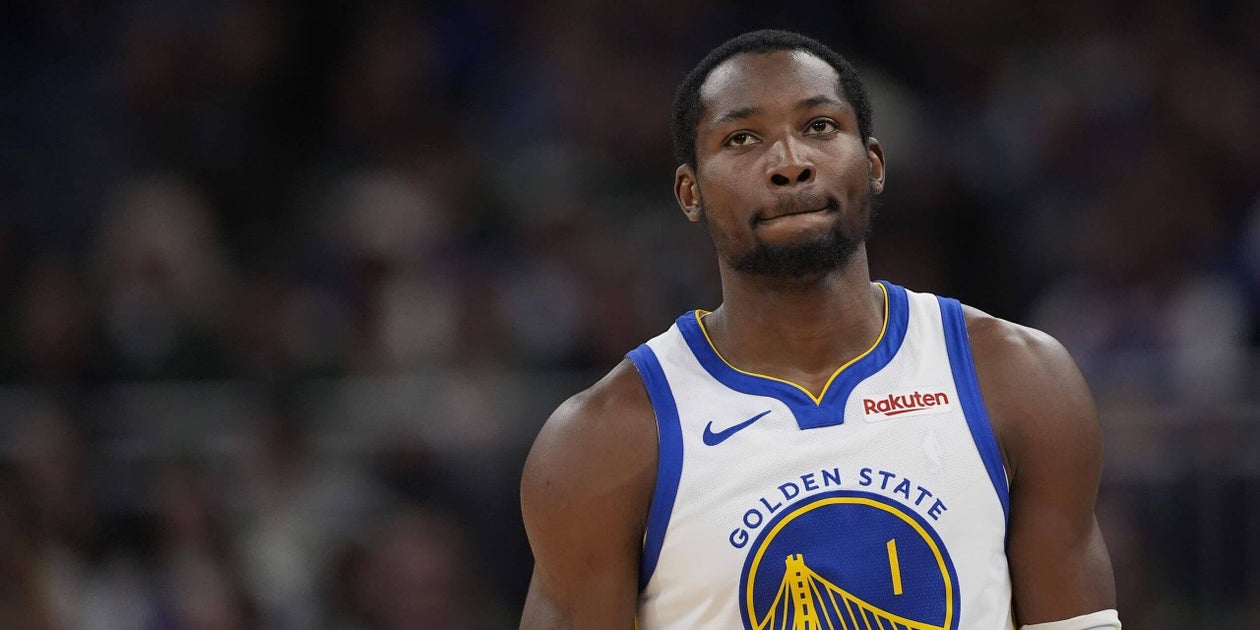
SAN FRANCISCO — Jan. 15 is here. Per the two-year, $48.5 million contract that Golden State Warriors forward Jonathan Kuminga signed during restricted free agency in early October, he can now be traded. This moment in Warriors history arrives at perhaps the weirdest time in his five-year tenure.
The question now: Is he still on the team after the NBA’s Feb. 5 trade deadline?
The situation has grown so sour, according to team sources, that the answer might be yes. Two dates illustrate how far and fast this relationship has devolved, with Kuminga’s trade value diminishing all along the way.
On Dec. 2, Kuminga’s frustration no longer remained beneath the surface, behind a smile summoned by his bent to stay positive. He mumbled loud enough to be heard as he rustled through the belongings at his locker inside Chase Center. A few choice words made clear his mood as he hastily dressed and departed.
The Warriors had just lost to the Oklahoma City Thunder. Stephen Curry didn’t play, and Jimmy Butler was knocked out by a first-half injury. The Warriors were down 11 when Kuminga entered the game with 5:08 remaining in the third quarter. They trimmed the deficit to three by the start of the fourth. Still, Kuminga spent the entire fourth quarter on the bench.
As a reserve, he had just eight points on 3-of-10 shooting with two turnovers in his 16 minutes. But he had seven rebounds — three offensive —and Golden State outscored Oklahoma City by three points with him on the floor. Yet, after years of internal discussion about how the fifth-year forward didn’t do enough of the little things to earn more playing time, with his rebounding struggles a central tenet of those complaints, this still wasn’t enough to get him back in the game.
He sat and watched as the Warriors turned a one-point lead with 4:54 remaining into a 12-point defeat. And Kuminga, who typically presents as cool, unbothered, was mad enough to show it.
One month later, Jan. 2, the tables flipped.
The Warriors, playing their fourth game in six nights, rested Curry, Butler and Draymond Green for Oklahoma City’s return to San Francisco. Coach Steve Kerr said during his weekly appearance on local radio that Kuminga would “for sure,” get some minutes later that night.
Kuminga saw the floor once in the previous 10 games, a total of 9:31 in a loss at Phoenix. But it seemed his recent stretch of absences would come to an end. If ever there was a time for him to show what he could do without the shackles of playing with future Hall of Famers, this was it. Again.
But Kuminga’s name popped up on the injury report an hour or so before Kerr spoke to the assembled media — lower back soreness. The Warriors lost by 37.
Warriors owner Joe Lacob, when approached about Kuminga moments after the game, quickly declined to comment and was visibly irritated. Kerr was asked when Kuminga got hurt during his postgame news conference.
“Just before the game,” Kerr said.
Was the coach afraid that it would linger?
“I don’t know,” Kerr said. “I have no idea.”
Kuminga’s absence certainly raised some eyebrows across the league, and frustration within the Warriors’ organization. Multiple team sources said they suspect Kuminga wasn’t actually hurt.
“I wouldn’t have played either,” said one Warriors player, given anonymity in exchange for candor. “It’s clear the coach doesn’t believe in him.”
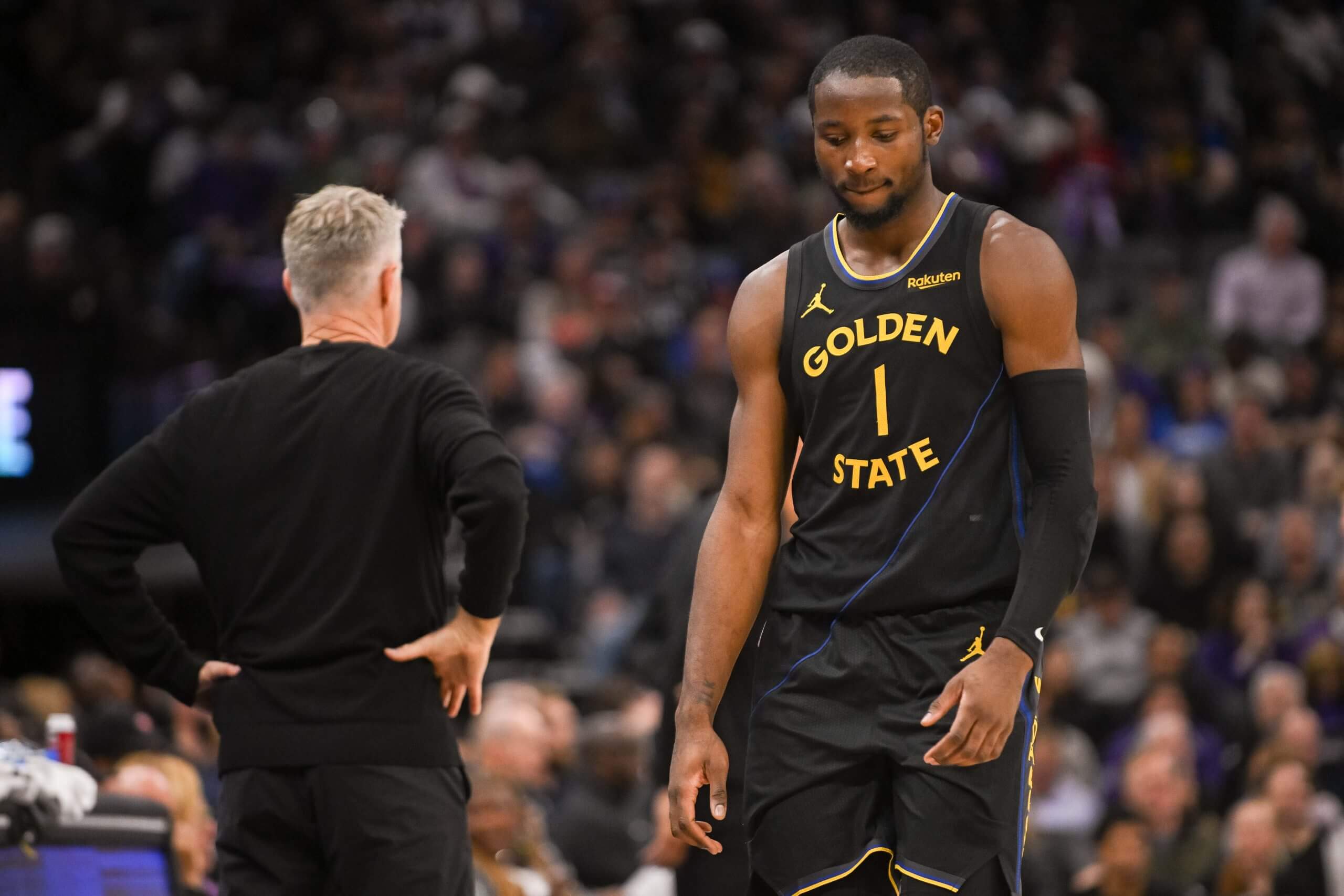
Jonathan Kuminga is removed in the fourth quarter of a Nov. 5 game against the Sacramento Kings. (Ed Szczepanski / Imagn Images)
For nearly two weeks, Kuminga has been a non-existent presence within the Warriors locker room, at least in the windows of media access. Early in the season, the aura of the young forward was a staple before and especially after games. He could almost always be found at his locker, joking with teammates, conversing with the media. But since that Jan. 2 game, he’s been a ghost. Kuminga sits on the bench during games and then seems to vanish.
The relationship between Kuminga and the Warriors appears to have come to a head, nearly five years after the Warriors drafted him with the No. 7 pick in the 2021 NBA Draft. But it may not be over. Just months after a contentious trade exploration and contract negotiation hijacked the Warriors’ offseason before leading to his return, this drama could continue throughout the rest of the season.
The Warriors, who have a team option for the second season on Kuminga’s deal, have lost significant negotiating leverage since the summer, in large part, because of their inability to showcase his potential. All those DNP-CDs for Kuminga, on top of the strained nature of his relationship with the organization, have emboldened suitors to lower their price point on a possible deal. And now, team sources insist that they are willing to keep Kuminga on the roster for the remainder of this season.
In the offseason, he becomes a $23.4 million expiring contract. For teams looking to trim future salary, expiring contracts can be valuable on the trade market. If they don’t get a deal they like, the Warriors claim they’ll wait.
Regarding the Kuminga trade demand that was just communicated through the media, and which truly changes nothing, it’s being met with a 🤷♂️ by the Warriors.
Much more here on how they got here, w/ @ThompsonScribe and @NickFriedell, at @TheAthletic https://t.co/NnYmIxTUrB
— Sam Amick (@sam_amick) January 15, 2026
Are they posturing? Perhaps. Rival executives are skeptical that the Warriors would follow through on that approach, if only because the negativity surrounding his situation has clearly made their already-challenging season so much worse. The Warriors, who talked like fringe title contenders coming into this campaign, have the look of a Play-In team.
“Mediocre,” Butler called his Warriors following Tuesday’s win over Portland that improved them to 22-19 at the halfway point of the season.
Despite their advanced age, Curry is still elite, and Butler has delivered. But Golden State is desperate for a third scorer and playmaker. This is illustrated by the home loss to Atlanta when both scored 30 points and De’Anthony Melton was the only other Warrior in double figures — and he needed 12 shots to get his 10 points.
Kuminga was supposed to fill that void. After Curry’s injury in Game 1 of last spring’s Western Conference semifinals series against Minnesota, Kuminga averaged 24.3 points on 55.4 percent shooting in 31 minutes per game. The Warriors lost all four games without Curry, but Kuminga looked to have solidified himself as a capable scorer when the offense featured him. It seemed logical to expect Kuminga could be at least a situational scorer during the regular season, especially in the inevitable off days for the Warriors’ older stars.
At least long enough to hold the Warriors over until he was inevitably traded.
But Kuminga is out of the rotation and glued to the bench. The Warriors have not found a consistent third option, or a primary option that allows Curry and Butler to rest more. Can the Warriors afford not to trade Kuminga? Would they be dooming this season by letting his youth, talent and athleticism, and his $22.5 million, sit on the bench and contribute nothing to this playoff quest?
“What’s that, $33 million just sitting on the bench, not playing?” one player said, referencing Kuminga and Buddy Hield.
Over these next three weeks, the saga that’s strangled the Warriors for years reaches a critical mass. The Warriors’ inconsistent play declares they need to make a move. Kuminga certainly wants out. The fans are clamoring for a trade. Kerr clearly doesn’t consider Kuminga a solution. Even Lacob, long one of Kuminga’s supporters, is down on the fifth-year forward, according to team sources.
Perhaps the only thing more dramatic than the Warriors finding themselves in this predicament is the idea that, on Feb. 6, they could still be in it.
What now?
As players filed onto the floor for Tuesday’s game against the Trail Blazers, one Warrior was noticeably absent until the final minute of warmups: Kuminga.
With just over 70 seconds left before the buzzer sounded, the national anthem played, and starting lineup introductions began. Kuminga came strolling out to the floor through the Warriors’ tunnel with a smile on his face. He took two practice jumpers before joining teammates Gui Santos, Quinten Post and Gary Payton II, who were kicking a basketball around like a soccer ball, playfully trying to keep it in the air.
This is life for Kuminga these days. Detached.
The Warriors are currently No. 8 in the Western Conference and have hovered around .500 most of the season. Their older players have logged heavy minutes keeping the Warriors afloat. With Kuminga now glued to the bench, the Warriors figure to need reinforcements or risk burning out Curry, Butler and Green just trying to make the postseason. Certainly, competing for a title requires an infusion.
Kuminga represents the Warriors’ last asset to add difference-making talent without taking from their core — whether as a player or trade chip. The miss on big man James Wiseman, taken second in 2020, adds to the significance of the Kuminga pick. At this point, the most the Warriors got out of three lottery picks was a solid rotation player in Moses Moody.
Since the Warriors let Chris Paul’s contract expire in 2024, and used Andrew Wiggins to get Butler in 2025, the only contract with enough salary to get a significant roster addition via trade is Kuminga’s. The next-largest contract after Kuminga is Moody’s $11.6 million and Hield’s $9.2 million. Perhaps Moody plus Hield’s expiring contract has value enough to be combined to get a quality player. But the higher the salary of the potential acquisition, the more Kuminga’s contract comes into play. And with the Warriors so close to the hard cap, the dollars must match.
Without Kuminga, any deal to bring in a significant haul requires using Green’s $25.9 million salary. Any deal involving Green changes the calculus for Golden State. After that, Butler and Curry each make more than $50 million, which all but takes them off the table save for a monster trade. That leaves Kuminga and what he can lure on the market.
The problem at the moment, it seems, is that the primary path to a Kuminga deal that was there in the summer appears to have disappeared. While team sources say the Sacramento Kings still have significant interest in Kuminga, the final offer that was rebuffed in the offseason — veteran guard Malik Monk and a 2030 first-round pick (top-12 protected) in exchange for Kuminga — is no longer in play.
Not only do the Warriors not have interest in Monk, but the Kings — well aware that Kuminga’s value has dropped in recent months — are no longer willing to offer the first-round pick. What’s more, the Warriors are now taking a harder stance than before in regards to the insistence that they don’t absorb contracts that extend beyond this season.
As such, sources from both teams acknowledge that a three-team deal is most likely if Kuminga is going to wind up with the Kings. Yet, while the Warriors have been tied to the Brooklyn Nets’ Michael Porter Jr., with the prospect of him coming Golden State’s way in that sort of three-team structure, a Warriors source insisted earlier this week that there had not been substantive talks between the two teams. There might be another suitor for Kuminga, though.
League and team sources confirmed a report that the Lakers have some interest in Kuminga, though it remains unclear if talks will unfold. The Warriors, the sources said, are aware of the intrigue and waiting to see how that situation evolves.
Yet, if there isn’t an offer in play that’s to the Warriors’ liking in these opening days and weeks, team sources say Kuminga could remain.
“I could actually see that happening,” one player said.
If it does work out that Kuminga’s with the Warriors after the deadline, another player said, “then he has to play.”
It wasn’t too long ago that he was doing just that — with Kerr’s blessing, no less — back before his season turned sideways in a flash.
A flawed beginning
Kuminga started in their first eight games of this season, with Kerr publicly announcing that he would be their starter “going forward” after the Warriors opened 3-1.
“Fantastic,” Kerr said of Kuminga’s early play. “I think he’s ready.”
When Golden State played in Indianapolis on Nov. 1, all was well in Kuminga’s world. Or so it seemed.
Before the game, he sat in his stall inside the visitors’ locker room at Gainbridge FieldHouse and described how much it meant to him that Kerr put him in the starting lineup.
“It meant a lot,” Kuminga told The Athletic. “It means the world. Knowing he has my back, it means a lot.
“Obviously, having the support from everybody else (too). I’m just not trying to let everybody down and trying to compete at the (next) level and as hard as I can.”
Kuminga’s words also hinted at a shift. After all, he and his agent, Aaron Turner, had spent the summer in prolonged contract negotiations with Warriors general manager Mike Dunleavy and the front office. Turner repeatedly used Kerr’s name in different interviews, questioning whether the veteran coach was putting his client in the best position for success, comments that, according to league sources, irritated many within the organization.
With a new season underway and Kuminga finally showing the consistency the Warriors had long been hoping for, it seemed a page had been turned.
But appearances, as it turned out, were deceiving. And as a hallway encounter with Kuminga four days later in Sacramento showed, the hard feelings that were front and center during the offseason clearly remained.
During the pregame coach’s news conference at the Golden 1 Center, Kerr had continued praising Kuminga’s ability to impact the game in the sorts of ways that he simply hadn’t in previous years. Yet, when a reporter relayed these flattering sentiments to Kuminga as he chatted with a Warriors official near the visitor’s locker room, his reaction said it all.
An eye roll. A head shake. Enough said — even without him saying anything at all.
From the time the Warriors selected Kuminga out of the now-defunct G League Ignite program to now, this has been the Kuminga experience far too often for the Warriors’ liking. But it certainly didn’t help that he faced mixed reviews from some of the Warriors stakeholders when he arrived in the summer of 2021.
Team sources confirmed that some in the organization, including Kerr, wanted Franz Wagner, but the German big man would go eighth to Orlando in the end. In a push to inject the Warriors’ roster with much-needed athleticism and potential starpower, Kuminga was drafted as part of the foundation of the post-Curry era along with Wiseman.
Kuminga joined a franchise that was still in the midst of a championship run. That year, the Warriors had Wiggins, Green, Payton and Otto Porter Jr. getting minutes at forward. Despite being the No. 7 pick, Kuminga ranked 20th in minutes per game among his draft class as a rookie. He’s currently 16th in minutes per game among all 2021 first-round picks. Plus, Kuminga had to fit his game into the Warriors system, which is centered on Curry’s offense and Green’s defense.
“The one thing I’ve always known and felt from the very beginning is we’re built around Steph and Draymond’s chaos at both ends,” Kerr said the day before the regular-season opener on Oct. 20 when describing what type of player he thinks fits best on the Warriors. ”Draymond is one of the most brilliant defenders of all time, and Steph is, obviously, one of the brilliant offensive players of all time. There’s a chaos to their game. And on the offensive game, the two of them together, the continuity, they do some unique stuff that we don’t even plan.
“So, we’ve always thrived with guys who understand that — guys like Shaun Livingston and Andre (Iguodala) … the guys who can really feel how to get Steph open, how to utilize the leverage that Steph provides by slipping to the rim or setting a screen, whatever it is. We’ve always thrived with the high-IQ guys and the switchability, length, defensive two-way stuff. That’s why those rosters we had from ’15 to ’19, it had all of that, and that’s why those teams hung all those banners.”
Where the Warriors have come up wanting in the last couple of years is in the areas of youth, athleticism and isolation play — which is how the league is trending. At times throughout his Warriors tenure, Kuminga had stretches where it seemed he filled that void. So much so that Green and Curry, just last season, declared it was time to explore life with Kuminga as a primary option.
That possibility remained entering this season. But after 12 games, it was gone. For some in the organization, this situation is symbolic of the short leash Kuminga has had for four-plus seasons. It’s also proof to those who believe Kuminga must leave because he’ll never get a true opportunity with the Warriors.
Some Kuminga supporters point to the lack of belief from Kerr as a reason the forward has never been able to reach his full potential. They describe a young player who gets in his head after making a couple mistakes because of how his playing time has been doled out through the years.
Maximizing the Curry window
After the Warriors drafted Wiseman, it became clear he was an impediment to Curry as they unsuccessfully attempted to shoehorn the rookie center into the starting lineup. Impeding Curry that year was problematic because Curry was the offense. In his first year back from missing nearly all of 2019-20, with Kevin Durant gone and Klay Thompson injured, Curry averaged a career-best 32 points per game to reestablish his supremacy. After the Warriors lost in the 2021 Play-In Tournament, Curry vowed, “You don’t want to see us next year.”
That offseason, the veterans led a contingency that wanted the Warriors to use their two lottery picks in a trade for another star. The Warriors opted to use the picks and selected Kuminga and Moody. They also signed veterans Otto Porter Jr. and Nemanja Bjelica to one-year deals.
Then, the Warriors started the following season 18-2. Guard Jordan Poole came back much improved. Andrew Wiggins was more comfortable in the system. And Curry was elite, especially in the playoffs. The Warriors won the title in Kuminga’s rookie year.
The following season, 2022-23, the Warriors were caught in a juxtaposition dubbed “the two timelines.” They drafted two more rookies in Patrick Baldwin Jr. and Ryan Rollins, while signing veterans Donte DiVincenzo and JaMychal Green. The Warriors’ roster featured five recent draft picks who had to find their way somehow. And after winning a title, Kerr leaned into the championship game plan, turning to vets who knew how to play with Curry. Even training camp invite Anthony Lamb, 25, received minutes over Kuminga. It would be part of a trend of Kuminga losing out on minutes to hard-playing forwards who thrive on the little things. The list includes Juan Toscano-Anderson, Payton II, DiVincenzo and, this year, third-year forward Gui Santos.
Wiggins missed the second half of the 2022-23 regular season, opening a door for Kuminga. He played well as the Warriors closed the season by winning eight of 10. But when the 2023 playoffs came, Wiggins returned and left Kuminga out of the rotation.
Kuminga’s role shrank even further last February when the Warriors traded Wiggins for Butler, who dominates the ball more and eats up more minutes than Wiggins. Butler makes good decisions, plays under control, passes the ball well, limits turnovers, is fluid in multiple defensive schemes, and even crashes the offensive glass — just how Kerr wants.
And since both Butler and Green are non-shooting threats, meaning opposing defenses don’t mind leaving them open, having another non-shooter on the floor in Kuminga destroys the Warriors’ spacing.
And spacing is everything for Curry.
Kuminga and his supporters believe he hasn’t always been put in the right position to succeed. He is most effective with the ball when he can attack in isolation and pick-and-roll. But with Butler and Green controlling the ball, it relegates Kuminga to being mostly off the ball.
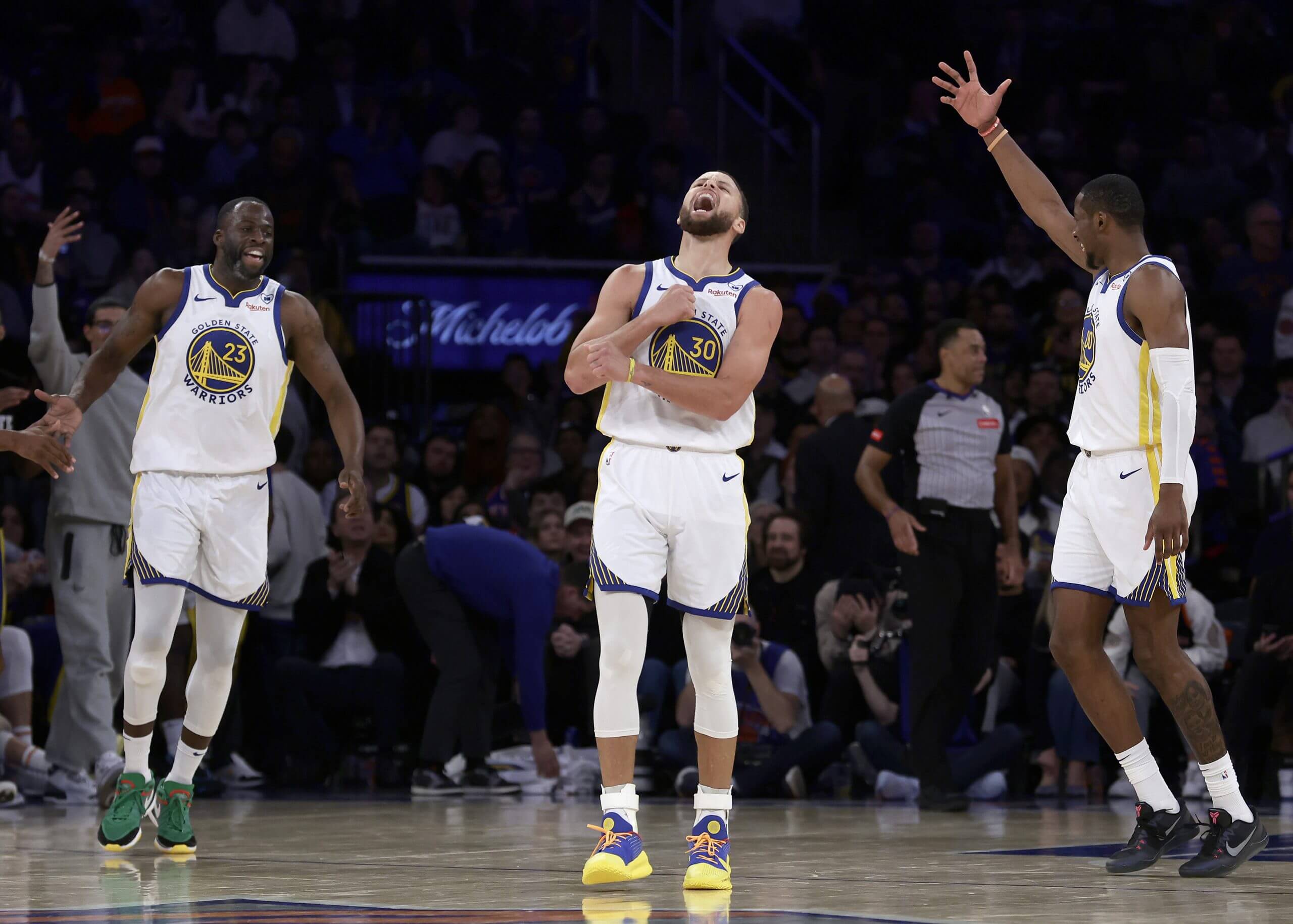
Green, Curry and Kuminga have a plus-10.0 net rating with what would be a top-five offense and a top-three defense in 184 minutes together. (Jim McIsaac / Getty Images)
Kuminga said after a Dec. 18 game against the Phoenix Suns that he fit “perfect” with Curry and Green. The numbers show that he has a case. That three-man group has a plus-10.0 net rating with what would be a top-five offense and a top-three defense in 184 minutes together, according to NBA.com.
The problem for Kuminga is that nobody gets to play with two future Hall of Famers all the time – and part of any young player’s growth is being able to fit with a variety of different teammates.
This season, Kuminga is shooting a career-low 43.1 percent and his 11.8 points a game is his lowest output since his second season. The splits before and after Nov. 12, when he was pulled out of the starting lineup, tell a story of how Kuminga’s production is tied to opportunity and confidence. As a starter, Kuminga averaged 14.9 points, 6.8 rebounds and 3.1 assists per game. He was a minus-31 in 349 minutes. After getting taken out of the rotation, Kuminga averaged just 5.5 points a game, shooting just 28.3 percent from the field, with 4.8 rebounds and 1.5 assists. He was a minus-19 in 99 minutes.
Where the gap becomes more noticeable is in net rating.
In the 13 games Kuminga has started, the Warriors’ net rating with him on the floor was minus-3.7 in 348 minutes through Nov. 11, according to NBA.com. With Kuminga as a reserve, the Warriors’ net rating is minus-8.1 in 98 minutes with him on the floor, the lowest of any reserve. His production nose-dived after getting pulled from the starting lineup on Nov. 12. Kuminga, who returned to the rotation on Nov. 29 after missing seven straight games because of the knee issue, was taken out of the rotation altogether going 1 for 10 from the field in a Dec. 6 win over the Cleveland Cavaliers.
“I’m disappointed for him,” Kerr said before a Jan. 9 game against the Kings. “That things didn’t continue to go the way they did the first couple of weeks. At the same time, it was gonna be tricky to start JK, Jimmy, Draymond, at the 2, 3 and 4. I think anybody can see that’s a tough combination, in a five-man combination, based on shooting. Sometimes, Steph can just offset every spacing obstacle in your way. He’s that good, but in the modern NBA, I think it’s gonna be tough to do that, and I think we recognize that. We gave that lineup several weeks, and eventually, I think the weaknesses of the lineup were exposed, and that’s why we went in a different direction.”
Kerr, Dunleavy and Lacob understand the conversation surrounding Kuminga is no longer around just Kuminga as a player — it’s what Kuminga represents. If he eventually gets moved, it will be another reminder that the Warriors’ initial plan to draft and develop young pieces and merge them with the veteran core has failed. With that, would be an acknowledgement that a part of their vision for the future failed as well.
But as Kuminga’s potential final days as a Warrior play out, the way he’s thought of in the locker room and the way he is viewed by the front office remain largely different from one another. The front office, especially after Kuminga’s decision to sit out that Jan. 2 game against the Thunder, appear more ready to move on than ever. But, team sources have reiterated in recent days, they won’t just make a move unless they get something of value in return.
Kuminga’s teammates, however, seemed to draw a line between basketball and the business of basketball as it pertains to the 23-year-old. He is still well-liked in the locker room, where there is a shared hope that he flourishes wherever he lands next. The one bond that Kuminga supporters and critics seem to share is an understanding that Kuminga believes he can still be a star, but he’ll never get the opportunity he’s seeking within the framework of the Warriors’ hierarchy.
Butler, in particular, has routinely publicly come to Kuminga’s defense as this Jan. 15 date neared.
“That’s my brother,” Butler said a night after Kuminga missed the Thunder game with back soreness. “So, I could care less if he out the rotation. We hang out. That’s my friend — that’s my brother, and that’s not gonna change. Basketball is basketball, but I love him like a brother, man. I wish him the best. And I still see him in here getting his work in, so his mind’s right.”
Butler’s comments represented a shift in tone. It felt almost as if he knew, like several players in the Warriors’ locker room, that Kuminga’s days on the team were likely numbered. As he did on media day, Butler side-stepped any questions about what might happen heading into the Feb. 5 trade deadline.
“That don’t got nothing to do with me,” Butler said. “Because I’m still gonna call and check in on him, still gonna go visit him, still go to his house, eat his food, play with his kids. So, his future — that’s between him and whoever else. But the bond and the brotherhood that we’ve built, ain’t no future gonna ever change that that’s my guy.”
Kerr, in his weekly appearance on 95.7 The Game in San Francisco on Wednesday night, offered the best summation of what he called a “difficult situation.”
“It’s just wait and see,” Kerr said. “We have to control what we can control. Try to keep moving the ship forward. This is not an easy situation. It’s not an easy one to talk about frankly. I try to protect everybody organizationally. Nobody’s winning right now with this situation, and it’s unfortunate, but it is what it is.”