
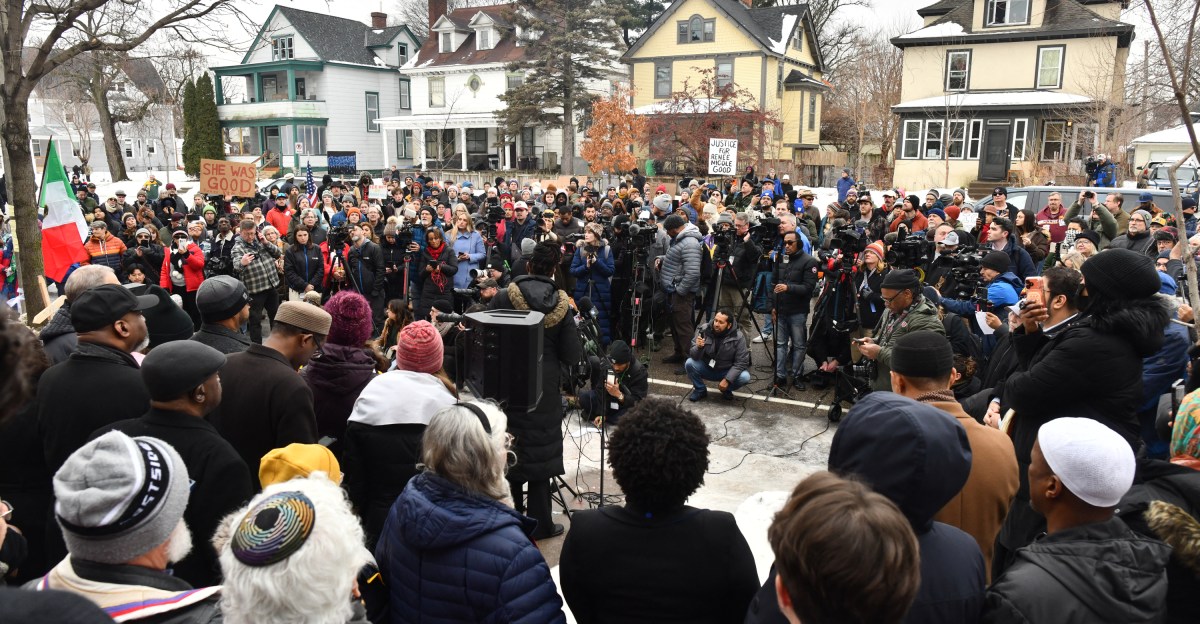
The Twin Cities, and much of the nation, are still reeling from ICE agent Jonathan Ross shooting and killing Renee Good last week. The local resistance to the federal immigration forces deployed in and around Minneapolis has grown, and the Trump administration’s rhetoric against Good and the protesters around Minneapolis has heated up. On Thursday, Trump threatened to invoke the Insurrection Act and send the US military to the cities to crush the activists.
Meanwhile, a question still hangs over the crisis: Will Ross face any legal accountability for killing Good? Vice President JD Vance insists that Ross has “absolute immunity” for his actions, and the Justice Department is declining to investigate him. But others wonder if the state of Minnesota can prosecute Ross for the killing. The short answer, at the moment, is maybe.
Today, Explained cohost Noel King spoke with Vox’s senior legal correspondent Ian Millhiser about the state of the competing federal and state investigations into Good’s death, what the Supreme Court has said about this issue, and whether the Trump administration’s immunity claims about ICE officers have any merit.
There’s much more in the full podcast. So listen to Today, Explained wherever you get your podcasts, including Apple Podcasts, Pandora, and Spotify.
A woman in Minnesota is dead and there is video of her killing at the hands of an ICE agent. The first response from many thinking Americans was: There will be a legal way of dealing with what happened here. There will be accountability. Why is that our response?
The whole point of legal accountability is to deter people from doing bad things. This isn’t the only reason I don’t break into my neighbor’s home, but one reason I don’t break into my neighbor’s home is I know that if I do, I will be arrested.
The federal government has shown little interest in prosecuting the ICE agent who shot and killed Renee Good, but Minnesota may try to prosecute him on state charges.The Justice Department is not cooperating or sharing information with Minnesota state investigators, which will make a state prosecution more difficult.The Supreme Court has a very old precedent stating that federal law enforcement officers are immune from prosecution for acts taken while carrying out their duties, but in June 2025, the Court issued another ruling saying that that immunity is not absolute if the actions in question were not “necessary and proper” for their responsibilities.
This is a question that the Supreme Court has been wrestling with for quite some time, is when do we want law enforcement officers to feel like if they behave badly, they will fear legal consequences?
All right, let’s talk about the investigation in Minneapolis at this point. What do we know?
We know it’s pretty splintered. Normally the way something like this would work is that federal law enforcement officers would work with the state police in order to determine what happened and if any criminal charges need to be brought. So there’s several reasons why the federal investigation [into the Good shooting] is looking like it’s not serious. One is that they appear to have kicked the state police out of the investigation. The state is no longer allowed to cooperate with the federal government. The federal government apparently is not sharing information with state police. And that’s a big red flag.
On top of that, the deputy attorney general, Todd Blanche, said that he doesn’t think a civil rights investigation into the shooting itself is warranted. And on top of that, six prosecutors in the US Attorney’s Office in Minnesota resigned in protest, because apparently the US attorney wanted the investigation to focus on Becca Good, the wife of the victim.
So, you know, it really looks like this federal investigation is not just a sham, but potentially something worse, because they may be looking to harass the widow here. And that leaves open the question of whether the state government is going to be able to conduct a thorough investigation without federal cooperation.
Minnesota itself seems to be indicating that it wants to conduct an investigation. They have requested that people “who have information or who have video or photos of the event to submit that information.”
But it’s unclear just how effective the state’s investigation is going to be if the feds will not cooperate.
Let’s talk about what we are hearing from the federal government. Vice President JD Vance, who has a law degree from Yale, said an astonishing amount before an investigation had even begun here:
“I can believe that her death is a tragedy while also recognizing that it’s a tragedy of her own making and a tragedy of the far left who has marshaled an entire movement, a lunatic fringe, against our law enforcement officers,” he said. And he has been very clear that he thinks the ICE agent involved, Jonathan Ross, has “absolute immunity.”
What does the vice president mean?
I mean, he needs to go back to law school if he thinks that that’s the appropriate term. “Absolute immunity” is a term that is used in civil lawsuits, not in criminal investigation — like when you have a private party suing another person, typically for money. The Supreme Court has said that three classes of individuals have absolute immunity from those suits. None of them are law enforcement. Those three classes of individuals are the sitting president, judges, and prosecutors. Jonathan Ross, the ICE officer who shot Renee Good, is neither the president of the United States, a judge, nor a prosecutor. So absolute immunity does not apply to him.
There are some doctrines that apply to criminal investigations. Probably the most important one is a doctrine that emerges from a case called In re Neagle. It was an 1890 case, so this is really old, and it involves a federal law enforcement officer who shot a man in the course of duty. The state of California wanted to prosecute him. And Neagle set the rule that in most but not all cases, when a federal law enforcement officer is acting within the scope of their duties, the state cannot prosecute them.
Okay, so even though the vice president was not using the right words, he may have been saying the right thing, because this guy is a federal officer. This precedent that’s been around since 1890 probably protects him, right? Unless somebody on the federal end decides to bring criminal charges?
Well, it’s unclear, because about six months ago, last June, the Supreme Court handed down another case called Martin v. United States. They weakened Neagle somewhat in that decision.
What I get out of Martin is that protections for federal law enforcement officers against state prosecutions are not absolute. So they are not what JD Vance said they are, even though there is still some protection there.
Is there a chance in your mind that this case ends up in some fashion before the Supreme Court?
I think that if the state of Minnesota prosecutes — and that’s a big if here, because first of all, we don’t know if they’re going to be able to conduct a thorough investigation given the federal sabotage. And second of all, we don’t know what the results of that investigation would be. Maybe they determine that they can’t bring a successful prosecution here. Even if Jonathan Ross is guilty, the prosecutors still have to prove their case beyond a reasonable doubt. And so they may determine that they just don’t have enough evidence that it’s worth going to a jury.
But if they bring a prosecution, I think that the state of the law governing when a state can bring a prosecution against a federal officer is very unclear right now. And especially given how high-profile this case is, this is the sort of case that I could easily see winding up in front of the Supreme Court.
If Minnesota state prosecutors are able to bring charges against this man, what does that mean for the way that ICE behaves in the streets next month, six months from now, a year from now?
I think it depends a lot on what the courts say. What the Supreme Court said recently in Martin, though, is that, well, we only want Neagle to apply when we know that this officer is actually carrying out federal duties. [The opinion says that] “federal officers may sometimes defeat state prosecutions against them by demonstrating that their actions, though criminal under state law, were ‘necessary and proper’ in the discharge of their federal responsibilities.”
If I was a Minnesota state prosecutor, I could argue that shooting someone when they had their wheels turned against you and they weren’t a threat to you is not “necessary and proper” to the discharge of federal law enforcement, and therefore prosecution should be allowed. And if I were Jonathan Ross’s attorney, I could argue the opposite.
That’s really vague language that the Supreme Court handed down in Martin. So I don’t know what the correct answer is to the question of whether or not Ross can be prosecuted at state court, because the only thing I’ve got to work with is this extraordinarily vague line from the Supreme Court about things that are “necessary and proper” to federal responsibilities.
As somebody who is a lawyer and who has covered the law for a long time, what do you make of the fact that a lot of Americans are feeling right now that the law does not work, that a woman is dead, that ICE is dragging people off the streets, in some cases violently, and the law does not seem to apply to those people?
They are correct that there is in fact selective law enforcement in the Trump administration. Trump had a very different reaction to the January 6 offenders, some of which endangered federal law enforcement officers a whole lot more than Renee Good did.
There’s no question here that the Justice Department is behaving in a political manner, and it’s a serious problem. For many, many years, there were very strong norms saying that even though the Justice Department is part of a presidential administration, prosecutorial decisions should be made by civil servants for neutral legal reasons and not for political reasons. And that norm has just completely broken down under this president.