
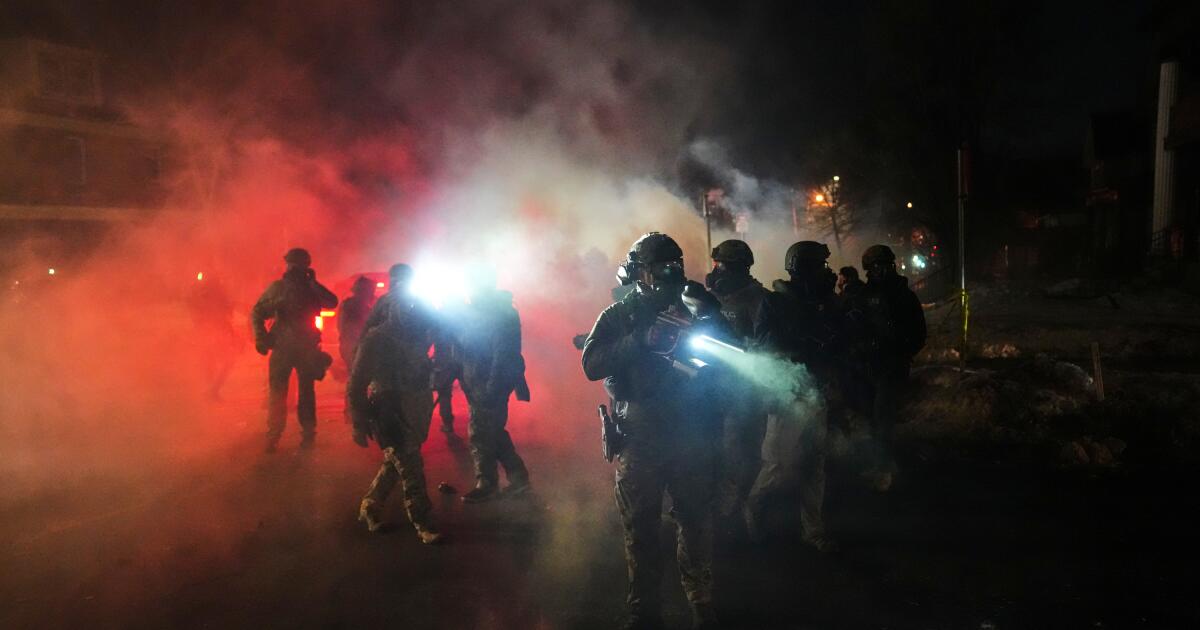
President Trump threatened Thursday to invoke the Insurrection Act as part of his crackdown on immigration, blaming Democratic politicians in Minnesota who have opposed Immigration and Customs Enforcement agents’ presence in the city and decried their violence against protesters.
“If the corrupt politicians of Minnesota don’t obey the law and stop the professional agitators and insurrectionists from attacking the Patriots of I.C.E., who are only trying to do their job, I will institute the INSURRECTION ACT,” Trump wrote in a post on his social media website.
The president made his threat a day after a federal immigration officer in Minneapolis shot an undocumented immigrant from Venezuela in the leg. The agency said the man, whom they identified as Julio Cesar Sosa-Celis, was one of three men who attacked federal officers with a shovel and a broom as an altercation broke out after federal agents tried to complete a targeted traffic stop.
“What we saw last night in Minneapolis was an attempted murder of federal law enforcement,” Homeland Security Secretary Kristi Noem said in a statement. “Mayor Frey and Governor Walz have to get their city under control. They are encouraging impeding and assault against our law enforcement which is a federal crime, a felony. This is putting the people of Minnesota in harm’s way.”
If Trump invoked the Insurrection Act — a 200-year-old constellation of statutes that grant the president emergency powers to thrust active-duty soldiers into civilian police duty — he could bring in federal troops to squelch protests. But scholars argue his legal standing is “wildly tenuous.”
“The president has threatened to invoke the Insurrection Act so many times it can be difficult to distinguish between a real threat and a false alarm,” said Elizabeth Goitein, senior director of the Liberty and National Security Program at New York University’s Brennan Center for Justice.
Other experts cautioned this time could be more serious.
“I think he’ll do it,” Kevin Carroll, former senior counsel in the Department of Homeland Security during Trump’s first term, said Thursday. “It could be tomorrow. The next time there’s a serious incident and a protest that gets a little unruly, they’ll invoke the Insurrection Act.”
Tension has swelled in the Minnesota city in the last week since an ICE agent shot Renee Nicole Good, a woman who was part of a group observing ICE activity, in the head.
Good, a 37-year-old mother of three, was killed as she took part in an “ICE watch” protest documenting federal immigration activity, after three ICE agents surrounded her SUV on a street.
Bystander videos shows one immigration officer ordering Good out of the vehicle and grabbing the door handle as another agent, Jonathan Ross, positions himself in front of her vehicle. As she begins to move the SUV forward and turn the steering wheel away from Ross, he raises his weapon and fires at least three shots at close range. Then, Ross curses at Good and walks away.
Ross suffered internal bleeding to his torso from the encounter, according to a statement from Homeland Security officials provided to the Associated Press.
“I would say that our agent is beat up, he’s bruised, he’s injured, he’s getting treatment,” Noem told reporters Thursday. The agency, she said, was “thankful that he made it out alive.”
After Good was fatally shot, Minneapolis Mayor Jacob Frey, a Democrat, told ICE to “get the f— out of Minneapolis” and dismissed federal claims that its officers killed Good in self-defense as “bulls—.” Still, he has urged residents to act peacefully, warning them Trump could bring in troops.
Minnesota Gov. Tim Walz has also spoken out against ICE, accusing the federal government of waging “a campaign of organized brutality against the people of Minnesota” and calling on them to “end the occupation.” This week, state Atty. Gen. Keith Ellison filed a federal lawsuit against the Department of Homeland Security, asking the court to block the “unprecedented surge” of agents into the state and declare it unconstitutional and unlawful.
U.S. Deputy Atty. Gen. Todd Blanche, in turn, accused Minnesota’s Democratic leaders of encouraging violence against law enforcement. “It’s disgusting. Walz and Frey — I’m focused on stopping YOU from your terrorism by whatever means necessary,” he said in a statement. “This is not a threat. It’s a promise.”
On Thursday, Walz appealed directly to Trump.
“Let’s turn the temperature down,” the governor said on X. “Stop this campaign of retribution. This is not who we are.”
Noem told reporters Thursday that the federal government had no plans to pull out of Minnesota. She confirmed she had discussed invoking the Insurrection Act with Trump.
“He certainly has the constitutional authority to utilize that,” she said. “My hope is that this leadership team in Minnesota will start to work with us to get criminals off the streets.”
Legal scholars say Trump’s authority is far from clear.
Despite regularly name-checking the Insurrection Act as far back as his first term, Trump fastidiously avoided invoking the law, relying instead on an obscure subsection of the U.S. Code to surge federalized troops into Los Angeles, Portland, Ore., and Chicago in 2025.
But an emergency docket decision from the Supreme Court days before Christmas in effect neutered that move. Citing an outré legal theory by the preeminent scholar Martin S. Lederman of Georgetown Law, the justices ruled 6 to 3 that the president would functionally have to invoke the Insurrection Act before his preferred statute could be used.
The administration quickly dropped its ongoing court battles and sent home the remaining federalized troops. At the same time, it announced a flood of aggressive new immigration enforcement in Minneapolis, which set off waves of protests across the city.
“It does feel like ICE is trying to trigger the conditions that would give rise to a reasonable application of the Insurrection Act,” said Eric J. Segall, a professor at Georgia State College of Law.
Other experts, however, are skeptical that Trump is any more serious about invoking the act than he has been in the past.
“I think the strategy is to try to get some sort of concessions and then say his toughness provoked the concessions,” said Harold Hongju Koh, a professor at Yale Law School. “If it gets worse he’ll blame it on Walz and if it gets better he’ll take credit.”
A poll released Thursday by the analytics firm YouGov showed that most Americans oppose deploying the military in response to domestic unrest. A survey of 3,752 U.S. adults found that 51% oppose and 34% support deploying the military to Minnesota, the company said. An even higher percentage, 56%, oppose the military being deployed to their own area.
Another reason the administration has so far shied away from the move is that its requirements are legally stringent — especially in cases where state and local officials oppose its use.
“The irony is if he wants to invoke the Insurrection Act, he has to say [Minnesota lawmakers] are like the Confederacy, that they’re trying to break away from the country,” Koh said. “Disagreeing with the way his ICE agents act is not the same as wanting to break away from the United States.”
Goetein agreed. The law is intended for situations where state and local authorities are overrun and request assistance or “where state and local authorities themselves are obstructing federal law,” she said.
“State and local law enforcement are not physically impeding ICE officers,” Goetein said. “They are not in any way obstructing the enforcement of immigration law.”
Some scholars fear Trump could invoke the act anyway, using the situation in Minneapolis as “a model” to provoke protest, label it insurrection, and use the law to deploy troops to blue cities across the country ahead of the 2026 midterm elections.
“The argument the Trump people will use is that there’s an ongoing insurrection in Minneapolis or anywhere else and therefore elections can’t be held,” Carroll said. “I think we’re nearing the greatest constitutional crisis since the Civil War.”
Should Trump invoke the act in California, its attorney general, Rob Bonta, said the state is prepared.
“The invocation of the Insurrection Act is a scenario we’ve been planning for — since even before the 2024 election,” Bonta said in a statement. “We’ll have to wait and see what the President does and how he does it, but we’re ready.”