
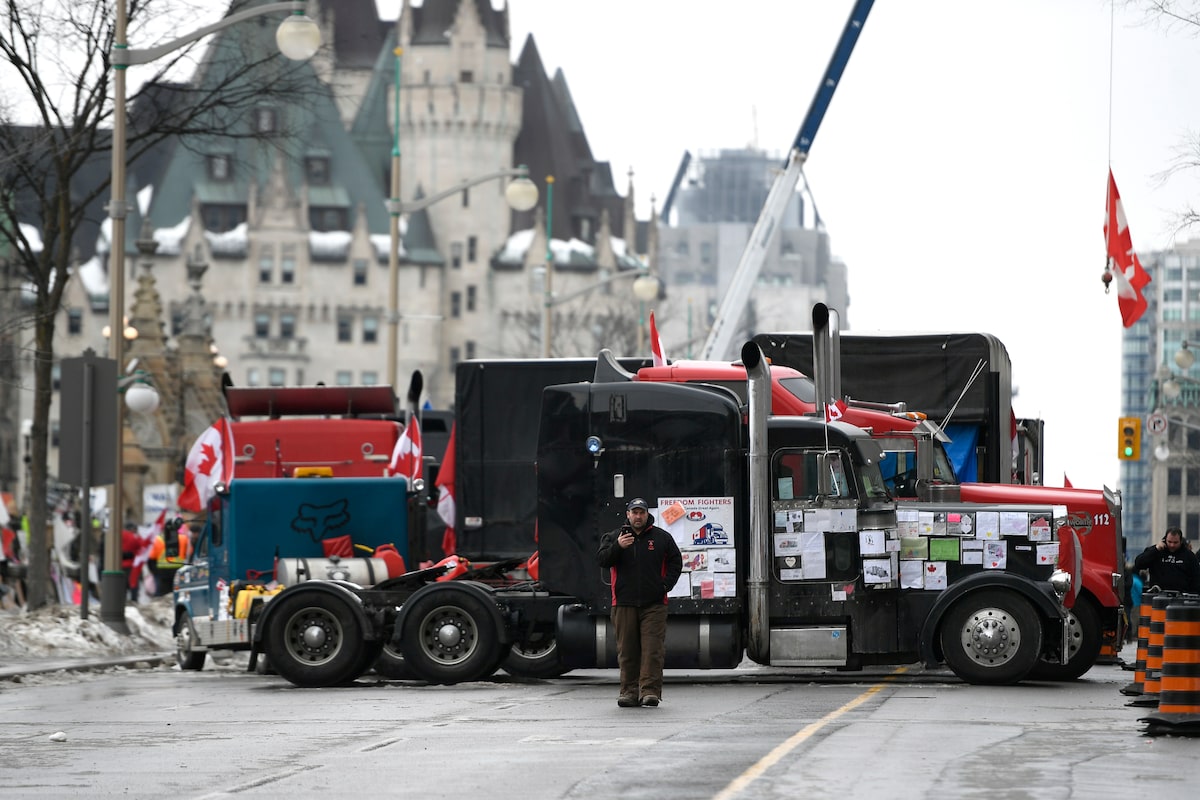
Convoy protesters in 2022 staged a weeks-long demonstration that gridlocked the city of Ottawa over the federal government’s pandemic measures.Justin Tang/The Canadian Press
The Federal Court of Appeal on Friday morning ruled that the Trudeau government’s 2022 invocation of the Emergencies Act in response to the weeks-long trucker protests in Ottawa and elsewhere was not legally justified.
Friday’s decision upholds a ruling from the Federal Court two years ago, which the federal government lost and subsequently appealed.
The appeal court was unanimous, from a panel of three judges, including Chief Justice Yves de Montigny. The judgment, in a rarely used move, was signed: “The Court.”
“The Federal Court correctly determined that the declaration of a public order emergency was unreasonable,” stated the appeal court on Friday of the previous ruling in early 2024.
Invoking Emergencies Act wasn’t justified and infringed on Charter rights, Federal Court rules
The appeal court also said the previous judgment was correct to rule that the use of the Emergencies Act infringed on the Charter of Rights and Freedoms: freedom of expression and the protection against unreasonable search or seizure.
The Canadian Constitution Foundation, a Calgary-based advocacy group that was among those who challenged Ottawa in court and won, said the appeal court ruling “sends a powerful signal to future governments.”
“It’s not an exaggeration to say this decision is about the principles of democracy,” said Joanna Baron, executive director of the foundation, in an interview.
The federal government did not immediately comment on the ruling.
In the winter of 2022, hundreds of protesters drove semi-trailer trucks to Ottawa and parked them there. They were angry over government vaccine mandates, which had been imposed in response to the COVID-19 pandemic, and aggrieved with the federal government generally.
The protests, billed as the Freedom Convoy, involved large rigs and people parked around Parliament Hill and surrounding streets. They gridlocked parts of central Ottawa. Some residents described feeling harassed and terrorized as truck drivers blared their horns, sometimes late into the night. Some border crossings with the United States were affected as well.
On Feb. 14, 2022, the federal government, under then-prime-minister Justin Trudeau, for the first time ever invoked the Emergencies Act, citing a threat to the security of Canada.
An Ottawa police vehicle blocks off Kent Street in front of parked trucks during the ‘Freedom Convoy’ protests in Ottawa on Feb. 6, 2022.Justin Tang/The Canadian Press
Invoking the Emergencies Act allowed the government extraordinary temporary powers, including the prohibition of citizens assembling in public and the freezing of bank assets related to the protests. The act became law in 1985 and included stricter rules to be deployed than the previous War Measures Act.
Still, the powers of the Emergency Act “amount to a temporary amendment of the Constitution in times of national emergency,” the appeal court said Friday in a summary of its 185-page judgment.
“The government did not demonstrate that it had reasonable grounds to believe that a threat to national security or a national emergency existed within the meaning of the Act, or that existing laws were unable to resolve the situation,” the summary stated.
In the appeal court judgment itself, the earlier conclusions of the Federal Court about how the situation could have been handled without the use of the Emergencies Act are reiterated.
The appeal court notes that the Federal Court found that it was not clear why tow truck drivers could not be compelled to help move parked semis in Ottawa under provincial legislation. The Federal Court also saw no obstacle in assembling large numbers of police officers from outside of Ottawa to help Ottawa Police remove blockade protesters.
The Federal Court further said it was debatable whether Ottawa Police couldn’t enforce existing laws because there were too many protesters, or “whether it was instead due to a failure of leadership and determination.”
A public inquiry, which is required by law after the use of the Emergencies Act, was held in 2022. In a report released in February, 2023, Justice Paul Rouleau concluded that the use of the act was appropriate but also said it could have been avoided if not for earlier mistakes made by police and government officials.
Five key take-aways from the Emergencies Act inquiry’s final report
Justice Rouleau found those errors were committed by a range of key players, including the Ottawa Police Service, Ontario Premier Doug Ford and Mr. Trudeau.
“I have concluded that in this case, the very high threshold for invocation was met. I have done so with reluctance,” Justice Rouleau wrote in the conclusion to his long report.
He remarked that the facts underpinning his conclusions weren’t overwhelming and said reasonable and informed people could reach a different conclusion.
A year later, the Federal Court did so.
Several advocacy groups – the Canadian Civil Liberties Association, the Canadian Constitution Foundation and others – had launched the legal challenge.
In January, 2024, Federal Court Justice Richard Mosley ruled that Ottawa’s decision did not “bear the hallmarks of reasonableness” and the federal government had failed to prove there was an actual emergency, as defined in law.
Justice Mosley concluded that Ottawa “cannot invoke the Emergencies Act because it is convenient, or because it may work better than other tools at their disposal or available to the provinces.”
A protester dances on a barrier in front of vehicles and placards on Rideau Street in Ottawa, during a protest against COVID-19 measures, on Feb. 16, 2022.Justin Tang/The Canadian Press
Friday’s Federal Court of Appeal decision will probably be appealed to the Supreme Court of Canada, according to legal experts, as Ottawa seeks to preserve the ambit for the exercise of executive power even after two losses in court.
The top court accepts only a small fraction of the proposed appeals presented to it but is often interested in those that involve complicated questions of public law, such as the Emergencies Act. However, it is possible that with two clear decisions in the lower courts, the top court may be less interested in hearing the case.
An appeal application to the Supreme Court must be filed by mid-March. A decision thereafter on whether to hear the case is not likely before the fall. If the top court hears the case, a final ruling would probably not arrive until 2028.
In a potential appeal to the Supreme Court, the question of earlier commentary on the trucker convoy from Chief Justice Richard Wagner of the top court may come to the fore.
In May, 2022, a group of about a dozen people, mostly lawyers, filed a complaint to the Canadian Judicial Council after Chief Justice Wagner did an interview with Montreal’s Le Devoir that April. In the interview, the Chief Justice likened the Ottawa protests to the initial stages of anarchy – “c’est un petit début d’anarchie,” he was quoted as saying – and said he found that worrying.
The complainants alleged that the commentary fit within the legal definition of a reasonable apprehension of bias, given that the case could eventually make it to the top court.
A month later, the judicial council’s acting executive director at the time, Jacqueline Corado, dismissed the complaint. In a written response she said it was “manifestly without substance” and called it a hypothetical scenario. She noted that if the case ended up at the Supreme Court, the parties involved would have to raise any concerns of bias.
Beyond the commentary to Le Devoir, Chief Justice Wagner in mid-June of 2022, at his annual press conference, also addressed the protests, in response to a question.
“You asked what impact that had on us: Obviously, like any other residents of Ottawa, it was deplorable,” he said at the press conference in French in remarks relayed in English by a translator.
“For several weeks, business closed, people lost their jobs, work was much harder for many people, especially for the most vulnerable. And I think this kind of situation should never happen again.”