
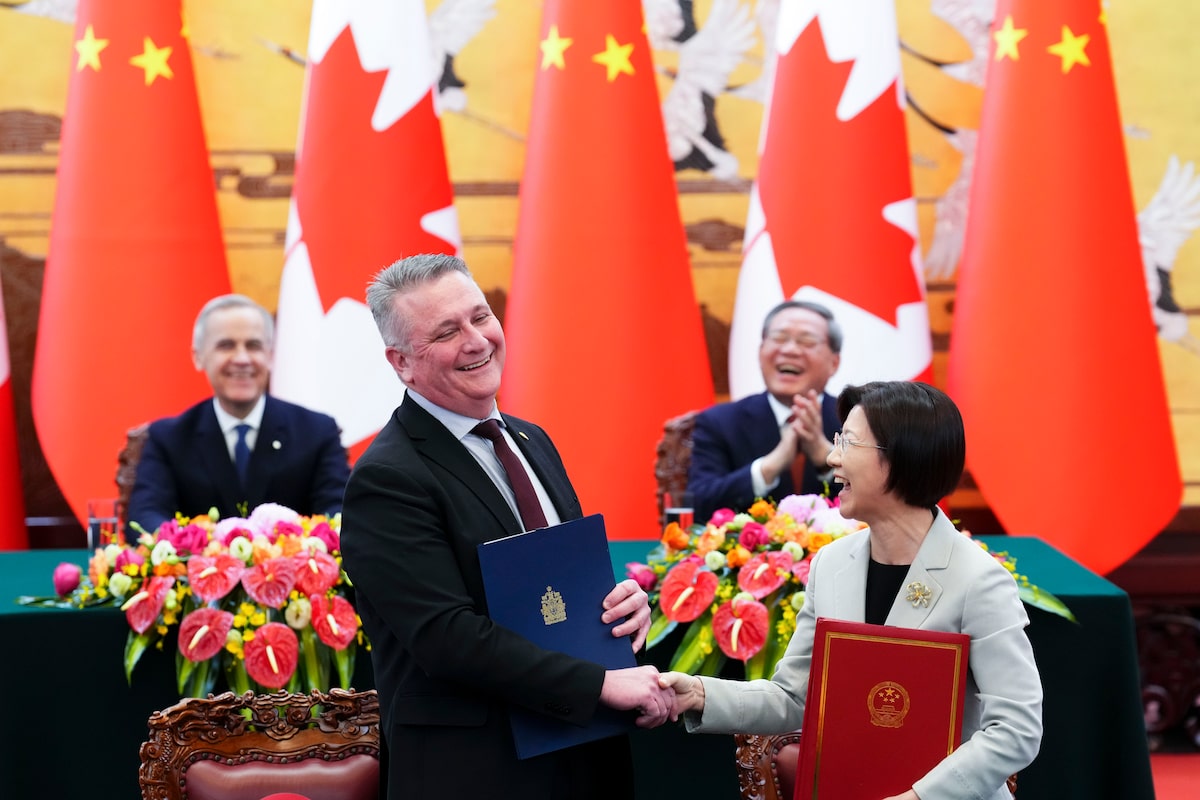
Prime Minister Mark Carney, back left, and Premier of China Li Qiang, back right, look on as Minister of Agriculture and Agri-Food Heath MacDonald, front left, and Sun Meijun, Minister of the General Administration of Customs in China, take part in a signing ceremony at the Great Hall of the People in Beijing, on Thursday.Sean Kilpatrick/The Canadian Press
The Canadian Food Inspection Agency has agreed to work more closely with China on food safety, a significant pivot for two countries whose political battles often manifest in agricultural trade disputes.
A memorandum of understanding, signed by both governments in Beijing Thursday, pledges to “enhance long-term co-operation and co-ordination on food-safety and animal and plant health matters.”
Prime Minister Mark Carney is visiting China in a bid to reset the relationship between the two countries and increase trade, and the MOU is a meaningful step toward this goal, say legal and food-safety experts.
According to the MOU, the CFIA and China’s customs agency will create technical working groups who will meet biennially to disclose information about existing and new food-safety laws, share new research and technology, and work through thorny or urgent food-safety concerns and differences.
“Everyone understands that these MOUs serve an important political function,” said Rambod Behboodi, international trade lawyer at Borden Ladner Gervais LLP. “Having them is better than not having them, and signing them gives a chance for countries to indicate that they are not enemies.”
Lawrence Martin: Rebuilding relations with China is a gamble Mark Carney has to take
Canada and China’s food trade has been fraught over the past few years as tensions between the two countries worsened.
In March, China slapped 100-per-cent tariffs on canola oil and meal in retaliation for Ottawa’s levies on Chinese-made electric vehicles. Beijing followed up on this move with 75.8-per-cent tariffs on canola seed in August.
China said that Canadian producers were dumping the crop into their market. However, the country has since explicitly tied these measures to Canada’s trade barriers. China’s trade restrictions also targeted pork, seafood and peas.
It was not the first time that Beijing targeted canola. In 2019, it also restricted imports from two major Canadian grain companies. While Beijing cited food-safety concerns, it was widely considered retaliation for the RCMP’s arrest of Huawei executive Meng Wanzhou. These restrictions lasted for three years.
An MOU will not solve these geopolitical tensions, said Mr. Behboodi. But working groups create channels of communication and provide an “escape hatch” for politicians, he said.
Opinion: How Canada can use China to deliver a counterpunch to Trump
Political figures can discuss the issue, both can “insist on the rightness of their position,” and then promptly pass responsibility to scientific working groups who will resolve the dispute without either country losing face.
“The technical framework is used as a way of moving the issue out of the political basket and into the technical basket, where it gets resolved,” he said.
More communication between scientists is also necessary to quell the spread of disease, said University of Guelph food-safety researcher Keith Warriner.
Viruses will take advantage of a chasm between scientists, he said, pointing to African swine fever, a virus deadly to pigs, as an example. If ASF infiltrated Canadian pork farms, the industry would be “finished.” An outbreak in China in 2018 spread across all mainland Chinese provinces within eight months, 130 million hogs died or were culled, and prices for China’s dominant protein doubled.
Canadian scientists need to know what is happening to protect domestic industry, Mr. Warriner said.
Increased communication between food-safety agencies will also streamline trade diversification, he said.
Canada-China talks on reducing canola tariffs have been fruitful, Anand says
A working group could iron out the food-safety standards for new products or food created using new technologies. In this way, experts say, Canada’s MOU with China could help to decrease trade reliance on the U.S. In October, the Prime Minister pledged to double non-U.S. trade within a decade.
“If we’re going to increase trade, we need exchange of information,” Mr. Warriner said.
This applies to imports of Chinese food, said Lawrence Goodridge, director of the Canadian Research Institute for Food Safety. Should Chinese imports increase, the CFIA will need to take steps to ensure they are safe.
Unlike trading partners such as Australia or the European Union, where national agencies publish information online, information from China is difficult to obtain.
This MOU could be the first step to more information sharing but, as was stipulated in the agreement, it is not legally binding and the establishment of a working group is subject to available funding and resources. Ottawa has announced sweeping cuts across all federal agencies.
“We need to take a risk-based approach to foods that we are importing into Canada,” Mr. Warriner said. “It is well and good to establish these committees but at a time when we’re also cutting back in terms of budget, is there going to be the person power to do that?”