
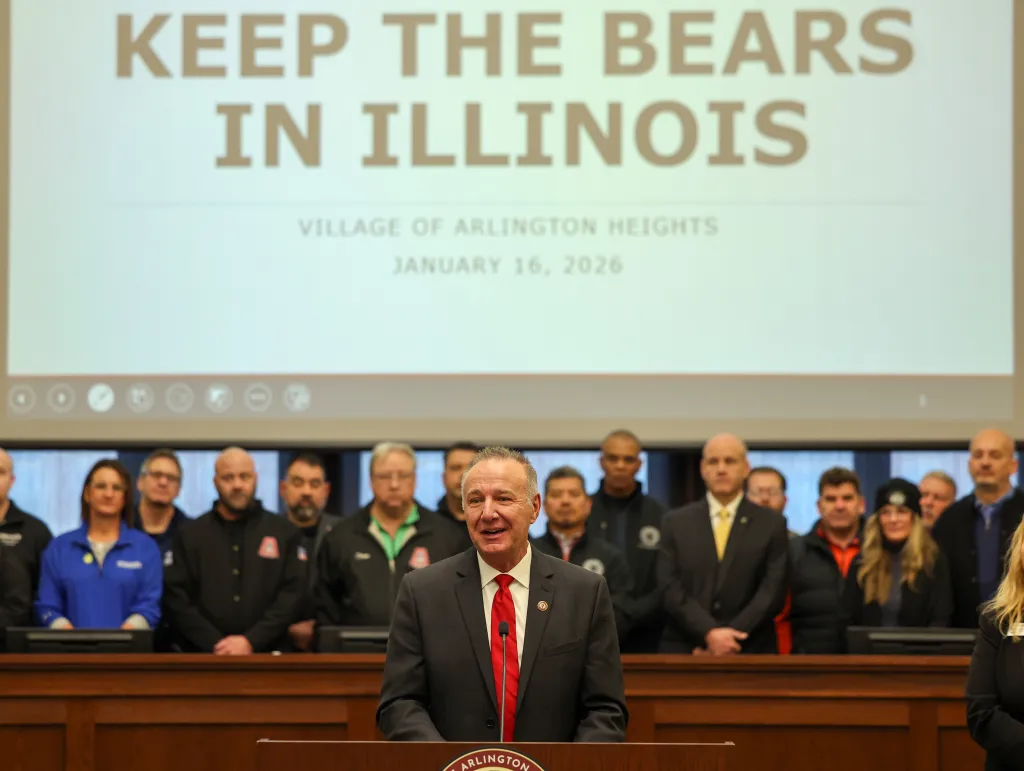
Arlington Heights officials called Friday for Illinois lawmakers to get moving on a proposed new Chicago Bears stadium in the northwest suburb — even as Indiana lawmakers introduced a bill to draw the team to their state.
Arlington Heights Mayor Jim Tinaglia warned that without legislation to let the Bears negotiate property taxes for the stadium, the team may move across the border, warning, “We cannot fumble this opportunity.”
What to know about the Chicago Bears’ possible move from Soldier Field
In Indiana, lawmakers introduced a bill last month to create a northwest Indiana stadium authority to acquire and finance sports facilities. Indiana previously created a commission to look into attracting professional sports teams to northwest Indiana, but the new proposal would go further to potentially provide money for the deal.
The measure was assigned Thursday to the Committee on Appropriations.
Indiana Gov. Mike Braun, in his State of the State address Wednesday, said his administration was “working hard” to attract the Bears. “Let’s get it across the finish line,” he said.
In response to the new legislation, the Bears quickly issued a statement: “The legislation presented by the State of Indiana is a significant milestone in our discussions around a potential stadium development in Chicagoland’s Northwest Indiana region. We appreciate the leadership and responsiveness of Governor Braun and Indiana lawmakers in advancing a framework that allows these conversations to move forward productively.”
Arlington Heights officials called a news conference Friday and issued an open letter to Illinois lawmakers, urging them to pass a “Mega Projects bill” that would let large developers — not just the Bears — negotiate long-term property taxes with local schools and other taxing bodies.
“We must stand together as Illinoisans to prevent our State from being out of the NFL business altogether, and support the Mega Projects Bill,” Mayor Tinaglia wrote. “The Chicago Bears should not get special treatment just because they are ‘the Bears,’ but they shouldn’t have it held against them, either. They should be treated the same as any other entity.”
Without the bill, the Bears might be on the hook for an annual tax bill of $100 million to $200 million, which would kill the deal, Tinaglia said.
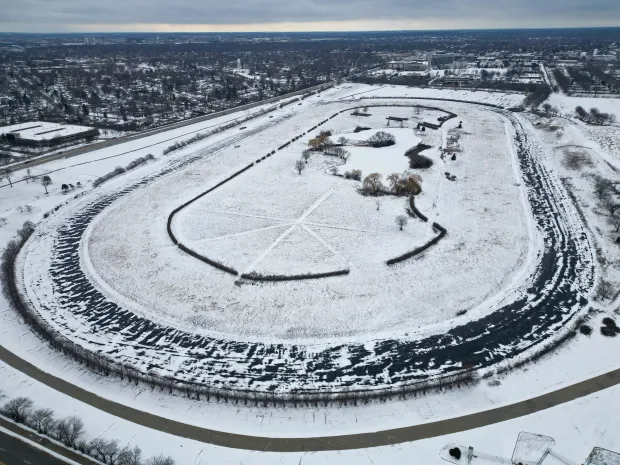 The former Arlington International Racecourse is covered in snow on Jan. 16, 2026, in Arlington Heights. The entire 326-acres site is owned by the Chicago Bears and is being considered as a location for the team’s new domed stadium and entertainment district. (Stacey Wescott/Chicago Tribune)
Currently, the Bears and Chicago White Sox pay zero property taxes on their stadiums, because they are publicly owned. The Cubs pay about $3 million a year, and the Bulls and Black Hawks about $6 million annually, according to an analysis by former state Rep. Mark Batinick.
The highest property tax bill in the country for a sports stadium is $8 million a year for SoFi Stadium outside Los Angeles, Tinaglia said. The mayor emphasized that the Mega Projects bill would not cost the state anything.
However, the Bears are asking the state to help pay for infrastructure, such as new expressway ramps and other road, rail and utilities work, which could cost an estimated $855 million.
A team consultant estimated the project would create 33,000 construction jobs, plus $11 billion in economic activity, plus more than $1 billion a year annually thereafter, with a domed stadium allowing year-round shows and concerts, and occasional special events like a Super Bowl or college sports championships that now go elsewhere.
Economic studies generally have contradicted such projections, repeatedly finding that sports stadiums are bad public investments.
But the competition between two states can drive both sides to make deals they might not otherwise offer.
The Kansas City Chiefs football team recently agreed to move from Missouri to Kansas for a new publicly-subsidized stadium.
After voters in Missouri rejected a sales tax extension for new stadiums, Kansas lawmakers agreed to pay for 60% of the cost of a $3 billion domed stadium with sales and other taxes. That amounts to $1.8 billion — the largest pro sports subsidy ever.
That deal came after Washington, D.C., dedicated $1 billion for the Commanders football team to move there from a suburb in Maryland.
J.C. Bradbury, an economics professor at Kennesaw State University in Georgia and a leading critic of publicly subsidized stadiums, previously told the Tribune, “In general, sports stadiums are never a good deal for taxpayers, no matter how the funding is laundered on behalf of the team. Sounds like a new shade of lipstick on the same old pig.”
Illinois Gov. J.B. Pritzker and state legislative leaders have opposed spending money to build a Bears stadium, and the team has said they would pay for the $2 billion dome themselves — the largest private development in the history of the state.
But the governor and House Speaker Emanuel “Chris” Welch have said they are open to having the state pay for infrastructure.
Welch previously called the Bears’ proposal “insensitive,” but this week told WGN-TV that passing the Mega Projects bill would be helpful to keep the Bears in Illinois.