
In the small, northeastern New Brunswick city of Bathurst, homelessness was not even on the radar a few years ago. Today the city of 15,000 is working on opening a 40-bed homeless shelter.
The quaint southwestern Saskatchewan city of Yorkton recently expanded its new emergency shelter to meet growing demand.
And in the remote British Columbia community of 100 Mile House, the town council just bought a specialized firefighting bush truck, to mitigate the risk of out-of-control blazes from homeless people increasingly setting up camp in the surrounding forest.
The surging reality of rural homelessness was highlighted in a new report this week from the Association of Municipalities of Ontario, which provided a rare statistical glimpse of a crisis that has historically been difficult to quantify.
According to the AMO report, 85,000 people were identified as experiencing homelessness in the province last year, 12,800 of whom were in rural and northern areas. That’s an increase of 31 per cent for rural areas, and 37 per cent for northern communities since 2024 (compared with an increase of 7.8 per cent for homelessness across the province as a whole).
Indigenous people were also significantly overrepresented, making up less than 3 per cent of the total Ontario population, but accounting for more than 13 per cent of those experiencing homelessness.
Surging homelessness has corresponded to increased strain on the emergency department in Medicine Hat, Alta.AHMED ZAKOT/The Globe and Mail
It is a crisis that is touching small and rural municipalities across the country, The Globe and Mail has found. Converging national crises of housing affordability, mental health and addiction have left advocates, local politicians and front-line workers in rural communities and small towns grappling with rates of homelessness that they are totally unequipped to manage.
Terrilee Kelford has been volunteering with homeless youth in Lanark County, Ont., for the past 25 years. As chair of the newly formed Rural Alliance to End Homelessness, she is hearing the same distressing stories over and over from her members, no matter where they are in the country.
“There are people sleeping outside in small towns across the country,” she said. “For years, folks even from rural communities would argue with me about the existence of rural homelessness – and that is no longer an issue.”
At the national level, Canada’s homelessness crisis is measured through point-in-time counts, which provide a co-ordinated one-day snapshot from dozens of communities across the country. In 2024, the most recent count, nearly 60,000 people in 74 communities across Canada were identified as experiencing homelessness on a given day – a 79-per-cent increase since the previous count, which took place between 2020 and 2022.
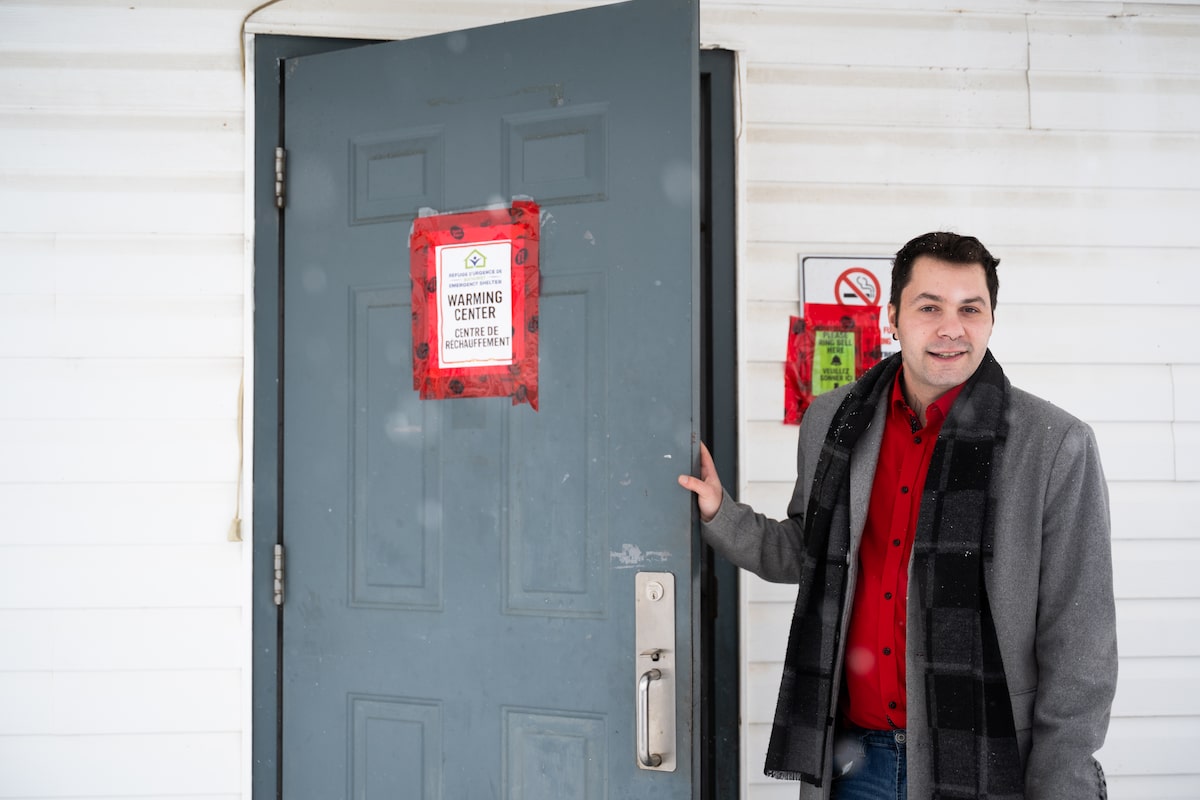
Elie Bérubé stands at the entrance of the warming centre in Bathurst, N.B. The temporary warming centre, housed in the Sainte-Anne Recreation Centre, was opened to fill the extra need, but the patchwork approach didn’t go far enough to address the dramatic rise in homelessness.
Ranz Bontogon/The Globe and Mail
The number of people who were unsheltered, specifically – which includes those sleeping on city streets or in tents or abandoned buildings, as opposed to in a shelter bed or a transitional housing program – had increased by 107 per cent.
“What we have is an unparalleled natural disaster unfolding on our streets,” Tim Richter, executive director of the Canadian Alliance to End Homelessness, said.
“It’s just at such a state that it’s becoming apparent everywhere.”
The New Brunswick city of Bathurst is a hub for small fishing towns and rural communities that dot the coast on the Chaleur Bay, overlooking Quebec’s Gaspé Peninsula.
In the past few years, it’s also become a hub for homelessness.
Mayor Kim Chamberlain said the city’s current 10-bed shelter for the population of 15,000 people is no longer adequate. Sixty-one people were counted as not having a place to sleep one night last fall, and there are likely more. Encampments in rural areas are often hidden in the woods to avoid complaints and police intervention, said Jennifer Pitre, director of community development for the Chaleur Regional Service Commission.
Bathurst Mayor Kim Chamberlain says the city’s small shelter is no longer adequate to serve the community of 15,000 given the dramatic rise in homelessness.Ranz Bontogon/The Globe and Mail
For the past few years, the city has scrambled to find a location for a temporary warming centre to fill the extra need, but the patchwork approach didn’t go far enough to address the dramatic rise in homelessness, Ms. Chamberlain said.
Safety was the biggest concern. Ms. Chamberlain worried that someone would die in the cold or from a fire. People have died in tent fires at encampments in cities across the country, including one this week in Sudbury – one of many northern Ontario communities struggling with rising homelessness.
In the hot, dry summer, Ms. Chamberlain said the local fire department was checking on unhoused people to ensure they had water.
She says the city asked the province for help and received $1-million for a new 40-bed shelter.
“We wanted to make sure we that we’re here for our people that are here locally and if someone from another city comes in, we won’t turn them away,” she said. “But at the same time when we meet with them, we try to find out: Do you have family, do you have friends?”
When Gladys Atrill was growing up in Smithers, B.C., she remembers being aware that a few people in her picturesque northern town of about 5,000 were “living rough.”
Smithers Mayor Gladys Atrill. Opposite the town hall is a homeless camp, where 20 to 30 people are living at any given time.Supplied
Now, as the mayor of that town decades later, homelessness has become one of her biggest challenges.
The town, located 1,000 kilometres north of Vancouver, has a homeless camp right opposite town hall where between 20 and 30 people are typically living. They are only the most visible of the town’s unhoused residents, which numbered 77 in last year’s point-in-time homeless count − all but nine of them living outdoors. The count in 2018, before B.C.’s fentanyl and illegal-drug crisis permeated every corner of the province, before COVID-19, was 29.
Last year, Ms. Atrill and her council hired a second community-safety officer for the town, and contracted with private security to monitor the camp.
They also have been working with the non-profit operator of a new 10-bed shelter downtown, in spite of some concerns about the location and community opposition. And they’re working with BC Housing in hopes of getting a brand-new housing project with 40 apartments that would come with supports for health, addiction, and other issues homeless people often face, along with 20 shelter beds.
Once a week, council participates in a “situation table,” helping to make decisions about how to fill available beds, respond to disruptions and provide treatment to those in need.
“We have been able to move some people through and off the street,” the mayor said.
Ms. Atrill says she tries not to disparage homeless people or make light of their struggles, as has become increasingly common among some residents who have grown frustrated. But she acknowledges that the accompanying public disorder and crime has scarred residents and business owners in the town.
Across northern and rural B.C., city councils, businesses and residents say they are trying desperately to come up with workable remedies as homelessness has doubled or tripled some communities in the past decade. Indigenous people often make up a huge proportion of those who are homeless. In Smithers, the rate is 87 per cent. In Quesnel, 59. In Campbell River, 58.
Small municipalities are pouring more of their limited resources into addressing the issue. In 100 Mile House, the council bought a specialized firefighting bush truck for $200,000 because homeless people there tend to live in the forest nearby, rather than in town where there is no shelter or any real service. In Salmon Arm, the town has given land for a new housing project. Williams Lake has put an extra $100,000 annually into policing to try to maintain public order, as well as hiring a wellness co-ordinator.
Dr. Paul Parks, who works in the emergency department at Medicine Hat Regional Hospital, says people regularly come into the ER because they are homeless.AHMED ZAKOT/The Globe and Mail
Surging homelessness has corresponded to increased strain on the emergency department in Medicine Hat, Alta., where Dr. Paul Parks said he routinely sees people coming in because they are homeless, including from many surrounding rural communities.
The latest PiT count identified 102 people experiencing homelessness in the city of roughly 65,000.
It is a distressing turn for the city, which in 2021 made headlines across the country after achieving “functional zero” levels of homelessness (meaning no more than three people were experiencing homelessness for three straight months).
Dr. Parks, who joined the emergency department at Medicine Hat Regional Hospital in 2009, as the city was launching a plan to end homelessness, said that while economic insecurity is a driving force behind the crisis, mental health care is nowhere near adequate.
“There’s a certain population within there that have severe mental illness that can’t go into any of the Housing First programs, can’t go into any of the kind of independent living supports that are getting created. And so then they get into this vicious cycle … in and out of the emerg,” he said.
“We try our best but we’re set up to fail.”
Dr. Parks says mental health care is nowhere near adequate to address the homelessness crisis in the city.AHMED ZAKOT/The Globe and Mail
When the Manitoba government announced a plan to end chronic homelessness earlier this month, Jan Marie Graham was disappointed to discover virtually all of the efforts were focused in Winnipeg.
“We need to start talking about how homelessness in Manitoba is a widespread phenomenon not just in Winnipeg, but also in Thompson, in Flin Flon, in The Pas, in Ashern, and Pine Falls, and Dauphin, and Selkirk,” the associate professor at Brandon University’s nursing department said.
Prof. Graham, who has authored studies on homelessness in the province, pointed out how, in Portage la Prairie – the colloquial “Island on the Prairies,” an hour’s drive west of Winnipeg – at least two dozen people have had no choice but to sleep in routinely frigid, -40 C weather at an encampment under a local bridge because there is no shelter available.
Meanwhile, she added, in Brandon, the increasing population of homeless adults – at least 229 people by last count in 2024 – have forced that city to reopen a temporary warming shelter.
Prof. Graham and her fellow researchers have heard from homeless adults about the desperation they feel. They talk about going to the emergency room and saying they are suicidal to get a warm bed for the night, or even committing a petty crime to get sent to jail for a couple months during the winter.
“There are simply no options in rural parts,” Prof. Graham said. “Where are they supposed to go?”