
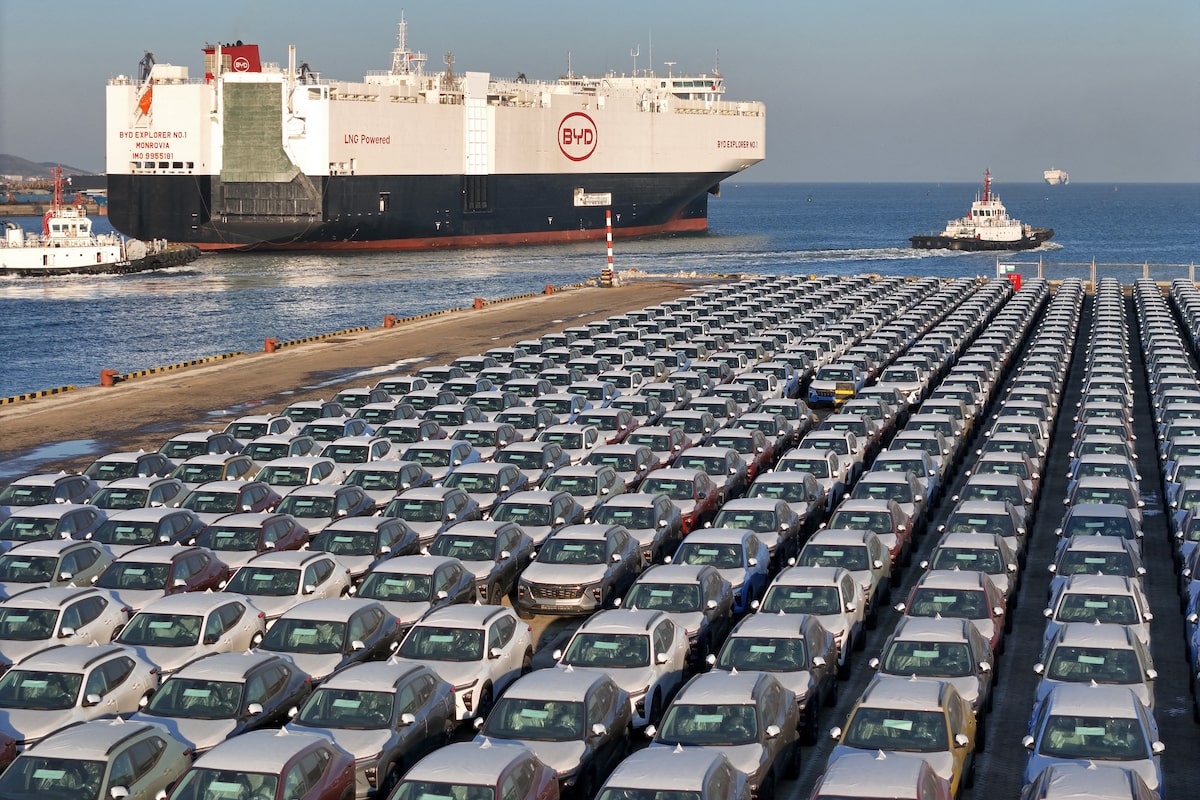
Electric cars bound for export wait to be loaded on BYD’s vessel at Yantai port, in China’s Shandong province. Canada is planning to allow nearly 50,000 Chinese electric vehicles to be imported.-/AFP/Getty Images
Ontario Premier Doug Ford says he only received a few hours notice about the federal government’s deal with China on electric vehicles, as he warned the move will hurt his province’s auto workers in the long term.
Mr. Ford on Monday continued his criticism of Prime Minister Mark Carney’s deal to allow nearly 50,000 Chinese-made electric vehicles into Canada at a low tariff rate, in return for significant reductions in Beijing’s levies on canola seed and a promised elimination of its tariffs on a host of other products.
While the deal was supported by Western and Atlantic provinces, which will see relief for their agricultural and seafood sectors, Mr. Ford has been critical of the agreement.
Carney’s tariff deal with China could risk auto-sector competitiveness, industry leaders say
Opinion: Will preferential access for foreign automakers really work?
The Ontario Premier said he and the country’s auto companies only found out about the deal a few hours before it was announced on Friday and said he’s “extremely disappointed by this decision.”
“So much for the partnership,” Mr. Ford said during a speech at the Royal Ontario Municipal Association conference in Toronto.
Mr. Ford added that he has made his opposition “very clear” to the Prime Minister.
“I’m doing so again today, because we need to be doing everything we can to support our auto workers,” he said.
He repeated his call for Ottawa to permanently scrap its EV mandate, which would require 20 per cent of all new auto sales to be zero-emission vehicles. Mr. Carney has paused the mandate for this year but has not outright cancelled it.
The Premier said the more than 500,000 people employed in the province’s auto sector are at risk.
Opinion: How Canada’s auto sector can survive its terrible, no-good, very bad year
While 50,000 vehicles is a small fraction of total auto sales, it represents 33 per cent of EV sales in Canada, he said, adding that Chinese EVs are about $15,000 cheaper than Canadian ones and the workers are paid much less.
“We get nothing but potential job losses in our factories, right across the board,” he said.
Mr. Ford added that he doesn’t believe the deal will yield any long-term benefits for his province.
“Folks, you hear there’s jobs coming. There’s no jobs coming,” Mr. Ford said.
According to a senior Canadian official, Canada is planning to reserve preferential access to its domestic auto market for foreign automakers who build vehicles under a new policy to be released in February. The official also said Canada gave advance notice to the United States of its Jan. 16 decision to part with Washington and slash tariffs on Chinese-made EVs that were imposed in tandem with the Americans in 2024. The official did not say when the advance notice to Washington was given.
The Globe and Mail is not naming the official, who spoke on Saturday, because they were not authorized to speak publicly on the unreleased auto policy. The White House did not immediately respond to a question from The Globe on Monday.
Mr. Ford said for auto manufacturers to break even, they have to produce 220,000 vehicles a year – including China.
“Well, they aren’t going to be manufacturing over 200,000 vehicles anytime soon in Ontario,” he said.
He added that the U.S. wouldn’t import Chinese cars from Canada because of possible cyber security threats.
With a report from Steven Chase in Beijing