
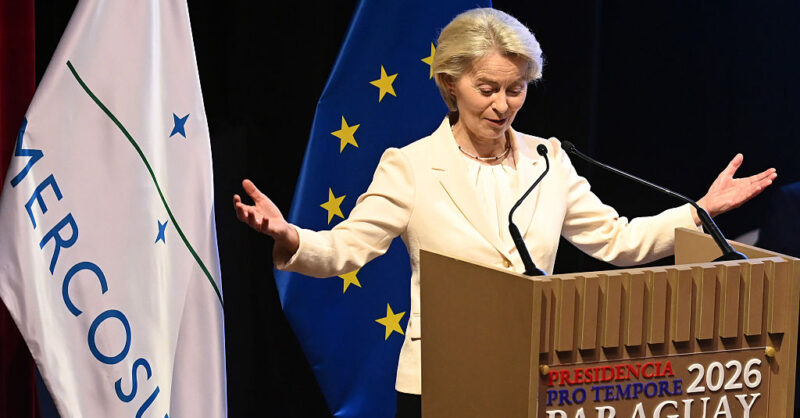
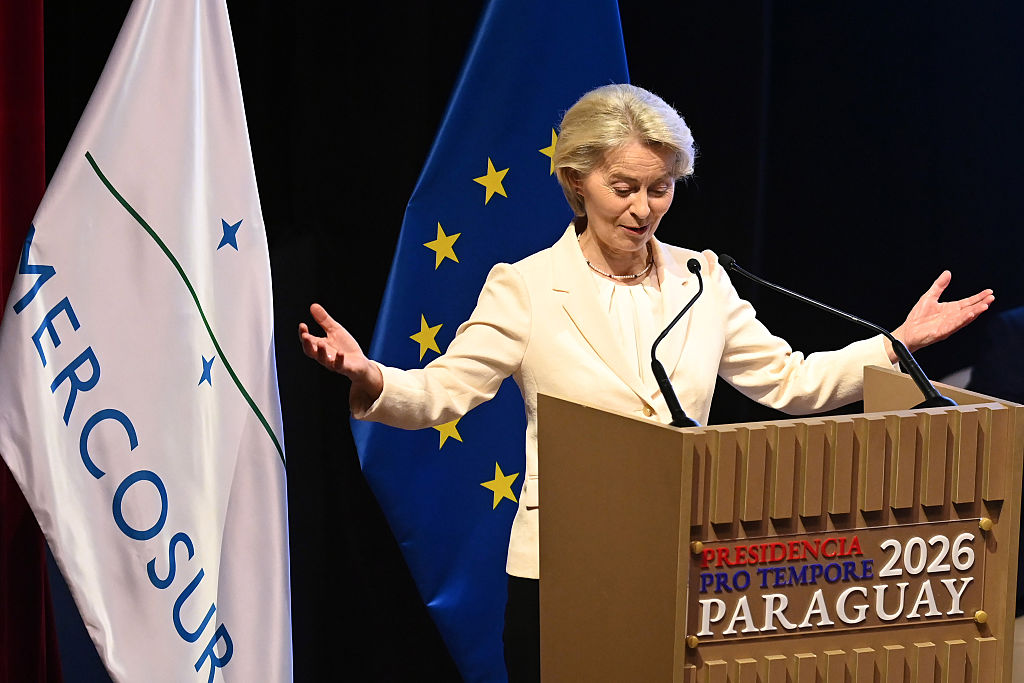
Photo by Christian Alvarenga/Getty Images
I don’t remember exactly when I first thought something was seriously wrong with the transatlantic relationship. Over the years, particularly in my time at the Hudson Institute think tank in Washington, I had many opportunities to meet and talk to the young conservatives coming up through the ranks of the Republican Party, the cohort which has now taken over the Trump administration. There certainly was something wrong then, but it took me a while to fully grasp it.
At first, I would listen to their seemingly harmless banter. There were jokes about the bureaucracy in Brussels or the long holiday breaks in Europe, the hagiography of Silicon Valley founders, and talk of the shameful absence of European counterparts. Cracks about the European propensity for too much talk and no action. The “Europoor” internet meme. Sometimes the jokes were even amusing, but at some point they turned into what seemed like a fixation. It was no longer funny. It was obvious that a powerful form of Europhobia was developing among a new generation of American elites, the kind of Europhobia today represented by the National Security Strategy issued by the Trump administration in December, in which Europe is portrayed as a civilisational enemy. It is the same Europhobia that leads secretary of the treasury Scott Bessent to go on television, as he did on 18 January, and claim that Europe projects weakness, while the US projects strength.
In retrospect, it seems to me that this political and intellectual current had an important impact on Brexit. Flowing almost unimpeded from American conservative circles to their equivalents in Britain, it helped shape the perception that the European Union was a historical loser, outdated and finished. The description of the EU as facing “civilisational erasure” through open immigration, now present in Trump’s official National Security Strategy, illuminates much about the Brexit-era fears over immigration a decade ago.
If Brexit was the first blow against the EU from a new Europhobic movement in America, we now face a second and far more serious attack. As the ideological worldviews prevalent in Europe and America continue to diverge, there is an obvious risk that the military and technological dependencies Europeans have allowed to develop may be used against them. For many decades, the West functioned as both a political and emotional community. In such a community, mutual dependence is not exploited, and partners refrain from anything that could jeopardise a shared destiny. But without the West as a political community, that logic disappears. I am told that German policymakers now lie awake at night worrying about what would happen if Trump decided to turn off the spigot of liquefied natural gas crossing the Atlantic. Germany is now more dependent on the US for energy than it ever was on Russia.

New year, new read. Save 40% off an annual subscription this January.
Warnings about the end of the world forged in 1945 are common sense, not alarmism. Donald Trump has made it clear that he wants sovereignty over Greenland, not mere access, and the announcement of 10 per cent tariffs against a number of European countries looks like an initial salvo in a campaign of economic coercion. These measures should be compared to a form of blockade during wartime, rather than the wave of tariffs announced in 2025, whose goal was purely economic.
If economic coercion fails, American troops in Greenland could attempt to prevent Danish vessels or aircraft from landing on the island. Should European countries accept the inevitability of such a move – whether a forced purchase or a military operation – any notion of European sovereignty would vanish. No one would again take either the EU or its member states seriously. After years of praising Ukraine for its courage and sacrifice in defending its sovereignty and territory, how shameful it would be if Europe were incapable of doing the same.
In the social media post announcing the new tariffs, Trump already seemed to regard European countries as no longer sovereign. The tariffs were presented as a response to a small deployment of troops from Germany, Sweden, France, Norway, the Netherlands, Finland and Britain. Trump accused them of playing a dangerous game, even though he had previously criticised them for not sending enough troops to Greenland. But why should sovereign countries be unable to participate in exercises with Denmark, the host nation, or why should Denmark be prevented from moving troops within its own territory? Bessent has argued that Europeans must accept diminished sovereignty because they are entirely dependent on Washington for their defence. This could mark the beginning of a century of humiliation. Writing in 1994, Henry Kissinger suggested it was easy to imagine a future in which Europe would lose its independence – not to Russia or China, but to the United States.
The alternative scenario is that Europeans recognise the threat and respond accordingly. This could trigger a chain of events capable of fostering a common European consciousness and, perhaps, even the birth of a European civilisational state. In reality, national or civilisational consciousness tends to emerge in opposition to other nations or civilisations – and neither Russia nor China fulfils that role. They are too distant, too weak to present what the historian Arnold Toynbee called a historical “challenge,” the psychological mechanism by which new civilisations are born. They are too foreign, too removed from European life, to compel a reckoning with fundamental questions of identity and values. America, by contrast, is a challenge – perhaps the preeminent challenge facing Europeans today, forcing them to ask what values they stand for and what sets them apart from the rest of the world.
It is in this effort to preserve itself against American power that Europe can, at long last, become Europe. First, it would need to affirm its full sovereignty in the face of the threats and ultimatums emanating from Washington. Events last year – particularly the American climbdown on tariffs on 12 May – demonstrated that only China, and perhaps India, were capable of such a stance. Scale matters: only a united Europe can safeguard European sovereignty. Second, a strategic break with the US would compel Europeans to take every existential decision into their own hands. Suddenly, the narcissism of small nations, to paraphrase Freud, would have to give way to a genuinely shared sense of belonging. American protection and tutelage have long prevented this process of consolidation.
The main obstacle to the rise of a European state is not Europe’s current military and technological dependence on the US. That dependence exists, but it flows both ways. Europe lacks financial markets deep enough to absorb its massive savings – and, as you may have noticed, Europeans are quite wealthy. Pension and investment funds across the continent have accumulated trillions in assets issued by American companies or the US government. Even the imposition of a cap on such holdings could send an already bubbly Wall Street into a tailspin. Such measures must be exercised with prudence, but in extreme circumstances they must at least be considered. What prevents European leaders from even entertaining them is less a sense of dependency than a certain mentality: an unhealthy attachment to a past that no longer exists. Ursula von der Leyen, Keir Starmer, Friedrich Merz – they may all have been among the throngs of young men and women dancing the night away in Berlin in December 1989. No one blames them for that. It is indeed a precious memory, and they should treasure it. But the music has stopped. The time has come not to wake up, but to sober up.
Until now, Europe has been caught between the priorities of its old nation states and a European Union aspiring to represent universal liberal values. These values were often labelled Western, but the ideology, hitherto shared by Europeans and Americans, still carried the illusion that it might one day become truly universal. If Europe and America can no longer agree on a common ideology – a new cult of strength across the Atlantic can scarcely be reconciled with the European belief in restrained power – then the search for universal values is effectively over.
Some may regard it as a tragedy, but there can be no European identity without the painful realisation that values are American or European, Chinese or Indian, but never universal. Given that the new National Security Strategy seeks to reshape European politics, drawing it closer to the values espoused by Trump, Europeans can remain faithful to their political ideals only if they preserve their sovereignty. At present, Europe continues to worship two gods: the European project and the transatlantic alliance. The moment has come to ask whether these might, in fact, be warring gods – and to ponder which of the warring gods we ought to serve.
[Further reading: Trump’s threat to Greenland must be a wake-up call for Britain]
Content from our partners