
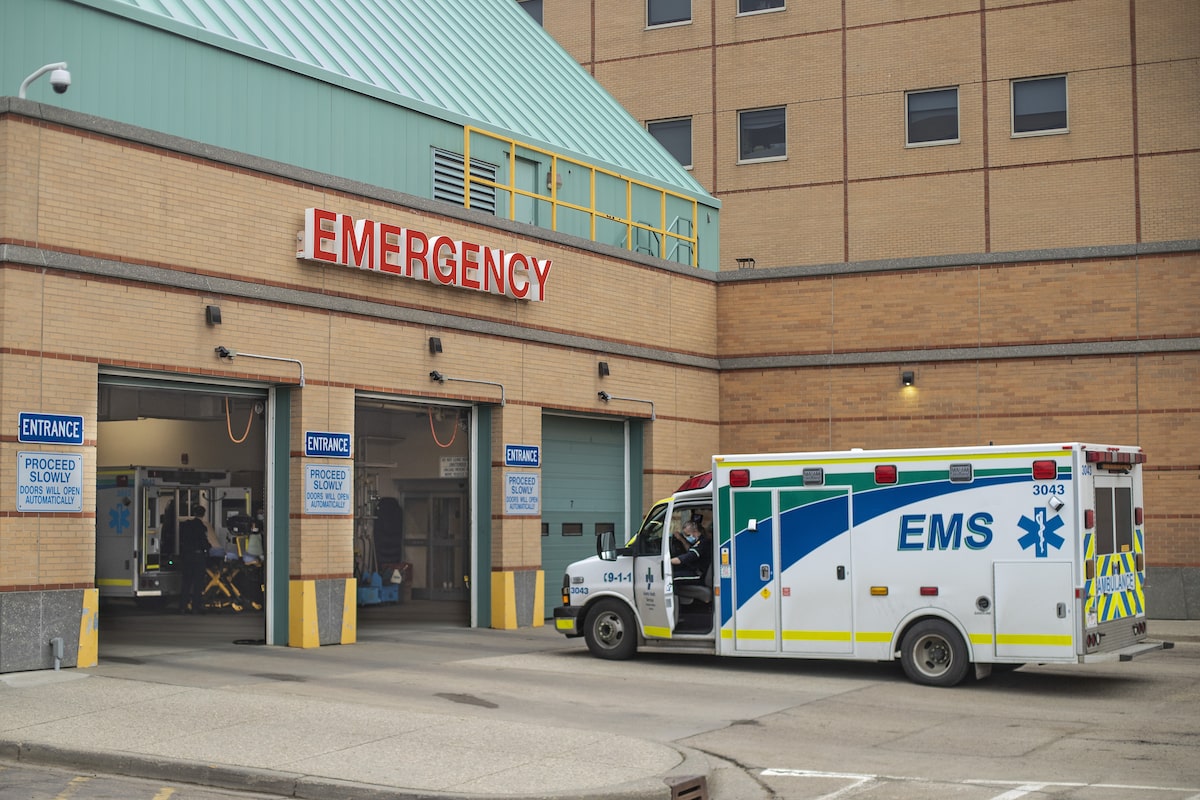
An Alberta health minister says reports of recent deaths and near-misses in overflowing emergency departments are concerning but he is confident that Albertans will still get the urgent care they need at hospitals.
In a document sent to government officials last week and first reported by The Globe and Mail, physicians detailed six preventable deaths and more than 30 close calls – cases in which high-stakes diagnoses were delayed because of severe overcrowding – in the first two weeks of the year.
Matt Jones, minister of hospital and surgical health services, told media on Tuesday that he is taking the anonymized cases seriously but said they are not representative of the provincial health system.
“The anonymized, unverified data that was shared is concerning to me,” said Mr. Jones at an unrelated news conference in Calgary. He added that the cases are difficult to comment on from a legal and privacy perspective.
“I do take them seriously. We must learn from them. But we also do incredible work every day for Albertans and their families.”
Senior with influenza waited 90 hours in Edmonton emergency department, family says
Edmonton doctors call on Alberta to declare state of emergency as hospitals overflow
Mr. Jones, who is one of four Alberta health ministers, said more than two million people visit Alberta EDs yearly and, of those, roughly 0.07 per cent die. He added that it is an “unfortunate reality” that sick and frail people access hospital care.
The cases outlined in the document, which were compiled by the Alberta Medical Association section of emergency medicine, are only the “tip of the iceberg,” according to Paul Parks, the group’s president-elect.
Front-line doctors and the Alberta New Democratic Party have called on the province to declare a formal emergency over the crisis playing out in EDs.
The Alberta government has been under fire for its response to ED overcrowding since the highly publicized death of Prashant Sreekumar on Dec. 22. Mr. Sreekumar, a 44-year-old father of three, died after spending eight hours in the emergency room at Edmonton’s Grey Nuns Community Hospital.
Mr. Jones, on Tuesday, said Albertans should “rest assured” that there is a process in place to report adverse events, near-misses or suboptimal outcomes, and learn from them.
He referenced Alberta’s Reporting and Learning System, where health care practitioners can voluntarily report patient safety concerns, hazards or incidents. Additionally, Mr. Jones outlined investigations that can be initiated in certain cases, including by service providers and the chief medical examiner.
In “extreme cases,” such as Mr. Sreekumar’s, a fatality inquiry can be ordered, during which a provincial judge will clarify the circumstances of a death, issue findings publicly and possibly provide recommendations.
Secret Canada: The toll of Canada’s ER closure crisis
The minister said he has met with physicians who are concerned about how pressures on the health care system are hindering patient care, acknowledging that there have been higher-than-normal waiting times. Mr. Jones said he has offered working group meetings between his department, Acute Care Alberta and the Alberta Medical Association.
“We want to work with everyone to make the system better and improve care,” Mr. Jones said. “I want to be very clear that, if someone requires critical care, urgent care, they should seek it and they should have confidence that they will get it.”
Earlier on Tuesday, Alberta NDP Leader Naheed Nenshi called on the United Conservative government to reconvene the legislature to hold an emergency debate and prop up a central command for co-ordination and decision-making to address overburdened EDs.
“This is an unprecedented crisis in our emergency rooms and our ambulance services, symptomatic of a system that is broken down,” Mr. Nenshi told media. “The government is not acting with the urgency required.”