
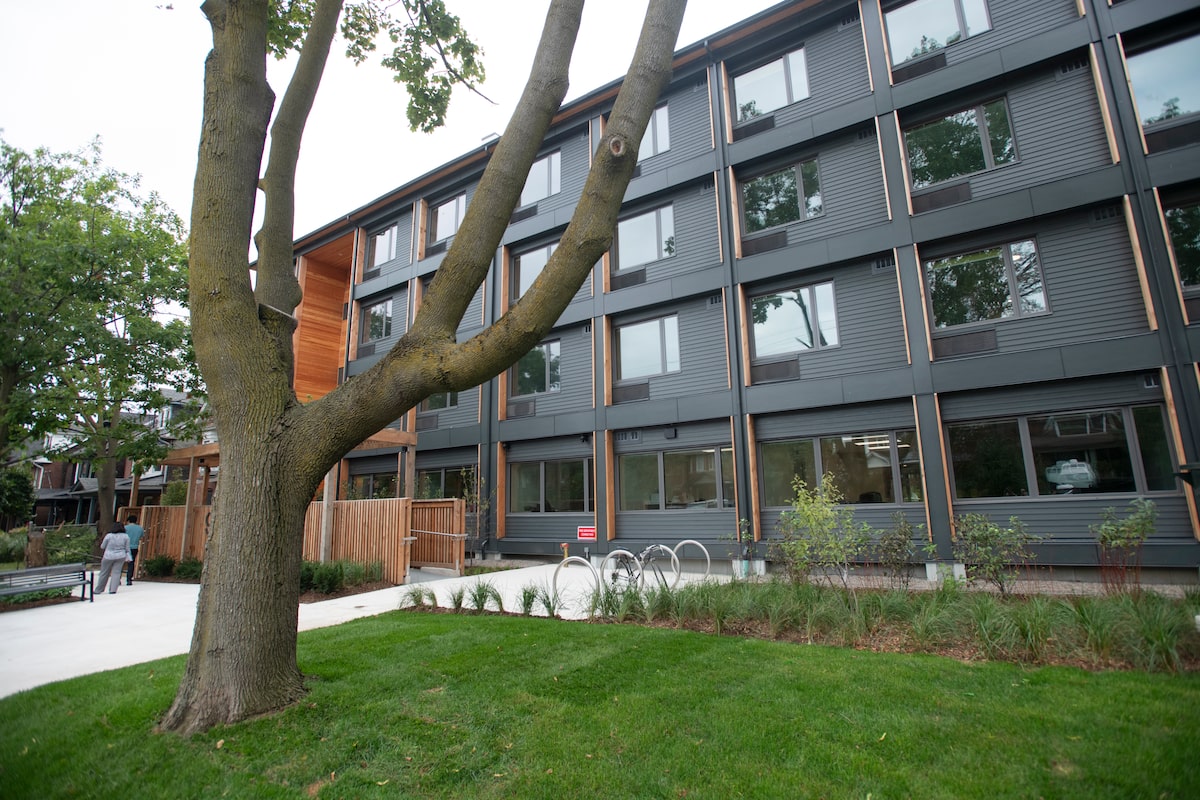
Dunn House, considered the country’s first social medicine housing project for people experiencing homelessness, opened in October, 2024. Its expansion will focus on at-risk seniors.Fred Lum/The Globe and Mail
A social housing project in Toronto that has seen success in improving the lives of people experiencing homelessness and reducing their visits to the city’s emergency rooms is doubling in size.
Federal, provincial and city officials on Tuesday announced additional funds for the project, called Dunn House, to create 54 new studio apartment units, these ones focused on at-risk seniors. As with the current residents, they will be able to access health and social services on site.
Federal Housing and Infrastructure Minister Gregor Robertson said Ottawa’s new funding of $21.6-million will help to deliver “urgently needed supportive housing for those who need it most.”
Dunn House, considered the country’s first social medicine housing project, was developed in partnership with Toronto’s University Health Network and opened in October, 2024. Currently, there are 51 studio apartments that have kitchens and bathrooms for individuals who made frequent visits to the emergency room and had in-patient admissions.
On the main floor of the building, there are communal spaces, as well as a primary-care clinic and access to a community support worker.
“In the case of these clients, their needs are greater than housing,” said Kevin Smith, president and chief executive officer of UHN. “It’s integrated with social services. It’s integrated with health care. It’s integrated with economic supports and behavioural supports.”
Keith Hambly (L) CEO of Fred Victor Housing, and Dr. Andrew Boozary, Executive Director, Social Medicine for the UHN, at one of the units, in 2024. Dr. Boozary, who championed the creation of Dunn House, said the current residents saw a 52-per-cent reduction in visits to the ER.Fred Lum/The Globe and Mail
He said that levels of government, from multiple political stripes, united to support the next phase of Dunn House.
Ontario plans to spend $2.6-million on annual operational funding. The City of Toronto will take the lead on delivering the new homes, acting as the public developer.
CreateTO, an agency with a mandate established by the city to manage its real estate assets, will use modular construction to build the housing units.
Dr. Andrew Boozary, a primary care physician who championed the creation of Dunn House, said the current residents saw a 52-per-cent reduction in visits to the emergency department and a 79-per-cent drop in days spent in a hospital bed, resulting in about $2.1-million in predicted annual savings.
Residents also hold leases on the units and are supported 24/7 with various services, ranging from psychiatry to addictions.
Opinion: Caught in Ottawa’s drug crisis, a homeless woman searches for a new life
“Really, it’s about people being able to will the trajectory of their health and well-being as they choose,” Dr. Boozary said.
“For some people, it’s been being able to go back to high school and finish their diploma. Others have been able to give back as lived experience experts. One of the tenants is now working for the mayor’s council. We’ve seen other people reconnect with their families after many years.”
Toronto Mayor Olivia Chow said city staff member, Jason Miles, had been living on the street, was in and out of jail and trapped by addiction and despair before he tried to end his life.
“Thank God he survived,” she said. “And thank God for the housing worker who never gave up on him. That worker helped Jason find Dunn House: not just a bed, but a home. A place where he found stability, medical care, social support; where he learned to cook and to garden.”
The Dunn House model “breaks the cycle of homelessness, sickness and despair,” she added.
There have also been palliative patients at Dunn House. “That’s something you can’t capture with the data; the human dignity of people being able to pass away at home,” Dr. Boozary said.
The project was developed by the UHN Gattuso Centre for Social Medicine, where Dr. Boozary serves as executive director, as well as the City of Toronto and community partners.
Dr. Boozary said decades of research show that homelessness severely shortens life expectancy, often by 30 to 40 years. This, he said, is why housing is considered the “most powerful social determinant of health.”