
Photo by House of Commons
Two things were certain going into today’s PMQs: Kemi Badenoch would seize upon the gift handed to her yesterday by Donald Trump, who called the UK’s decision to hand over the Chagos Islands an “act of great stupidity”, and Keir Starmer would find a way to make it all about Robert Jenrick.
Both of these duly came to pass. The personnel headaches in both parties were unpicked, with some good jokes from Starmer on Jenrick’s defection to Reform and a fair bit of rebuttal of Badenoch about the Prime Minister’s own troubles with his frontbench. If that’s what you love most about PMQs, it’s worth a watch. But the real developments were on foreign policy, where Badenoch has a new strategy.
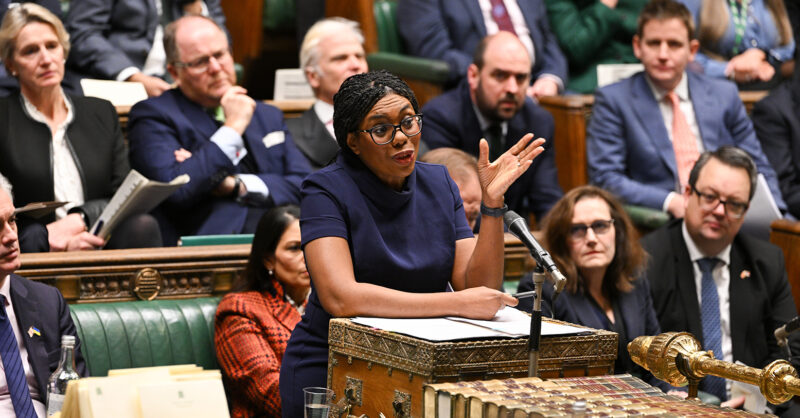
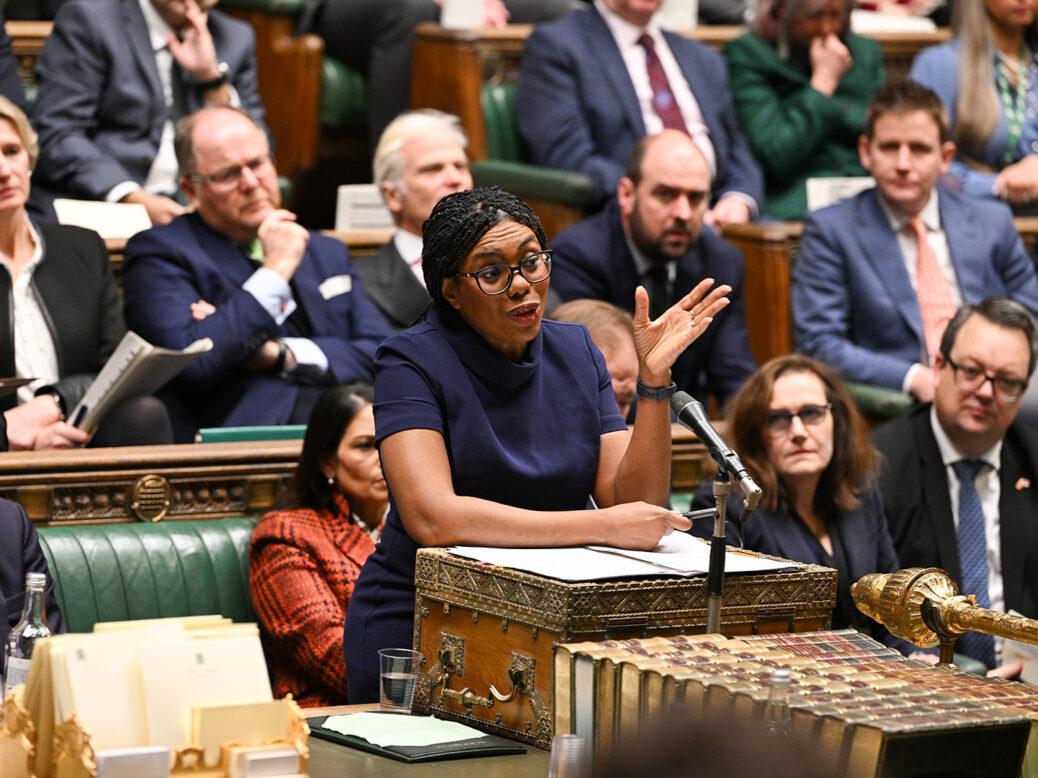
For a start, the Tory leader’s questions are getting shorter and sharper, leaving Starmer at risk of looking waffly. More than that, she seems to have finally learned how to use her six opportunities to set up traps, kicking off by welcoming the government’s position that Greenland’s future should be decided by its people and asking whether Trump agreed. The Prime Minister appeared somewhat caught off guard by the overture, but he handled the subsequent balancing act of calling out Trump’s tariff threats as “totally wrong” without seeming too critical of the US president. Then Badenoch launched into the line of questioning everyone knew was coming, asking whether, if those in Greenland should decide their own future, the Chagossians should too.
And here is where it got interesting. Two weeks ago, in a week where international news overshadowed domestic politics, Badenoch fumbled it. Her problem was that the Labour and Tory positions on the big foreign policy stories were too close together. Since then, she has hashed out a way for her party to define itself, using the few points of difference the Conservatives have with the government to attempt to paint Starmer as weak on the world stage.

New year, new read. Save 40% off an annual subscription this January.
In Badenoch’s quiver today: the Chagos deal, thanks to Trump’s sudden change of heart on whether the UK is right to hand the territory over to Mauritius; concerns over protecting veterans as the government moves forward with the Northern Ireland Troubles Bill; and yesterday’s approval of what the opposition lead called the “Chinese spy-hub embassy” in the heart of the City of London. She even managed to repeat last week’s trick of getting a call-and-response going with her MPs, leading a chorus of “too weak” as she outlined Starmer’s security shortfalls.
What does any of this have to do with Greenland and the reality of a US president who sees his power to take over random territories he has his eye on as totally unrestricted? Not all that much, as the PM tried to counter. He accused Badenoch of undermining the UK’s position on Greenland by highlighting comments made by Trump “for the express purpose of putting me and this country under pressure”.
“He wants me to yield on my position and I’m not going to,” Starmer continued, with a sudden swagger reminiscent of Ed Miliband’s “hell yes, I’m tough enough”.
Who won? It’s hard to tell. Starmer made good use (twice) of Badenoch’s embarrassing gaffe two weeks ago that Greenland was a “second-order issue”, and repeated the comments of former Tory defence secretary Ben Wallace that the UK defence sector had been “hollowed out”. But Badenoch’s focus on the cost of the Chagos deal (despite Trump’s apparent assumption, the UK will pay the Mauritian government £3.4bn to lease the strategically crucial Diego Garcia base after the handover) enabled her to link the resurgence of the row to Britain’s response over Greenland, arguing that this money should be used to fund the armed forces instead.
Starmer, she argued, was “too weak to stand up for our national interest”. And in return, the Prime Minister did not look as confident as one might hope in a week in which standing up for the national interest is the only game in town.
Ed Davey did not help matters. The Lib Dem leader raised the spectre of Tony Blair’s ill-faited relationship with George W. Bush, accusing Starmer of tying the UK to a president “increasingly acting like a crime boss… threatening to smash up our economy unless he gets his hands on Greenland” and urging him to take a leaf from Canadian PM Mark Carney’s book. Starmer’s response was testier than usual, suggesting Davey was just after a soundbite and painting his position as “foolhardy”. Badenoch and Davey have very different stances on Trump (both of which are easier to take in opposition than from No.10) but their combined assertion that the government is weak on issues of security is a major risk.
Two other questions worth are worth flagging. The first came from the Green Party’s Ellie Chowns. What was notable here was not the question itself, but the force of the PM’s response. Starmer took the opportunity for a broadside Zack Polanski, flagging the Green leader’s call for the UK to withdraw from Nato and accusing him of wanting to negotiate with Vladimir Putin on surrendering Britain’s nuclear deterrent. For an added bit of sting against the man who is hoovering up support from Labour’s left flank, he cited the Green Party’s support for drug legalisation, slagging off the party as “high on drugs, soft on Putin”. It was all a bit much, given Chowns had asked a question about farming pollution, and shows how nervous Labour strategists are getting about the rise of the Greens.
Finally, let us return to Robert Jenrick, who made his first PMQs intervention from the Reform bench. There were howls of laughter and jeers before the erstwhile shadow justice secretary had taken to his feet, and you could see Starmer itching for another chance to use his jokes about Nigel Farage. Jenrick didn’t let him. His question was a sombre, un-political plea on behalf of the parents of a former prison officer who had been murdered after he left his job, meaning his family were denied compensation. Would the Prime Minister look into it? Starmer, of course, said he would. The earlier defection jokes suddenly seemed crass and irrelevant. A reminder both that Jenrick is a savvy Commons operator who is not to be underestimated (whatever one thinks of his long-term political ambitions), and that sometimes the pantomime of PMQs is best avoided.
[Further reading: Inside the Labour factions pressuring Starmer to rejoin Europe]
Content from our partners