
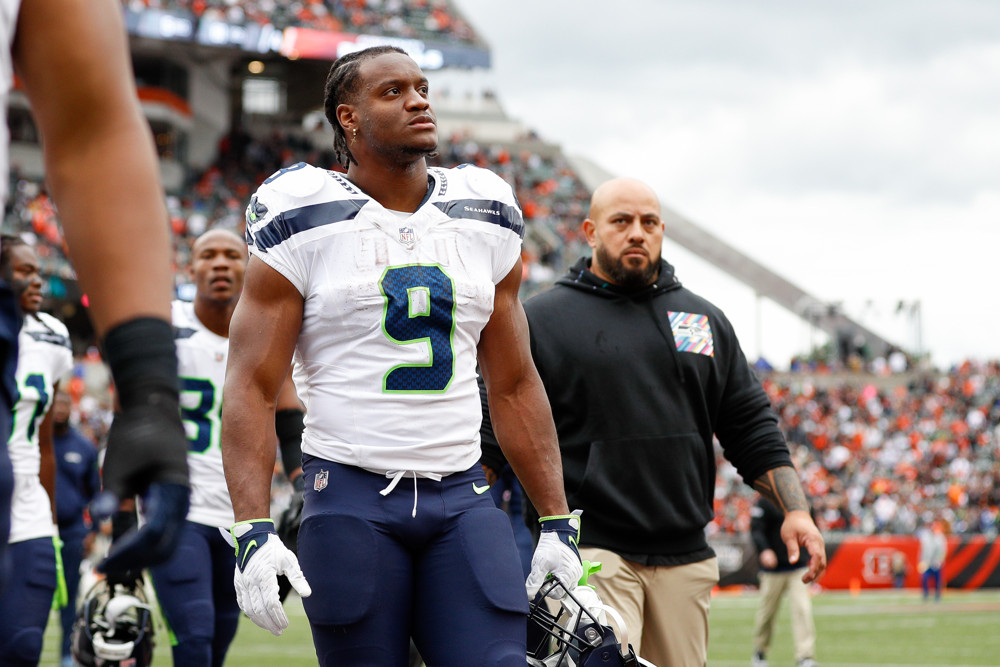
It’s the right NFC Championship Game. The Seattle Seahawks and Los Angeles Rams have been in the top two slots in DVOA for nearly the entire year, a clear cut above anyone in the conference. Both teams were historically good, among the top 10 DVOA teams since 1978. Both romped through the regular season, regularly blowing out lesser competition. They have a combined regular-season DVOA of 81.1%, the highest ever for a postseason game. We’ve already had two classic DVOA Bowls between the two during the regular season, with each team taking one – it’s a rubber match in the Conference Championship Game. The Week 16 game, in particular, was an all-time classic, with the Seahawks overcoming a 16-point deficit and scoring three different two-point conversions to come out on top 38-37. That’s the reason this game is being played in Seattle instead of Los Angeles. If this game is half as good as that one, we’ll have a banger on our hands.
But while this is DVOA Bowl III, these two teams have been travelling in opposite directions over the last month.
The Seahawks are coming off the best game of the year. Their 41-6 dismantling of the San Francisco 49ers in the Divisional Round had a single-game DVOA of 109.9%. It was just about the closest thing you’ll see to a perfect game, with the defense not allowing a touchdown, the offense moving down the field at will, and even special teams getting on the board with the opening kickoff touchdown. The win was large enough that it propelled the Seahawks to a 45.1% DVOA, placing them the top five in DVOA all time, including the postseason. They’re only behind 1991 Washington, 2007 New England, 1985 Chicago and 1989 San Francisco. They are mingling with football royalty.
The Rams, on the other hand, are somewhat fortunate to be here. They only had a 32% Post-Game Win Expectancy against the Bears, being outgained by nearly 80 yards and fumbling multiple times. They weren’t that much more impressive against Carolina, escaping in a 34-31 struggle that required them to come from behind twice in the fourth quarter. While they remain second in DVOA at 35.9%, they have just a 6.1% DVOA in the playoffs after a couple of very questionable performances defending the pass. It’s been over a month since they last looked truly dominant, and now they’re sledging their way into enemy territory against a more rested team.
But you know what? They’re still here. And it’s not how you start, it’s how you finish. The Seahawks had to win the NFC West to get the No. 1 seed, and they’re going to have to do it again to get to the Super Bowl. Will they continue to roll? Or will the Rams shake of the cold of Chicago behind their presumptive-MVP quarterback and OPOY-contending wideout to beat Seattle for the second time this year? It’s Sunday’s main event, and it should be a good one.
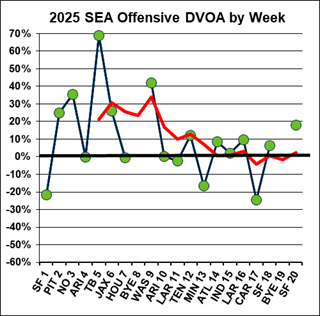
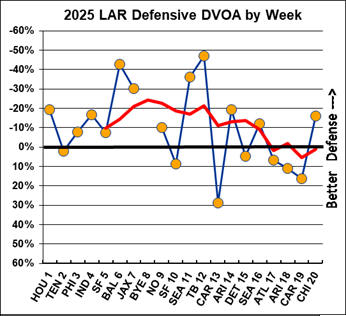
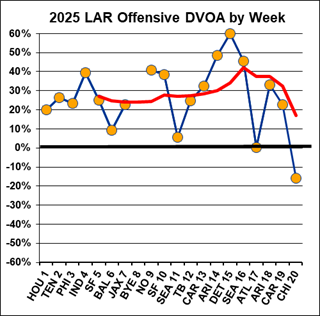
Week-to-week charts represent each team’s single-game DVOA, with separate charts for offense and defense. The extra line is a rolling five-week average. If you’re checking out FTN’s DVOA for the first time, it’s all explained right here.
Except for WEIGHTED DVOA, which gives more weight to recent games, all stats are regular-season only unless noted.
Check out our preview of the AFC Championship game.
LAR (14-5)
SEA (15-3)
DVOA
39.9% (2)
41.2% (1)
WEI DVOA
32.3% (3)
49.1% (1)
Rams on Offense
LAR OFF
SEA DEF
DVOA
30.6% (1)
-24.2% (1)
WEI DVOA
28.1% (1)
-35.5% (1)
PASS
47.6% (1)
-20.2% (1)
RUSH
17.3% (1)
-30.1% (1)
Seahawks on Offense
LAR DEF
SEA OFF
DVOA
-12.4% (4)
8.5% (10)
WEI DVOA
-7.3% (9)
3.2% (13)
PASS
-9.8% (4)
32.5% (5)
RUSH
-15.7% (5)
-4.0% (14)
Special Teams
LAR
SEA
DVOA
-3.1% (26)
8.6% (2)
When the Seahawks Have the Ball
The matchup that will most likely decide the NFC Championship is the Seattle passing offense against the Rams pass defense, as the two weakest units in the game poke directly at the other’s biggest flaw.
Even taking into account the Seahawks’ romp over San Francisco, their passing game has fallen into a hole in the second half of the season. Since Week 10, they’re 18th in passing DVOA at 10.1%, with three games in the negatives – and remember, passing is much more effective than rushing, so a passing performance with negative DVOA is quite bad indeed. The Rams have just one of those all season, and that was last week in the freezing cold and snow in Chicago.
The Seahawks’ bad days? Well, they tend to come against the Rams! They had a -10.2% mark in their Week 16 win, as Sam Darnold threw a couple interceptions and absorbed four sacks. They had a 1.3% mark in their Week 11 loss – yes, it comes out slightly better despite Darnold throwing four picks, as he was more efficient on the plays where he wasn’t throwing the ball directly at Rams defenders. The Rams didn’t quite stop Jaxon Smith-Njigba, who had a combined 17 receptions for 201 yards and a touchdown in the two games, but they made big plays at key moments.
That’s been the story of the two Seahawks-Rams games, really – when do the Rams get big plays against Darnold in the passing game, and how much to they hurt. For most of the year, the trend was for the Seahawks passing attack to be good when throwing to JSN and not so good targeting anyone else. Darnold’s DVOA drops from 79.2% when throwing to his best receiver to 21.1% targeting any other Seahawk, a much more significant dropoff than any other good quarterback and their top targets. It’s a one man show in the receiving corps, and it’s JSN’s overall greatness (and, to be fair, Darnold’s touch on the deep ball) that was driving the passing success. Smith-Njigba is an incredible threat – second in DYAR, fifth in DVOA, and the best deep threat in the league this season. Stopping him is goal one, two and three for any defense facing Seattle.
But that wasn’t the case in the two Rams games. Darnold only threw four interceptions all year when targeting JSN, but two of them came against the Rams – both Kobie Turner and Cobie Durant jumped short passes to Smith-Njigba. Darnold had better DVOA targeting Kenneth Walker III and AJ Barner against the Rams thanks to the impact of those picks.
And that’s the thing. On a regular, down-by-down basis, the Rams haven’t really shut Darnold down yet. Darnold has a -25.4% passing DVOA against the Rams, his third-worst opponent this season. But the Rams have recorded 10 interceptions or sacks against him, twice as much as any other team and first- and second-most against Seattle this season; they’ve gotten splash plays more than any other defense has. Remove the big plays and the Rams still do well against Darnold, but his 52.3% DVOA is within spitting distance of his 61.5% mark against all teams when you take out sacks and interceptions – the “apart from that, how was the play, Mrs. Lincoln?” version of passing stats.
The Rams are only still alive because of big defensive swing plays, too. Their pass defense this postseason is 15.5%, which would have ranked 26th in the regular season as both Bryce Young and Caleb Williams were able to attack them deep on multiple occasions. But they have four interceptions, including the crucial one in overtime to set up their game-winning field goal. Interceptions have, conservatively, saved the Rams nine points in a playoff run where they’ve won both their games by three. They’re going to need to generate some more if they want to take down Seattle.
The Rams’ strategy for doing this is creating chaos. Late movement, a lot of simulated pressure, anything it takes to prevent a quarterback from getting a clean read. Darnold’s interceptions against the Rams didn’t come from great athletic plays by the corners; they were created either because Darnold didn’t know a defender was going to be in a spot or because he was busy being clobbered as he tried to throw. The Rams pressured Darnold 32.9% of the time, up from his 28% season average. The tradeoff, though, is that when Darnold wasn’t pressured, he usually could find someone with acres of space around him – 56.4% of Darnold’s throws against the Rams were to someone charted as “open” or “wide open.” That would have been first in the league by a pretty substantial margin, as Darnold did a good job finding the holes in Los Angeles’ zones.
The Rams have been getting pressure this postseason, with a 33.7% pressure rate. But they have just two sacks on those 30 pressures and have forced only one checkdown and two throwaways. They haven’t really been burned yet, as Williams and Young were a combined 9-for-25 for 96 yards, albeit with two touchdowns, when pressured. But pressure without sacks is a great way to get burned; only the Buccaneers allowed more passing yards while getting pressure than the Rams did and, at 13.0 yards allowed per completion while getting pressure, these often became explosive plays. They have to connect with Darnold, bring him to the ground, and they just haven’t done that enough this postseason. Darnold is, fortunately, less mobile than Young or Williams so they should have an easier time doing it, but if Darnold can absorb the Rams pass rush and find JSN running downfield against single coverage, it’s going to be a long day for Los Angeles. But in the regular season, they were able to get home, and it’s fine if JSN has another 100-yard day if it also leads to a crucial Darnold mistake in the fourth quarter. We probably won’t see another nine-sack game like the Rams had against Darnold in last year’s playoffs, but bringing heat and making him beat you is likely the Rams’ best strategy. They just need to be more effective this week than the last couple.
On that note, all three Seahawks left tackles were not practicing as of Thursday afternoon. You would expect one of Charles Cross, Josh Jones or Amari Kight to take the field, but keep an eye on that.
The other big question is how Seattle’s run game will look with Zach Charbonnet out for the year, tearing his ACL. That puts a lot of pressure on Kenneth Walker III, because it’s hard to imagine Seattle leaning too heavily on Velus Jones Jr. in an NFC Championship Game and George Holani just came off IR. Walker was the more effective of the two Seattle running backs against the Rams this season with a 25.9% DVOA on 27 carries, but a lot of his value came on one 55-yard touchdown run against them in the second game. The Seahawks ran all over the 49ers by stretching their weakened defense, and that doesn’t really work against the Rams – they actually have NFL-quality defenders out there, who can not only run down those wide runs but stay disciplined in their lanes and not be gashed by massive cutbacks. The Rams were fifth in DVOA against runs, but sixth outside compared to 11th up the middle – they’re typically more susceptible to power runs up the gut than someone stretching them out wide. The Rams rank 31st in stuff rate at 12% and 27th at power (short-yardage) success at 73% but are up near the top of the league in second-level and open-field yards; you don’t typically bust huge, explosive plays on the ground against them. Their 6.9% explosive run rate allowed is sixth best in the league.
All this is to say, the Seahawks have the wrong running back healthy. It’s Charbonnet, not Walker, who has success rushing up the middle – a -2.4% DVOA to Walker’s -24.8%. It’s Walker, not Charbonnet, who is the Seahawks’ source for explosive runs – a 14.9% rate to Charbonnet’s 6.5%. Charbonnet is the one they turn to for regular, consistent success (a 41.3% success rate to Walker’s 38.0%), while Walker hits the home runs. You typically don’t hit home runs against this Rams rush defense! And it’s important that Walker can get some of those consistent yards which isn’t his forte, because you don’t want to face the Rams defense in long yardage situations. They were the top defense in the league on third-and-longs this season with a -69.7% DVOA. They were second best on second-and-longs at -32.3%. They were more average when you had them in short or medium situations, but when you got into obvious passing downs, they were absolutely lethal – you can run more of that simulated pressure when you don’t have to worry about the run. In their two games this season, Seattle had a 6.0% DVOA on second, or third-and-short, but a -35.4% when they had at least seven yards to go for the first. They have to stay out of long yardage situations, and a steady diet of three- or four-yard gains from Walker would be a massive boon, even if that’s not really his forte.
When the Rams Have the Ball
It was the weather, right?
Matthew Stafford hasn’t looked like a top MVP candidate this postseason. He had a 33.8% passing DVOA during the regular season, tops in the league by a fairly substantial margin. But that’s fallen to -4.9% in the playoffs, as he’s been inaccurate and turnover prone. He’s only thrown one interception, but he’s fumbled twice, has four turnover-worthy throws, and has been sacked five times despite only facing pressure on 21.3% of his dropbacks. Our charting has him with an accuracy rate of 61.4%, down from 74.7% in the regular season, and his success rate has fallen from 55.1% to 42.9%.
Some of this, surely, was the terrible conditions in Chicago. While cold weather has never really been Stafford’s problem, the snow was a nightmare. Stafford has a 22.6% DVOA against Carolina and a -30.4% one against Chicago. He often seemed uncomfortable with both his grip and his footing. The conditions should be better this week, even with a slight chance of rain, and I’d expect to see something more like the Stafford we’ve seen all year this week. The Rams will need him.
It will be very interesting to see the personnel decisions when the Rams have the ball; just seeing who each team gets on the field.
The Seahawks love to live in dime, which they can do because Nick Emmanwori is such an effective safety slash slot corner slash run-stuffing linebacker. No team uses dime as frequently or to as great an effect as Seattle has. Sean McVay has spoken glowingly about Mike Macdonald’s scheme, talking about how they can put these lighter personnel groupings on the field and still dictate physically and schematically because of the versatility of the pieces at play. Heck, the Seahawks haven’t allowed a play of any kind to go over 20 yards in a month! The ability to take away big plays by sitting in dime without being gouged in the rushing game is their superpower, and a big reason why they’re here.
This has not slowed the Rams down yet. They’re have a 30.8% offensive DVOA against Seattle this season, including hitting 56.5% through the air. In Week 16, Stafford had over 400 passing yards, three touchdowns and no interceptions – that had never been done in league history against the best scoring defense, and most of that came by picking apart Seattle’s dime. It was Stafford’s best day of the season, with 286 DYAR and a 73.7% DVOA. His success rate was low at just 47%, but he found the big splash plays when he needed to and never made the back-breaking mistake. Seattle has forced 24 turnover-worthy this season; none came from Stafford. Seattle has only allowed 44 explosive plays and eight of them were from Stafford. Seattle’s gotten pressure on 34.2% of their snaps and recorded 47 sacks but that fell to 20.3% and zero against Stafford. The Rams stared right into Seattle’s biggest strength and picked it apart a month ago. They weren’t quite as effective in Week 11 but still managed a 12.6% DVOA. Seattle has only given up five games of double-digit offensive DVOA this season, and two of them were to the Rams.
One very important thing about that Week 16 matchup – Davante Adams missed it with a hamstring injury. So the Rams spent most of that game in 13 personnel, with Colby Parkinson, Terrance Ferguson and Davis Allen all on the field alongside (usually) Puka Nacua. And the Rams were great in 13 personnel! They ran 335 plays out of that during the regular season, putting up a 39.3% DVOA. Seattle certainly wasn’t terrible against 13 all season long, with a -19.9% defensive DVOA, but that’s worse than their overall numbers. And it makes logical sense – if your opponent is going light defensively, you can fight that by going heavy offensively. It sure led to plenty of offense in Week 16.
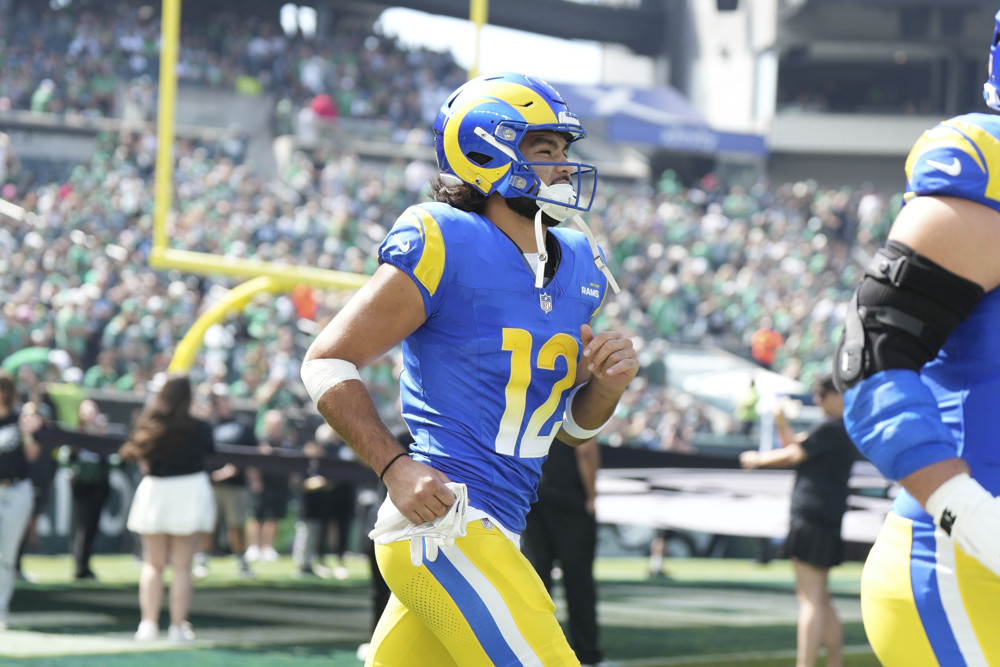
But despite how successful they were out of 13 personnel, the Rams have gotten away from it in the playoffs. In the last two games, they have just 28 snaps in 13 personnel, almost all of it on first downs, almost all of it runs – and almost all of it against Carolina. It makes sense that, with Adams healthy, you want to get him on the field as much as possible. But considering the success they’ve had working out of and passing out of these heavier formations, and considering how light Seattle plays, you would hope to see a little bit more of it this week. It’s not like Adams was shredding Seattle in the first game, anyway – just one catch on eight targets, albeit for a touchdown. Adams has said he’s looking forward to getting another crack at Seattle’s defense, but it might be wise to lean more on those multi-tight end sets – and Puka Nacua, of course.
The Seahawks have not had an answer for Nacua yet this season. Last time out, he had 12 receptions for 225 yards and a pair of scores, racing up and down the middle of the field in zone coverage. Josh Jobe was the main victim, but Nacua caught passes matched up against Riq Woolen, Devon Witherspoon, Nick Emmanwori, Ty Okada, Ernest Jones IV and Coby Bryant – it didn’t particularly matter. Perhaps Seattle will let Witherspoon shadow Nacua more this time, as Jobe couldn’t get the job done. More effective, however, might be just doubling him as much as possible; anything to make sure he doesn’t get into a one-on-one match with a safety who he’s going to burn. After all, Nacua led the league with 11 contested catches this year; it’s not like tight single coverage dissuades Stafford from looking his way or Nacua making a play. The Rams offense doesn’t run through Nacua to the same extent the Seahawks run through Smith-Njigba, but the two favorites for Offensive Player of the Year tied with 27 explosive receptions each. Blanket him, focus your defense on taking him away, and see what else McVay does to respond.
Try to keep them out of third-and-short, too. Leonard Williams pointed out this week that the Rams have the shortest distance to go on third downs, meaning they can drop back and throw quick passes, without the need to sit back and read coverages. Stafford had the ninth-quickest time to throw on third downs this season at 2.56 seconds, and that dropped to 2.39 against Seattle. Finding the first sack ever for a Macdonald defense against a McVay offense would be handy, as would be finding a way to slow down the rushing game. The Rams had rush DVOAs of 14.5% and 6.2% against Seattle, two of the top five numbers they allowed all season. The Week 11 matchup was more about the Seahawks giving up explosive runs, but Week 16 saw both Blake Corum and Kyren Williams regularly pick up solid gains and limit the amount of long downs and distances the Rams faced. The Rams led the league with 5.5 adjusted line yards – they don’t get stuffed and they rarely get touched before they’re a couple yards down field. Seattle usually is very good at stopping this – they have the advantage in pure power-on-power situations, they led the league in limiting second-level and open-field yards and are first and second in rush defense DVOA on all three downs. But the Rams have beaten them before, often out of those 13 personnel sets we mentioned earlier – another reason why it would be useful if the Rams returned to them more often in this matchup.
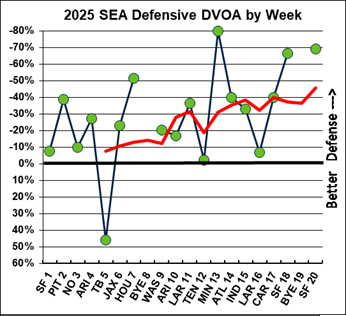
Honestly, that’s what I keep coming back to as I watch the Rams – they need to return to what was working. While they lost to the Seahawks in Week 16, they still had a 45.5% offensive DVOA and moved the ball up and down the field. They played well enough defensively, too – they had a 60.3% Post-Game Win Expectancy and lost on a number of failures on high-leverage plays (including “picking a loose ball up in the end zone”). But since then, the Rams offense hasn’t looked like the Rams’ offense. It’s possible Stafford torpedoed his MVP case with a nightmare game against Atlanta in Week 17. They toyed around with Arizona in Week 18, very nearly blew it against Carolina in the Wild Card Round and then froze their butts off in Chicago. This has not looked like the No. 2 DVOA team in weeks. Sure, they’re good enough, and they have moments and drives where they look like they did two months ago. But the consistency hasn’t been there. They haven’t been able to get into a rhythm – self-inflicted wounds, mental mistakes, lapses in protection and abandoning areas of playcalling for unexplained periods of time. You can’t do that against the Seattle defense and expect to have success. This game is going to be about execution more than it is springing some kind of surprise on the opponent – they’ve played each other too much to really have anything unexpected up their sleeves. The Rams have not been executing cleanly. That has to change, or they’ll be watching the Super Bowl from home.
Special Teams
A huge advantage for Seattle here. It’s not quite as big as the gap between Seattle’s 8.6% DVOA and Los Angeles’ -3.1% would make it appear, because the Rams have fired their special teams coach and made some changes in personnel. But when one team is at the top of the league and the other had to fire their special teams coach, yeah, it’s a mismatch.
The Rams rank 30th in field goals and extra point value, but much of that is the now-cut Joshua Karty. Karty had -12.2 points of weather-adjusted value on kicks, while Harrison Mevis, the Thiccer Kicker, has been much more reliable at +6.5. A few fewer Karty blocks and misses, and this game would be in SoFi.
But Karty is a loss on kickoffs; while his knuckleball kicks had a few high-profile misses, he still ended up with +1.6 points of value on kickoffs. Ethan Evans, the punter who replaced him, is at -8.4 points of value, in large part because McVay got so burned by some of those bad kicks that they just have Evans boot the ball into the end zone over and over again. He has 49 touchbacks, more than 10 more than anyone else in the league. That gives Rams opponents fantastic field position – though, considering Rashid Shaheed returned the opening kickoff for a touchdown last week, maybe it’s not a horrible strategy. There are worse things than starting on the 35, after all.
Outlook
The arrow’s pointing towards the Seahawks on this one, considering their better rest and superior form. But this is far from a strong pick, and even the 2.5-point line favoring the Seahawks seems a bit strong.
In general, when all else is equal, I fall back to looking at the coach, quarterback, and health when trying to pick a close game, and the Rams have two of those factors in their corner. I expect Matthew Stafford to look more like the MVP he’s been over the course of the full season, and I don’t yet trust Sam Darnold to perform in a game he absolutely must perform in, as opposed to a romp like Seattle had against San Francisco. The question marks at left tackle and loss of Charbonnet concerns me for Seattle’s offense. McVay versus Macdonald is a tie at best. That should have me taking the Rams here.
But that Seahawks defense has just been so phenomenal over the back half of the season. They are coming off of one of the most complete and thorough butt-kickings you will ever see in the postseason. And they’ll be in front of one of the loudest home crowds in the league, dying to get back to the Super Bowl in the post-Russ era.
I’m leaning Seattle. And no matter who wins, I’ll be picking them to come out on top in Super Bowl LX, too. If that even matters after winning two out of three DVOA Bowls. Now there’s a real honor!