
Trinity Lutheran church is a small, rural congregation in Sibley County, Minn., a district southwest of Minneapolis that voted more than two-thirds for Donald Trump in 2024. It sits near a bend in the highway where farm fields stretch to the horizon.
On a recent Sunday, Pastor Scott Richards asked his parishioners to pray for their neighbours in the city. He also asked that they pray for Renee Nicole Macklin Good, the 37-year-old woman who had been shot dead by an Immigration and Customs Enforcement agent a few days earlier.
Her killing has triggered furious protests in Minnesota, a state that has become a collision point in America’s divided politics. “These are difficult and gut-wrenching times,” Mr. Richards said.
The pastor spoke about a mother in their small community who had disappeared recently. She was plucked from the street by immigration agents. She had lived and worked for 20 years in Gaylord, a nearby town of 2,200. Mr. Richards asked for volunteers to help deliver groceries to her two teenaged children.
After the service, Jordan Wiest, a 30-year-old farmer, said he feels sickened by what he has seen as a result of the surge of ICE agents ordered into his state by President Donald Trump. “We’re a pretty conservative part of the country here. It’s a huge Republican constituency in the rural areas. But at some point there’s being conservative, and then there’s being just inhumane towards people. And for me, this is crossing the line,” he said.
Mari Lu Martens, a retired school principal in Sibley County, said she doesn’t think local people are on-side with the administration’s actions. “I know these people, and they don’t abide by cruelty,” Ms. Martens said.
Gaylord’s Trinity Lutheran Church is far away from the raucous protests in Minneapolis-St. Paul, but the policies driving them are stirring debate.Will Allen-DuPraw/The Globe and Mail
The church has a U.S. flag and cross in a closet. Most voters in this county chose Donald Trump in 2024.Will Allen-DuPraw/The Globe and Mail
Minnesota is facing an immigration enforcement siege.
More than 3,000 agents of the Department of Homeland Security have been sent to the state to apprehend people without legal status. So far, it has led to more than 3,000 arrests, according to DHS.
The citizens of Minneapolis have responded with protests and hostility. They have rallied against ICE’s presence at the city’s main federal building. They’ve organized patrols that observe and record the immigration officers. They stand sentry near schools. When they spot ICE agents, they blow whistles and send alerts in online group chats.
The presence of the agents has been destabilizing, according to Minnesota’s state lawmakers. Workers have been apprehended on the job or on their way to work. Kids have stayed away from school. Residential streets can erupt in chaos when ICE tries to make an arrest.
When ICE arrives, as it did on this recent raid in St. Paul, neighbours will often record them.
Leah Millis/Reuters
Some Minnesotans who voted Republican said they’re uneasy with the ICE operation, that it clashes with their sense of decency and is making them rethink their support for Mr. Trump.
But several also said they’re skeptical of Democrats in the state, led by Governor Tim Walz, the former Democratic vice-presidential candidate.
They are troubled by a ballooning fraud scandal that has been described as “industrial” in scale, which the White House has connected to members of the Somali diaspora in Minnesota. The scandal has been cited as one of the reasons for the immigration enforcement surge.
Mr. Trump’s focus on Minnesota doesn’t seem to be letting up. He has threatened to cut federal funding to the state, which could have significant consequences for many people who rely on government services.
Local leaders, including Mr. Walz and Minneapolis Mayor Jacob Frey, have demanded ICE leave. But while residents of Minneapolis and St. Paul seem firmly opposed to the federal government’s actions, those in rural areas tend to be more ambivalent. In this way, Minnesota reflects the larger political divisions playing out across the country, which has led to conflicts between local and federal authorities.
As polling shows Americans overall are growing more skeptical of the Trump administration’s approach to immigration enforcement, it’s still an open question whether the fallout of Ms. Macklin Good’s killing and the ICE surge will prove to be a moment of political reckoning.
A model state for the American left
Minnesota has voted Democrat in 13 consecutive presidential elections, the longest streak of any state in the country. The party in Minnesota is known as the Democratic-Farmer-Labor Party, a product of the 1944 merger of the Farmer-Labor party and the Democrats. The DFL currently controls most state offices.
Under Mr. Walz, the party has pursued a progressive agenda that includes protecting abortion rights, free school meals, family and medical leave and clean-energy initiatives. A 2021 Urban Institute study ranked Minnesota fourth in the country in per capita public spending on low-income residents. It has long been something of a model state for the American left.
“There is a legacy here of a higher-trust society, generally, and a more efficient government, to the extent that these things are determined at the state level. As well as a more supportive social safety net,” said C. Daniel Myers, a professor of political science at the University of Minnesota.
Federal workers got a taste of Minnesota’s volunteer spirit during last year’s government shutdown, when this mobile pantry fed TSA employees at the Minneapolis airport.Tim Evans/Reuters
Minnesota’s strong social welfare system has played a role in its changing demographics.
With 9 per cent of its population born abroad, the state ranks in the middle of the pack nationally. An estimated 2 per cent of its population is undocumented, well below the highest rates in places such as Texas, Florida, California and Illinois. It’s among the states that have attracted a high proportion of refugees, part of a tradition connected to well-organized church-based settlement programs.
When Somalia descended into civil war in the 1990s, a small number of Somalis began making their way to Minnesota. As word spread about available jobs, the community quickly grew. Today, about 80,000 people of Somali origin live in Minnesota, some of them American-born. The vast majority are U.S. citizens.
Somali Americans in Minneapolis have been more careful recently to carry passports wherever they go, or put signs on businesses asking federal agents to keep out.
Tim Evans and Brian Snyder/Reuters
One of Minnesota’s more famous Somali Americans is congresswoman Ilhan Omar, often a target of insults from Mr. Trump. These protesters in Mogadishu, where she was born, hailed her as a hero last month while denouncing the President for denigrating their country.Farah Abdi Warsameh/The Associated Press
The sprawling fraud investigation that Mr. Trump has cited as justification for the immigration enforcement surge has shaken Minnesota, and called into question the effectiveness of its government oversight.
The investigation began by examining an organization called Feeding Our Future, a non-profit that acted as a sponsor in a federal nutrition program, doling out money from government to local organizations that were supposed to provide meals to children. Investigators alleged it flourished during the COVID-19 pandemic when oversight requirements were loosened so money and services could be delivered more quickly.
Ringleaders were accused of recruiting participants who submitted false billing to the state’s Department of Education, claiming to have fed children when they hadn’t. Prosecutors alleged more than $240-million was fraudulently obtained and distributed.
The vast majority of the accused were of Somali origin. One exception was the person prosecutors identified as the ringleader, Aimee Bock, who was convicted in March, 2025, and is awaiting sentencing. More than 60 others have been convicted or pled guilty.
After the FBI raided Feeding Our Future’s office in 2022, its leaders began to face charges of fraud.Shari L. Gross/Star Tribune via AP
Prosecutor Joe Thompson, speaking about the case in December, called it a ‘staggering industrial scale fraud.’Giovanna Dell’Orto/The Associated Press
In a press conference in December, Joe Thompson, the First Assistant U.S. Attorney for Minnesota at the time, said he believes Feeding Our Future is part of a much bigger problem.
“Minnesotans and taxpayers deserve to know the truth of the fraud. It is not small. It isn’t isolated. The magnitude cannot be overstated,” he said. “It’s a staggering industrial-scale fraud.”
He said investigators had identified 14 programs paid out of Medicaid funds, a kind of public insurance, that were at high risk of being defrauded. These programs provided services such as housing stabilization, adult daycare for those with disabilities and services for people with autism.
Mr. Thompson said he thought as much as half or more of US$18-billion spent on those programs since 2018 may have been fraudulent. The state’s Medicaid director, John Connolly, said at a press conference in December that he has seen evidence of tens of millions in fraud, but not billions.
So far, 98 people have been charged in these fraud investigations and 85 of them are of Somali descent, according to the White House.
Mr. Thompson said the state has not done a good job of supervising its programs.
“It’s a state that has long taken pride in having a strong economy, good schools, beautiful lakes, many parks and a sense of community spirit and civic mindedness. This fraud really calls into question all of that,” he said.
On Jan. 13, though, Mr. Thompson resigned along with six other members of his office after local investigators were prevented by federal authorities from joining the investigation of the killing of Ms. Macklin Good and, as American outlets reported, after being pushed to investigate the actions of her partner.
Governor Tim Walz, having bowed out of the gubernatorial race, came a few days later to this vigil for Renee Nicole Macklin Good with his wife, Gwen.Stephen Maturen/Getty Images
Mr. Walz has come under intense scrutiny for the state’s failure to catch the fraudulent activity. He recently announced he wouldn’t seek re-election to a third term, a decision many observers attribute to the fraud scandal.
Ellie Wilson, executive director of the Autism Society of Minnesota, said she believes the issue stems partly from the well-intentioned goal of providing services quickly with a minimum of bureaucracy.
But oversight of state government spending has likely been an issue for a long time, she said.
“There are certainly many things left to be desired about our system,” she said. “There’s just a lack of investment in oversight, in credentialing, in infrastructure that maintains and oversees these types of providers.”
Mr. Walz has said he is accountable for the fraud and he intends to fix it.
“A single taxpayer dollar wasted on fraud is a dollar too much to tolerate. And while there’s a role to play for everyone – from the legislature to prosecutors to insurance companies to local and county government – the buck stops with me,” Mr. Walz said this month.
‘I’m glad my husband is alive’
The surge of immigration agents to Minnesota is part of the Trump administration’s response to what it calls the “fraud epidemic.”
But lawmakers in Minnesota warned that the presence of so many federal agents, who outnumber Minneapolis police officers by about five to one according to Mr. Frey, was bound to lead to someone getting hurt.
Even after the death of Ms. Macklin Good, ICE is pursuing aggressive tactics that local officials complain target people of colour based solely on their appearance.
On a recent Monday morning, Christian Molina was driving to a mechanic’s shop in Minneapolis from his home outside the city. He paused at a stop sign and saw what he described as ICE agents down a nearby alley.
As an ICE vehicle began to follow him, Mr. Molina kept driving. He later explained that he did not immediately react because he’s a U.S. citizen and had not violated any traffic laws.
After a short pursuit, the ICE vehicle crashed into the back of his car, apparently as a deliberate tactic, and then penned in his vehicle.
“They hit me when I was driving,” Mr. Molina said later.
Open this photo in gallery:Open this photo in gallery:
While Christian Molina dealt with ICE after agents damaged his car, passersby began to crowd around the scene in Minneapolis.Tim Evans/Reuters
Masked, armed agents approached him as he got out of the car. As the confrontation became heated, citizens in the area quickly alerted one another with whistles and in group chats.
People came running, recording with their phones and shouting at the officers. As more than a hundred people filled the street, the screech of whistles and honking horns blended with the chanting of the crowd, telling ICE agents to go home and calling them Nazis.
When the crowd got too close, ICE agents threw canisters of tear gas and fired pepper spray, further angering protesters.
The agents eventually accepted Mr. Molina’s assertion of citizenship and let him go, the crowd cheering as they left.
Mr. Molina’s wife, Lorena, was in tears afterward. She said she pleaded with officers to spare his life.
“We’ve lived here for over 25 years, but it’s so scary now,” she said. “I’m glad my husband is alive.”
Maggie Wood, a local resident, ran six blocks to answer the call for observers. She was nearby when chemical irritants were deployed, and later felt burning in her lungs.
She listened as other residents described the ICE presence as a military occupation.
“I didn’t realize how mad I was until I was faced with it,” Ms. Wood said.
What Trump promised ‘was a mirage’
State officials have argued that the ICE enforcement action is hurting business and making people afraid to leave their homes.
At a fast-food restaurant in St. Cloud, Minn., a city of about 70,000 with a significant Somali population, two workers were at the end of their shift on a Tuesday afternoon earlier this month. They were nervous about making a short walk across the parking lot and asked the assistant manager to escort them to their car.
They made it about 10 metres before ICE agents pounced. The masked agents put the two employees into the back of a dark SUV. The vehicle drove off before the door had even closed.
The assistant manager stood helpless with her hand over her mouth. She made a phone call in which she described how agents told her to back away while they grabbed the two employees and put their hands behind their backs.
She broke down in tears as soon as she ended the call.
A couple of blocks away, at a strip mall of Somali-run shops, people were still discussing a confrontation with ICE agents the day before.
Abdi Adam, a U.S. citizen who has lived in the country for 25 years and drives an Uber, described it as like a scene from a movie. ICE vehicles entered the parking lot from the entrance and exit simultaneously, blocking anyone from leaving. Then dozens of agents descended, leading to an hours-long standoff marked by hostility and fear. The man who had been sitting at the next table from Mr. Adam in the Waamo Cafe was grabbed and taken away, he said.
“Even after 9/11, it was nothing like this. And it was bad after 9/11,” he said. “Yesterday was scary.”
Mr. Adam said he voted for Mr. Trump in 2024, as many Somalis did.
“It’s a paradox,” he said. “People thought he would fix the economy. I’m like everybody else who voted for Trump and got disappointed. It’s like he tricked people with black magic. What he promised was a mirage. And worse than a mirage, it’s something that could destroy your life.”
He said he’s leaning Democrat next time.
Jaylani Hussein is the executive director of the Council on American-Islamic Relations’ Minnesota chapter. He described what’s been happening as an “onslaught of attack.” He said it’s wrong that an entire community is being treated as criminals for the actions of a few people alleged to have taken part in the social services fraud.
“Crime does not belong to a community. Individuals who’ve committed a crime should take responsibility. But the idea that somehow all Somalis are involved in fraud, or that fraud is happening in the Somali community unlike other communities – it’s a lie. And we’re dealing with the aftermath.”
‘I was just trying to see where my mom was’
The pain and shock that ICE enforcement can inflict on a community was driven home this month in the town of Gaylord. Known as the egg capital of Minnesota, it’s a family-oriented agricultural hub small enough that its lone traffic light was removed about a decade ago.
On the morning of Jan. 8, Josefa Lopez-Zuniga – the mother who pastor Mr. Richards later spoke about to his congregation – paid a visit to the bank on the town’s main street. She had lived in the area for about 20 years, was never in trouble with police and held a job at a local food-processing company. But she didn’t make it home that day. Her two children were alerted to a photo on a local Facebook page of Homeland Security agents surrounding their mother’s car near the bank.
Her son, 18-year-old Josh Miranda, described how he frantically called ICE facilities in the state trying to locate his mother.
“When I attempted to call them they were so eager to hang up,” he said. “I was just trying to see where my mom was and they were basically just telling us they couldn’t do anything.”
That night, they finally received a phone call from Ms. Lopez-Zuniga, which lasted barely 30 seconds. She told them she was in an ICE detention centre and wanted them to know she was okay.
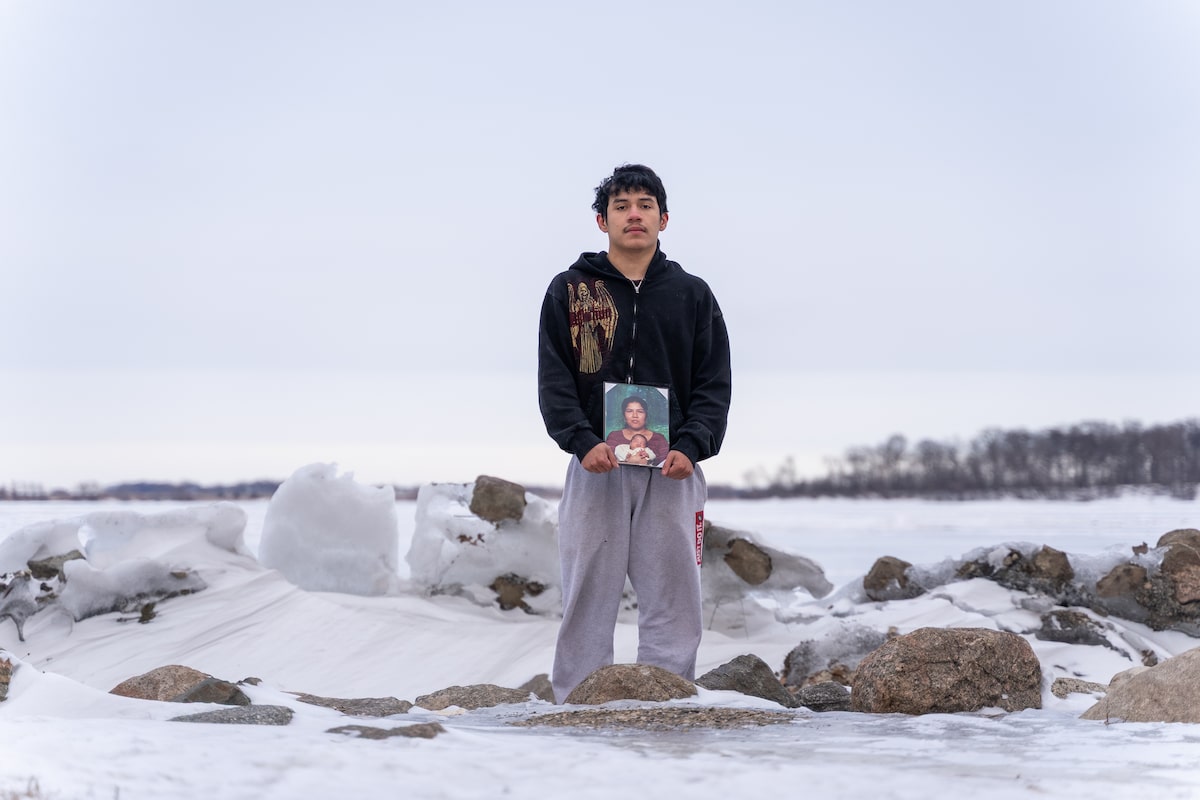
Josh Miranda and his sister have U.S. citizenship, but their mother does not.Will Allen-DuPraw/The Globe and Mail
The next day she was flown to El Paso, Tex., more than 2,000 kilometres away at the southern border.
“We’re worried that they’re going to do something that we won’t have knowledge of,” Mr. Miranda said. “I couldn’t sleep the last three days. I’m trying to help her, trying to see what I can do to communicate with her.”
He regularly calls the detention centre, but they usually just hang up, he said. He feels lost without her.
Mr. Miranda and his sister, 19-year-old Jennifer Miranda-Lopez, were both born in Minnesota and are U.S. citizens. They said their mother grew up in Honduras and fled violence in her home country, coming to the U.S. around 2005. Back then, she appeared before an immigration court in Texas and was permitted to enter the country, her son said, but she doesn’t have citizenship. He has been trying to hire a lawyer to argue her case.
He said his biggest fear is that his mother won’t know that he’s trying to fight for her.
Josefa Lopez-Zuniga was running errands at First National Bank when ICE caught her at this intersection. From here, it’s a short walk north to Gaylord City Park, where Josh Miranda has fond memories of spending time with his mother.
Will Allen-DuPraw/The Globe and Mail
The urban-rural divide
Prof. Myers, the University of Minnesota political scientist, said when he lectures on America’s political divide he often uses slides of his state’s demographic makeup to illustrate his points.
First, there is the diploma gap. Those with higher levels of education are now more likely to vote Democrat, while blue-collar workers have been moving to the Republicans. That’s the opposite of how people were voting through the 1980s.
There’s also the split along rural and urban lines. Only nine of Minnesota’s 87 counties voted Democrat in the 2024 presidential election, but the urban and suburban districts they won were large enough to carry the state.
And lastly, a person’s attitudes to immigration and race are an increasingly telling political indicator.
“Up until 2004, your views on immigration were not actually a good predictor of which party you were in. And obviously that’s not the case any more,” Prof. Myers said.
He said, historically, new voting coalitions form to break political deadlock, but it’s unclear to him how America’s divide will shift next.
Sports-bar owner Mike DeWitte said Minnesota has become divided along rural and urban lines.
Mike DeWitte, 58, runs Tanker Bay, a sports bar in the rural town of Winthrop, which has a population of a little more than 1,000. On a Sunday afternoon, more than a dozen people, mostly men, sat around the bar watching a football game on television.
Mr. DeWitte describes himself as a Republican, but not necessarily a Trump fan. He said nearly everyone in his rural Minnesota town works with immigrants and gets along with them.
He said he doesn’t like seeing families separated and thinks there should be a path to citizenship for people who’ve lived and worked in the U.S. for years.
“The biggest thing is we have to protect our borders and still be able to treat people with dignity,” he said.
But the fraud allegations rocking the state are deeply troubling, he said.
He thinks many rural Minnesotans are supportive of the immigration enforcement action because they believe some immigrants have taken advantage of the social welfare system.
“Especially when they see that fraud in Minneapolis,” he said.
In rural Minnesota, people have a hard time with how the big city runs the show, Mr. DeWitte said. Minneapolis feels to them like a culturally very different place. He said can’t even give away tickets to Timberwolves basketball games because his employees would rather avoid the city. There’s still a great deal of shock and anger that a police station was burned in Minneapolis in the protests after the death of George Floyd, he said.
“A lot of rural Minnesotans still have hard feelings about what went on in that time.”
Mr. DeWitte’s mother was a DFL supporter, he said, but today’s party is “way off base” in his eyes.
“Before, it was all about supporting farmers, labour politics, social justice. I think that’s fallen away,” he said. In his view, the party abandoned the political middle for the radical left.
When he travels to Minneapolis he sees a place where, as he puts it, the minority is the majority. People sort themselves into their various identities, from racial to gender to sexual orientation, and his sense is that those voices are treated as though they’re more important than others.
“It’s like there’s all these categories. I don’t feel like we think of ourselves as Minnesotans, together. I never felt like that 20 years ago.”
Beyond borders: More from The Globe and MailThe Decibel podcast
In polls, Canadians used to broadly agree that ambitious immigration growth was a good thing. In 2024, that consensus crashed. To find out why, The Decibel asked professor Rupa Banerjee and Tony Keller, author of Borderline Chaos: How Canada Got Immigration Right, and Then Wrong. Subscribe for more episodes.
From our foreign correspondents
In Year One, Trump demolished all checks on his power at home. In Year Two, it’s the world’s turn
Colombia, Panama and Grenada face a new Monroe Doctrine with déjà vu
Young people in red states pick up where Charlie Kirk left off