
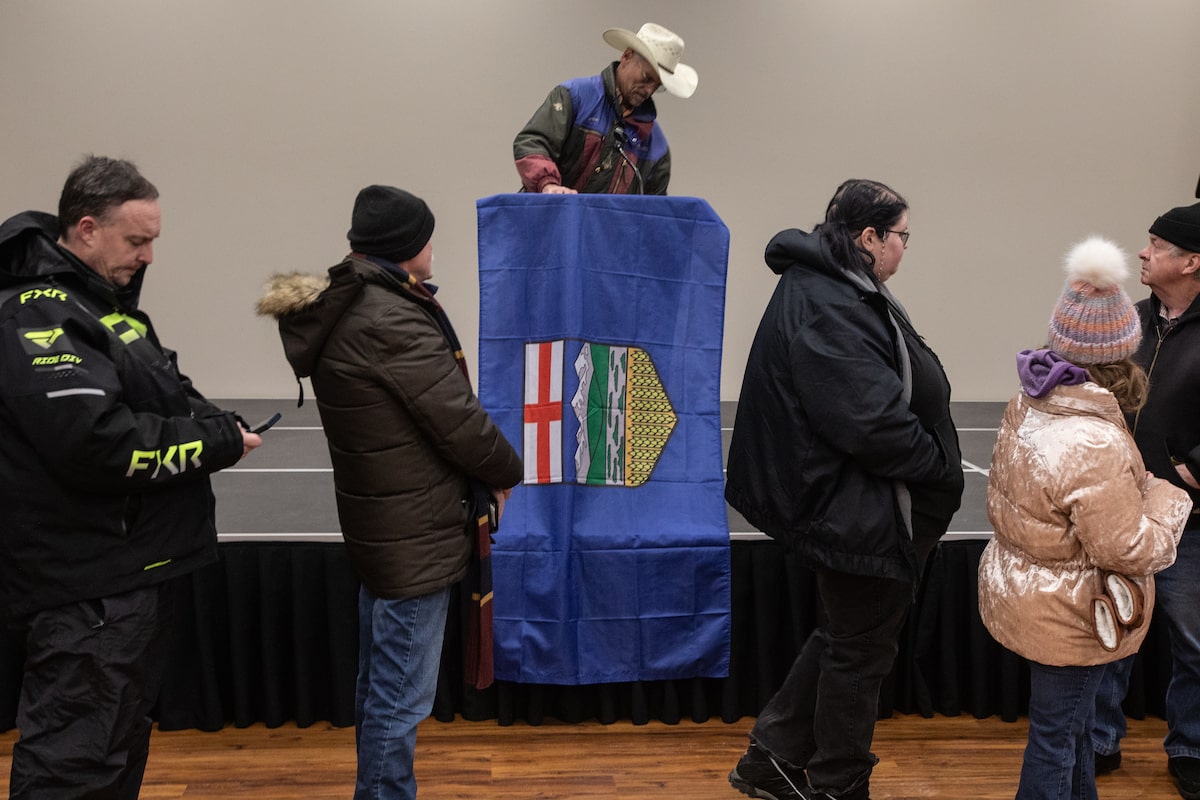
People line up to sign a petition that seeks to have a referendum on Alberta separation, in Stony Plain, Alta., on Thursday.JASON FRANSON/The Canadian Press
With the prospect of a separation referendum looming over Alberta, the province’s election watchdog is under pressure to ensure it keeps foreign cash out of campaigns as U.S. political leaders exhibit interest in the province’s independence movement – but experts worry that Elections Alberta lacks the necessary resources to do its job.
A petition drive aiming to trigger a referendum concerning Alberta’s secession from Canada is currently under way, and comes as U.S. President Donald Trump seeks to amplify his country’s influence in the Western Hemisphere.
On Monday, Mr. Trump posted a photo of the Oval Office with him displaying an American flag superimposed on Canada, Greenland and Venezuela, and the next day Republican congressman Andy Ogles told the BBC he believed Alberta wants to join the U.S.
On Thursday, U.S. Treasury Secretary Scott Bessent, in an interview, chided Prime Minister Mark Carney for not taking advantage of Alberta’s natural resources and directly referenced the province’s potential independence referendum.
“I think we should let them come down into the U.S., and Alberta is a natural partner for the U.S.,” said Mr. Bessent.
Canada’s Finance Minister, François-Philippe Champagne, avoided direct criticism of his U.S. counterpart when asked at a cabinet retreat in Quebec City to respond to Mr. Bessent’s remarks.
Mr. Champagne said he has a very good relationship with the Treasury Secretary and he pointed to Ottawa’s recent Memorandum Of Understanding with Alberta related to energy resources.
“One thing I’ve learned over time is that you don’t need to comment on every single comment,” he said.
Sam Blackett, spokesperson for Premier Danielle Smith, said in a statement that Alberta wants to build more pipeline capacity in all directions including to the U.S., but Ms. Smith “also believes the overwhelming majority of Albertans are not interested in becoming a U.S. state.”
The United Conservative government under Ms. Smith has made it easier for Albertans to take part in what she calls “direct democracy.” That includes citizens initiatives, which can force a province-wide vote.
Citizen-led referendums in Alberta are governed by complicated rules about disclosure requirements and who can finance campaigns, all of which gets policed by the election watchdog, says Shaun Fluker, a law professor at the University of Calgary.
“Without any doubt in my mind, I’m certain that Elections Alberta does not – has never had – the resources to undertake this sort of stuff in the volume that it appears to be looking at,” Prof. Fluker said in an interview.
First Nation launches legal action against potential Alberta referendum on separation
With foreign interference and influence in local democratic processes “an ongoing concern” around the world, he worries how it could play out in Alberta.
Wesley Wark, a senior fellow at the Centre for International Governance Innovation, underlined the risk of foreign interference during an Alberta independence referendum in an affidavit filed to the Sturgeon Lake Cree Nation’s lawsuit on Jan. 14 against the Alberta and federal governments, and the province’s chief electoral officer.
Mr. Wark, who served on an advisory council on national security for former prime ministers Paul Martin and Stephen Harper from 2005 to 2009, was called as an expert witness in the suit.
In his affidavit, Mr. Wark wrote that the Alberta Prosperity Project – the province’s leading advocacy group for independence – has expressed policy seeking close ties with the Americans that “must be regarded as an open door to U.S. political influence and potential interference.”
But the shape and impact of a foreign interference campaign may only be detected in retrospect, Mr. Wark wrote.
Jeffrey Rath, lawyer for the Prosperity Project, said he and his colleagues are setting up a February meeting with the U.S. Treasury Department but wouldn’t provide specifics. He said unnamed members of the U.S. State Department, over two separate meetings, have said they would not seek to have Alberta join the United States.
Tony Keller: A referendum in Alberta could be Donald Trump’s 51st state opportunity
Mr. Rath, who celebrated Mr. Bessent’s comments about Alberta, said he would share who he was meeting with “at the appropriate time.”
“We’re basically meeting with the U.S. administration at the highest level, so take that for what it means. The public isn’t entitled to know anything beyond that.”
Mitch Sylvestre, the proponent of the current independence petition and chief executive of the Prosperity Project, acknowledged he cannot control foreign influence on a broad-based campaign. But he said he is closely watching money flowing into his campaign organization, Stay Free Alberta, to ensure he complies with election-finance rules.
“There is absolutely no way there’s any foreign money coming into our campaign that I know of,” Mr. Sylvestre said in an interview.
“As a matter of fact, I wouldn’t accept any funds from any large U.S. corporation or entity based on the fact that I don’t want the optics of it.”
Alberta Justice Minister Mickey Amery, whose department was responsible for changing legislation and making it easier for referendums, declined an interview with The Globe and Mail. Heather Jenkins, Mr. Amery’s spokesperson, said in a statement that the province “would take necessary action in the case of any credible threats of interference.”
Elections Alberta gets extra $6.7-million to handle surge in recall petitions
A legislative committee signed off in December last year for an extra $6.7-million in funding for Elections Alberta, to help the agency handle a spike in recall petitions initiated by constituents unhappy with legislature members.
However, Elections Alberta’s compliance and enforcement budget remains unchanged from last year at $695,000.
Steve Kaye, the agency’s deputy commissioner, said in a statement that the current compliance budget is sufficient, citing “robust” processes and teams. While financial filings are submitted at the end of election activities, the watchdog would immediately investigate any alleged nefarious activity as it’s reported, he said.
“We believe the team is correctly funded and staffed and, as a result, able to address any potential uptick in complaint and/or investigative activity,” Mr. Kaye wrote. “If we did not believe this, we most certainly would have requested a funding increase.”
Prof. Fluker, from the University of Calgary, said a recent Elections Alberta investigation underscores how problematic the referendums could become for the agency.
Opinion: Alberta separatists should be careful what they wish for
In that case, it investigated a small environmental non-profit called Crowsnest Headwaters. The group was campaigning for the “no” side during a 2024 non-binding referendum on whether residents in the Crowsnest Pass supported the development of a coal mine in the area.
Four days after a resounding win for the “yes” campaign, an investigator with Elections Alberta told Crowsnest Headwaters he had received a complaint that the organization had shirked elections laws.
The investigator asked for reams of documents, including bank records and expense receipts, and asked to interview the group. The ensuing investigation took roughly eight months.
Prof. Fluker worries that kind of timeline – for a relatively simple process – could be problematic in the case of a separation referendum, because investigations won’t be resolved until well after a vote.
“I have real concerns, frankly, about the potential for there to be offside contributions into some of these Alberta separation referendum questions,” he said. Despite rules barring contributions from people and groups outside Alberta, the potential scope of what Elections Alberta will have to monitor is huge, he said.
With reports from Bill Curry