
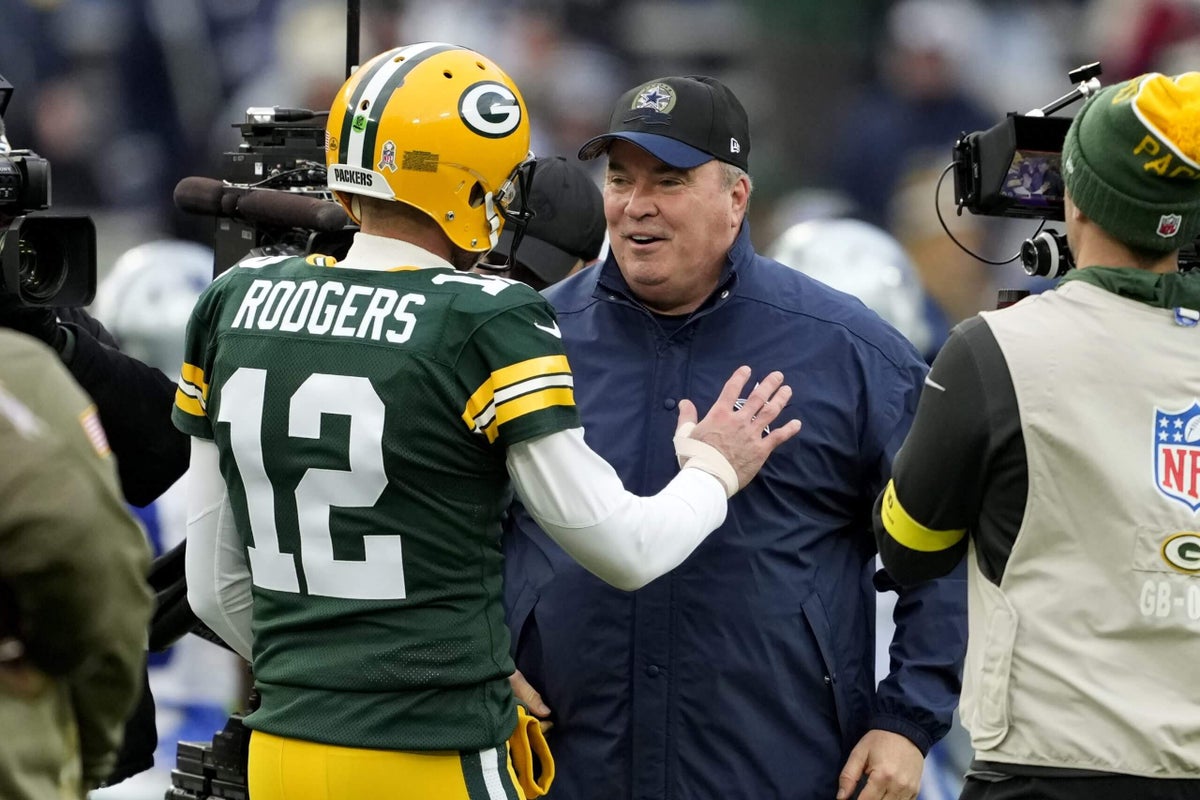
PITTSBURGH — Last June, Aaron Rodgers stood outside the Steelers’ practice facility for the first time, answering questions about his long courtship and his first day in a new city. Asked what he appreciates most about Pittsburgh, the veteran gunslinger was armed and ready with a quick-witted comeback.
“I love the Greenfield Avenue area,” Rodgers grinned through his graying beard.
Then, he paused.
“Mike told me to say that.”
Mike, of course, is Mike McCarthy. Together for 13 seasons in Green Bay, Rodgers developed into an MVP-caliber quarterback, kick-started his Hall of Fame career and hoisted the Lombardi Trophy after beating, coincidentally, the Steelers in Super Bowl XLV.
But well before McCarthy reached the pinnacle of his profession in Green Bay, he was just a kid from Pittsburgh’s Greenfield neighborhood who was raised on Chuck Noll’s Steelers and their four-Super Bowl dynasty in the 1970s. His father, Joe McCarthy Jr., was a firefighter who owned a bar. As the story goes, a young Mike McCarthy spent his Sundays sweeping around bar stools before going to church. It doesn’t get any more Pittsburgh than that.
Now, McCarthy is coming home. The Steelers have reached a verbal agreement to make the 62-year-old their fourth head coach since they hired Noll in 1969.
Inevitably, many will connect the head coach to his former quarterback and wonder: When will the other shoe drop? League sources emphasized to The Athletic — on two separate occasions over the last week — that the Steelers were not considering McCarthy as a way to entice Rodgers to return for a second season. At the same time, countless players and several others inside the organization would welcome the quarterback’s return. Rodgers, who was non-committal on his future after the playoffs, at least left the door open for 2026 a few weeks earlier.
“Obviously, I’m 42 years old, and I’m on a one-year deal, so you know what the situation is,” Rodgers said ahead of the regular-season finale. “Whenever the season ends, I’ll be a free agent, so that will give me a lot of options, if I still want to play … I mean, not a lot of options, but there’ll be options, I would think maybe one or two if I decide I still want to play.”
It’s worth noting that, toward the end of 2024, Rodgers told at least one reporter that he’d like to play for McCarthy again. In that way, even though the Steelers did not make this decision because of Rodgers, there is no doubt it increases the likelihood that the now-42-year-old QB will be the one leading the team out of the tunnel in 2026, especially as a once-promising 2026 QB draft class continues to collapse.
That is, if Rodgers wants to play. (Oh man, here we go. The speculation is already beginning. And it’s sure to dominate the news cycle for weeks, probably months to come.)
If it’s possible, let’s forget about Rodgers for a second. Yes, this is a hire that has everything to do with a quarterback. But, no, it’s not the one everyone is thinking about.
By hiring McCarthy, the Steelers are taking a calculated risk that an experienced offensive mind who has worked closely with some of the game’s great QBs can identify and develop the next franchise quarterback to get them out of their current cycle of veteran Band-Aids. That’s really what this is about; ultimately, McCarthy’s tenure in Pittsburgh will and should be judged based on that one point alone.
It’s a gamble, and the Steelers parted with tradition to make it happen. When you ask, Why do the Steelers do something a certain way? The answer is typically: Because they always have. No place is that more true than at head coach. Traditionally, the Steelers have favored young, defensive-minded head coaches who have provided stability and continuity for decades. Noll was 37 when he was hired. Bill Cowher and Mike Tomlin were 34.
Had the Steelers stuck to their mold, Rams defensive coordinator Chris Shula would have been the obvious choice, a 39-year-old from football royalty who is getting the best out of a young, homegrown defense in L.A. If not him, tradition would say the Steelers would have picked Vikings defensive coordinator Brian Flores, who is 44 and would have fit neatly into the Steelers’ “Blitzburgh” identity. Or maybe Miami Dolphins defensive coordinator Anthony Weaver, a 45-year-old former player who knows the Steelers-Ravens rivalry from the other side and would have been a leader of men in the mold of Tomlin.
Nope. The Steelers bucked 50-plus years of precedent by bringing in a head coach who specializes on the offensive side of the ball and who now becomes the NFL’s third-oldest head coach. In doing so, they are acknowledging why they’re in this position in the first place: They’ve failed — repeatedly — to identify, draft and develop a successor to Ben Roethlisberger. This is a league in which teams fall into two categories: Those who have legitimate quarterbacks and those who don’t.
Yes, this year’s wide-open AFC playoffs have featured the return of defensive football. Still, in a division with Lamar Jackson and Joe Burrow and in a conference that also includes Patrick Mahomes and Josh Allen, the only way the Steelers are going to create sustained success, get out of 10-7 purgatory and stop putting old Band-Aids on the most important position is to find that next franchise QB.
Maybe that process begins this year with 2025 sixth-round pick Will Howard, or with a 2026 draft pick. Or maybe they do run it back with Rodgers for one more year before making an aggressive move in the 2027 draft. Either way, the Steelers are putting their faith in a coach who has worked closely with Joe Montana, Rich Gannon, Brett Favre, Dak Prescott and Rodgers to get them out of this cycle of stagnant QB play. More than the 18 years of experience, more than the 174 wins and 12 playoff berths, and more than even the Super Bowl ring, that’s what this hire is about.
You could argue the Steelers could have — or should have — gone down the same path with a young offensive coach. Maybe Seahawks offensive coordinator Klint Kubiak or his brother, 49ers offensive coordinator Klay Kubiak, would have been the right mix of youth and offensive acumen. Or maybe you feel they should have taken a bigger chance on youth and upside by bringing in Rams passing game coordinator Nathan Scheelhaase, who is just 35.
But this is the barstool the Steelers chose. It’s up to the NFL’s third-oldest head coach to find and develop the quarterback to stabilize the franchise — and fast; closing time can’t be far off.