
From Philly and the Pa. suburbs to South Jersey and Delaware, what would you like WHYY News to cover? Let us know!
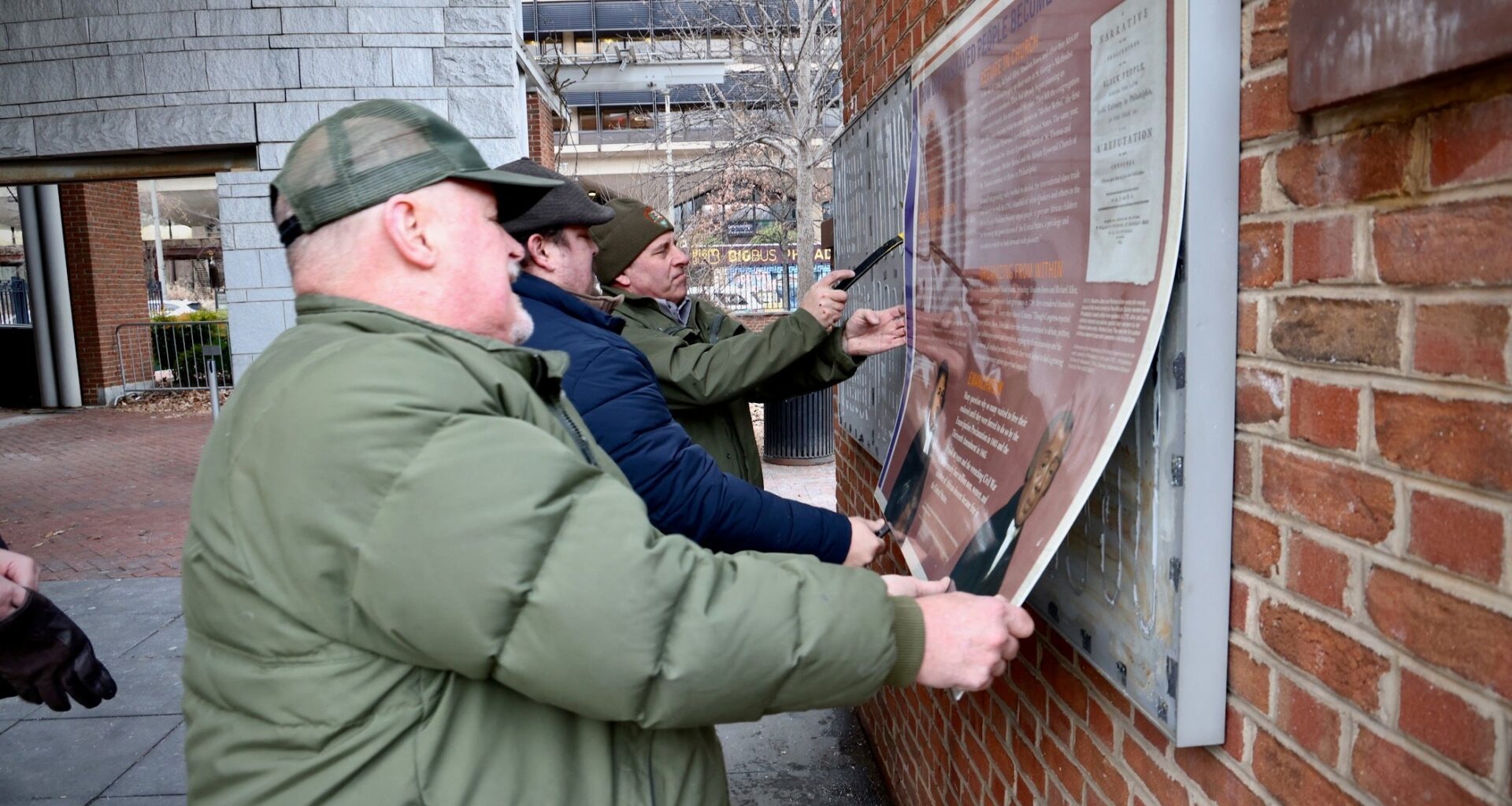
Philadelphia is heading to federal court Friday in an effort to force the National Park Service to return interpretive panels removed last week from the President’s House site on Independence Mall. The panels documented the lives of enslaved people held by President George Washington during the nation’s first decade, when Philadelphia served as the U.S. capital.
In a seven-minute produced video posted on social media, Mayor Cherelle Parker announced the lawsuit Tuesday night, saying the city is seeking an injunction requiring the federal government to restore the exhibit and halt any further changes to the site.
“You cannot erase our history,” Parker said. “Yes, it is flawed. Yes, it is imperfect, and yes, it includes the real life lived experiences and stories of people who endured a great deal of pain, so that America could realize its promise.”
The case stems from the National Park Service’s removal of multiple panels from the President’s House exhibit last Thursday. City officials say the work was done without notice and in violation of a long-standing cooperative agreement between Philadelphia and the Park Service that requires consultation before any alterations are made.
The President’s House served as the executive mansion for George Washington and John Adams from 1790 to 1800. While Washington lived there, he enslaved Black men, women and children, some of whom were brought from Mount Vernon to work in Philadelphia. Their stories were largely absent from public interpretation of the site until community activists pushed for change more than two decades ago.
Slavery exhibit
The exhibit opened in 2010 after years of organizing by historians, artists, and advocates, including the Avenging the Ancestors Coalition. The panels detailed the lives of nine enslaved people held by Washington at the President’s House, including Oney Judge, who escaped to New Hampshire, and Hercules, a highly skilled chef who later fled enslavement.
The panels were funded primarily by the city and private contributions, not by the federal government. Parker said that fact underscores Philadelphia’s legal position that they acted improperly when removing them.
“Our course of action was clear as the federal government had breached that cooperative agreement,” she said. “I want you to know we also filed seeking a preliminary injunction to stop any further damage to the exhibit or the site.”
The Park Service has since agreed to preserve the removed panels during the litigation, but advocates say the manner in which they were taken down raises concerns about possible damage. Witnesses reported seeing workers use heavy tools to pry the panels from the walls and load them into trucks.
Michael Coard, a local attorney and founder of ATAC, however, said he was concerned that the panels were already beyond repair.
“They used a gigantic crowbar and just ripped it off,” he said. “So when you saw it then thrown into the back of the pickup truck, even if we could get it, it probably has to be replicated because I think the damage is already done.”
ATAC, which helped lead the original campaign for the memorial, announced it is joining the legal fight by filing a brief in support of the city’s lawsuit. During an online meeting Tuesday night, coalition members framed the dispute as part of a broader struggle over how American history is presented on federal land.
Coard told supporters that the coalition is pursuing a two-pronged strategy combining legal action with public protest.
“We are going to raise hell in the streets and raise legal issues in the courtrooms,” Coard said. “That’s the same two-track concept that the civil rights activists had in the South in the 1940s and 50s. They didn’t just rely on Thurgood Marshall going to court.”