
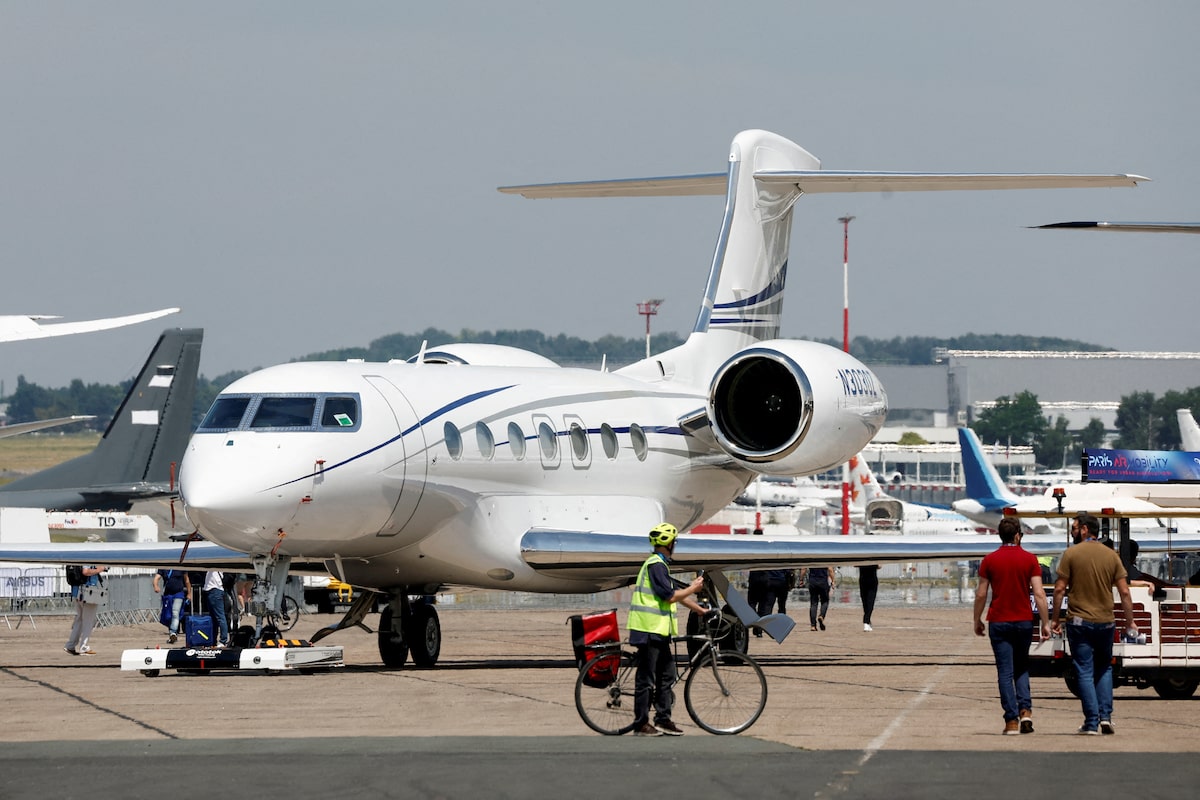
A Gulfstream Aerospace G500 aircraft arrives at the International Paris Airshow at Le Bourget Airport near Paris in 2023.Benoit Tessier/Reuters
U.S. President Donald Trump’s threat to decertify Canadian-made aircraft in the United States could hamper the services of several U.S. airlines and aircraft operators, according to Cirium, an aviation data company.
Mr. Trump made the threat on Thursday night on social media, along with a warning he would slap 50-per-cent import taxes on planes made by Bombardier Inc. BBD-B-T and other domestic manufacturers. He made the declaration in an apparent reaction to the Canadian aviation regulator’s move to review changes to U.S.-made Gulfstream business jets.
“Based on the fact that Canada has wrongfully, illegally, and steadfastly refused to certify the Gulfstream 500, 600, 700, and 800 Jets, one of the greatest, most technologically advanced airplanes ever made, we are hereby decertifying their Bombardier Global Expresses, and all aircraft made in Canada, until such time as Gulfstream, a Great American Company, is fully certified,” Mr. Trump wrote.
Where appropriate, aviation authorities certify aircraft for safety reasons, including updates or changes to existing models. Canada is reviewing electronics changes to Gulfstream G700 and G800 models the company made to increase its range and payload, said John Gradek, who teaches aviation leadership at McGill University.
Reuters reported a Trump official said the President did not mean to say Canadian-made aircraft in operation are decertified. Presumably, it would affect new aircraft made in Canada by Airbus SE, Bombardier, De Havilland Aircraft of Canada and helicopter maker Bell Textron Inc., as well as their U.S. customers.
In a statement, Bombardier said it has contacted the Canadian government in response to Mr. Trump’s declaration, and emphasized its U.S. footprint.
“Bombardier is an international company that employs more than 3,000 people in the U.S. across 9 major facilities, and creates thousands of U.S. jobs through 2,800 suppliers. Our aircraft, facilities and technicians are fully certified to FAA standards and renowned around the world. We are actively investing in expanding our U.S. operations,” including a new service centre in Fort Wayne, Ind.
Bombardier shares fell by about 6 per cent in early trading on the Toronto Stock Exchange.
Industry Minister Mélanie Joly told CBC the Gulfstream’s certification process is under way, and the demands for approvals were made “recently.”
“We believe that this can be resolved,” Ms. Joly said. “The certification process is something we don’t politicize.”
Mr. Gradek said Gulfstream is upset Bombardier is outselling it in the U.S., and unhappy with delays obtaining Canadian certification of recent updates. “This is a trade war between Gulfstream and Bombardier,” he said by phone. Rather than lose the sale battle, Gulfstream pressured Mr. Trump to ban the Bombardier planes from the U.S., he said.
Gulfstream owner General Dynamics GD-N, Bell Textron, De Havilland and the FAA did not immediately respond to e-mailed questions.
Yves-François Blanchet, leader of the Bloc Québécois, called on Mr. Trump to withdraw his threats.
“This threat undermines economic stability and the entire continent’s air transport network on false pretenses, and potentially jeopardizes its security,” Mr. Blanchet said.
Benoit Poirier, a stock analyst at Desjardins Group, said the matter could be resolved easily. “Both [Gulfstream] aircraft are already certified in the U.S. and EU. Assurances could likely be provided that Canadian certification will follow shortly,” Mr. Poirier said.
According to Cirium, “decertifying” Canadian-made aircraft in the U.S. – normally a responsibility of the U.S. Federal Aviation Administration – could affect Delta Airlines, SkyWest, NetJets and others. There are 5,425 aircraft of various types made in Canada in service in the U.S., including 58 Airbus A220s.
Cirium said there are 2,678 Canadian-made Bombardier aircraft registered in the U.S., flown by 1,202 operators. This includes 150 Global Express aircraft in service operated by 115 operators.
Mr. Poirier, in a research note, said the headlines are bad for Bombardier, but the threat is likely empty and unenforceable.
Still, the U.S. market is key for makers of private and business jets.
There are about 2,970 Bombardier jets operating the U.S., many of which are owned by large companies, wealthy people and fleet operators. The market is undersupplied, he said, with a two-year wait for new deliveries.
Tariffs would restrict buyer and traveller choice, while affecting U.S. factories and jobs, he said, given the high U.S. content in Bombardier planes.