

Listen to this article
Estimated 4 minutes
The audio version of this article is generated by AI-based technology. Mispronunciations can occur. We are working with our partners to continually review and improve the results.
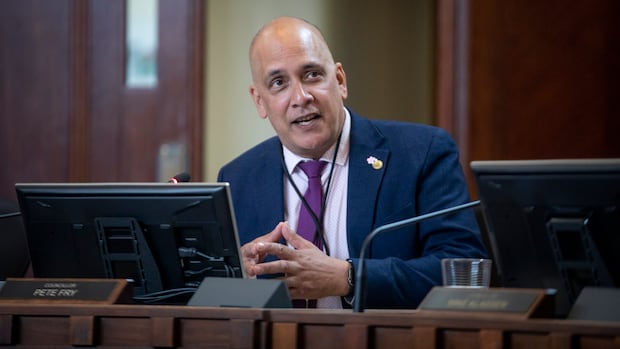
Pete Fry is hoping that for the first time since 2005, Vancouverites might elect a city councillor as its next mayor.
“I care about this city and I want this city to be a place where everybody feels that they can thrive and have a good life. And I feel that under the current leadership, it’s not happening,” he said.
Fry, who for a period of time in 2025 was Vancouver’s only opposition councillor, announced his mayoral candidacy for the Vancouver Green Party on Friday, following months of speculation.
In an interview with CBC News, he said his campaign would focus on a collaborative, empathetic approach, contrasting his demeanour with that of Vancouver Mayor Ken Sim.
“I don’t think Ken’s been leading with empathy. I just don’t think that’s his leadership style,” he said.
“There’s a broader cautionary tale in here, where we elected a guy who really didn’t know the job and who promised to run the city like a business. And the city’s not a business, and there is a level of understanding and appreciation for how governance works, and Ken didn’t come in with that.”
‘Winner take all’ approach doesn’t work, Fry says
Fry, the son of longtime Liberal MP Hedy Fry, worked as a graphic artist and ran unsuccessfully for city council in 2014 and 2017 before winning in 2018 and 2022, all under the Green Party banner.
While now an opposition councillor, Fry generally voted with former mayor Kennedy Stewart in his first term, and said that he would try to restore a collaborative approach to city hall.
“I think that this winner takes all approach to having the power and controlling city hall is actually doing us a disservice,” he said.
“I look at other local governments where the mayor is the cheerleader and chief, and lifts up their councillors to do the best for their local government in their city.”
Fry said that while a detailed platform would come closer to election day, he would focus on community services, safety and well-being, while on housing, he would try to prioritize mid-density developments.
“We see a lot of rezonings in the Broadway area, but we don’t see a lot of shovels in the ground. So, I believe that I think the next real focus has to be on the more modest scale, the six-storey construction, which can be built quickly, a lot less expensively, and more broadly across the city.”
Split vote on the left?
Fry enters an increasingly crowded field for this October’s mayoral election hoping to unseat Sim, who is seeking a second term.
Coun. Rebecca Bligh, a former ABC member, is running with her new Vote Vancouver party, while former Sim chief of staff Kareem Allam is running with the newly created Vancouver Liberal Party (which this week announced the recruitment of school board chair Victoria Jung and park board commissioner Scott Jensen).
In addition, OneCity is in the midst of its own mayoral nomination between William Azaroff and Amanda Burrows, and Team Vancouver, COPE and the Conservative Electors Association have all announced their intention to run a mayoral candidate.
Fry said negotiations were ongoing with OneCity and COPE to have a united campaign before OneCity decided to hold their own nomination process, but added he was optimistic they could eventually come together before the election with one mayoral candidate and an agreement on a shared slate of council candidates.
“If we came to that kind of agreement that saw whoever was rising to the top, the others would get out of the way, [then] let’s go,” he said.
“The values that I bring as a leader is that I’m not interested in seeing myself surrounded by a bunch of Greens. I value the plurality … I think that they all have value, and I think that the partisan approach to politics in Vancouver has done us a disservice in many respects.”