
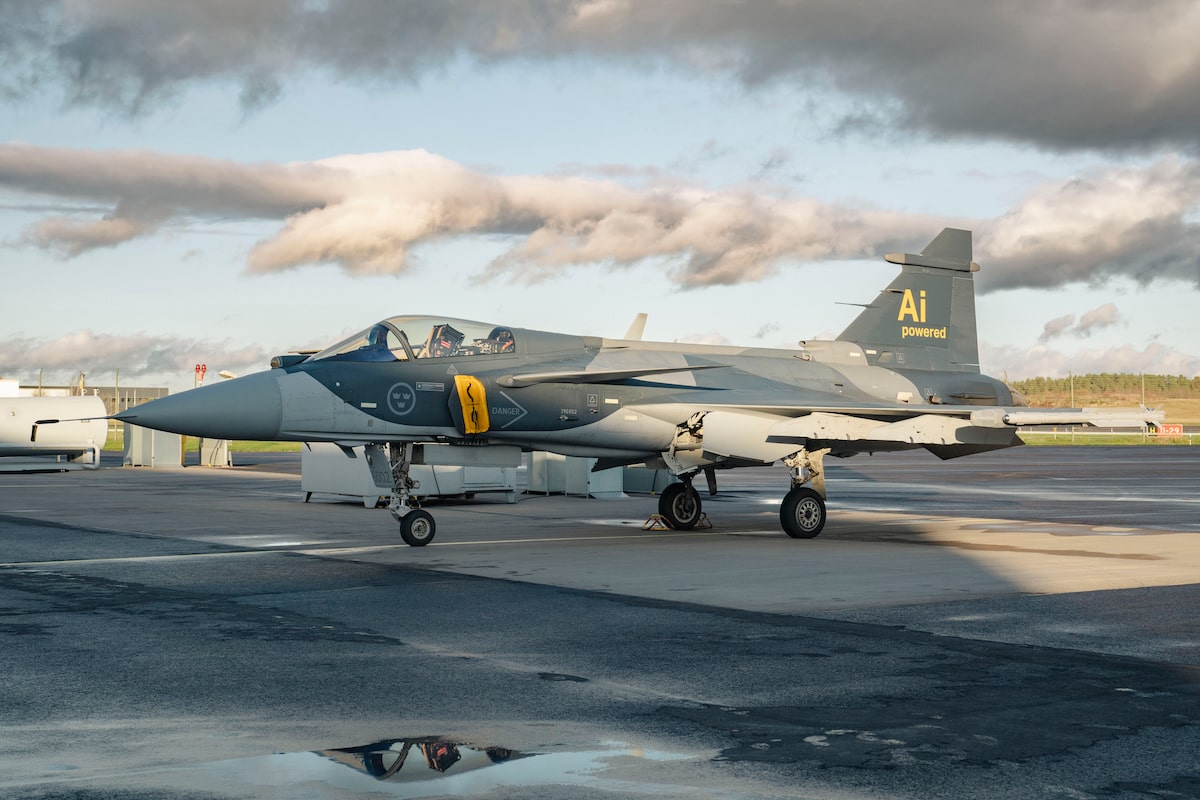
A Saab Jas 39 Gripen E-series jet in Lindköping, Sweden. The Swedish aerospace company has proposed to build the fighter jet and its GlobalEye military surveillance plane in Canada.Felix Odell/The Globe and Mail
In Ottawa, various cabinet ministers are praying that TACO – the “Trump always chickens out” theory – is still valid. Or largely so, or at least somewhat so, for they are on the verge of gambling big on the U.S. President’s rage factor.
TACO is high on their minds because Prime Minister Mark Carney and several of his cabinet ministers, including Industry Minister Mélanie Joly, are thought to be embracing the idea of Canada building the Saab Gripen fighter jet and Saab GlobalEye military surveillance plane. They are both Swedish creations whose construction in Canada would create 12,600 jobs, Saab has said.
One senior politician close to the military action, whom The Globe is not identifying because they were not authorized to speak publicly, told me that odds of a deal with Saab have climbed to 85 per cent from 50 per cent or less before last fall.
The TACO thesis is high on their minds because building the Gripen supersonic fighter – less so the GlobalEye, which is based on a plane already built in Canada (the Bombardier 6500 series business jet) – is bound to trigger apoplexy in Mr. Trump. When that happens, he typically announces tariffs, or sanctions, or launches armadas of warships.
Mr. Trump would fly into a rage because Canada has ordered 88 U.S.-made F-35 stealth fighter jets. Were the Gripen to enter the RCAF fleet, Canada would not need the full F-35 package, though it has already paid for 16 of the aircraft and is obliged to take them.
Opinion: The idea of a mixed fleet of Canadian fighter jets should not take flight
The question is whether his rage would be followed by punitive tariffs against Canada. Maybe, but maybe not, if TACO comes into play again.
Take Greenland, the Danish-controlled semi-autonomous territory that Mr. Trump wanted to “buy” and did not rule out invading if Denmark refused to succumb. On Jan. 17, he said he would hit the eight NATO countries that had sent small numbers of troops to Greenland with 10-per-cent tariffs. The TACO reversal came four days later – no tariffs, no invasion threat, just the vague outline of some “future deal” thought to centre on building U.S. military bases on the island.
Ditto last April, when Mr. Trump’s “Liberation Day” saw him unleash a barrage of tariffs. The markets went into the tank, sending U.S. Treasury yields soaring. The President quickly dulled the edges of his tariff sword. He also threatened several times to fire U.S. Federal Reserve chairman Jerome Powell (which he cannot legally do, but never mind that) because Mr. Powell was reluctant to crunch interest rates. Again, Mr. Trump backed off; Mr. Powell will keep his job until his term ends in May.
On the other hand, Mr. Trump did not back down on his threat to remove Venezuelan President Nicolás Maduro from power. And he has sent a naval armada within striking distance of Iran and said he may launch an attack.
Trump’s pledge to levy 50% tax on Canadian planes sparks confusion in industry
Mr. Trump obviously dislikes Mr. Carney, who upstaged him at the Davos forum earlier this month. His threats against Canada have become a natural reflex. The latest, on Thursday, saw him vow to impose a 50-per-cent levy on Canadian-made aircraft all because Transport Canada allegedly failed to certify U.S.-made Gulfstream private jets. Never mind that the ministry has been working on their certification and that Gulfstreams are allowed to fly in Canada. Details are not Mr. Trump’s concern.
To be sure, there is a fair chance that Mr. Trump will hit Canada with punishing tariffs if the F-35 order is scaled back in favour of the Gripen. It’s a risk worth taking – the upside outweighs the downside. In Davos, Mr. Carney said the world is undergoing a “rupture, not a transition “ from the Pax Americana era. He called for middle powers like Canada to band together.
The upshot is that it would be exceedingly difficult for Ottawa to square Canada’s foreign policy trajectory with buying the full F-35 order. The new reality is that Canada and other non-superpowers have to pursue their own national interests, which means derisking from the Trumpian United States.
The F-35 is an extremely expensive and complicated American plane – an AI-powered computer with wings – that is dependent on endless U.S. software upgrades and a steady supply of spare parts. Handing the U.S., that is, Mr. Trump, an effective veto on the long-term sustainability on what would be Canada’s most crucial weapon seems not just risky, but plain irresponsible. Better to hedge with dozens of Canadian-made Gripens while reaping the rewards from the creation of a domestic aerospace R&D and supply network for the aircraft that would put Canada on the global defence-procurement map.
Which way will Mr. Carney go? His Davos speech suggests that building the Gripen and downgrading the F-35 order would fit well his new geopolitical and geo-economic philosophy. The question is whether he has the courage to put the Gripen play in motion, which in turn hinges on his evaluation of the TACO premise. The risks are big either way, but the risks of giving up the chance to pursue military sovereignty and create an enormous defence aerospace industry along the way are far greater than worrying about placating Mr. Trump.