
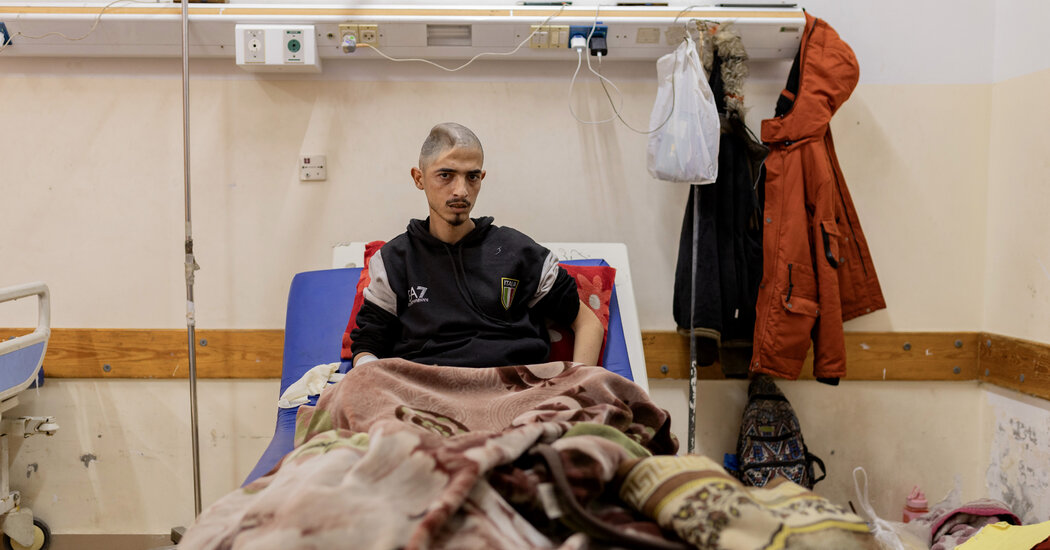
After Mohammed al-Ser suffered a severe head injury in June, which he said was caused by shrapnel from an Israeli missile, doctors reconstructed his skull. But he has yet to regain the use of his left arm and leg.
Mr. al-Ser, 27, is among the thousands of Palestinians waiting to be evacuated for medical treatment as the border between Gaza and Egypt looks set to reopen in the coming days.
When approached for comment on Mr. al-Ser’s account of his injuries, the Israeli military said it had carried out a strike in that area in June 2025, targeting a Hamas operative.
The medical system in the Gaza Strip was decimated over more than two years of war. The border crossing, close to the city of Rafah, was a lifeline for patients seeking medical treatment they could not get inside the enclave.
The expected reopening of the Rafah crossing has brought hope to Gaza’s sick and wounded, and to their families.
Yet it is unclear how many will be able to leave Gaza through the crossing. On Friday, COGAT, the Israeli agency responsible for coordinating with Palestinians, said that the crossing would open on Sunday, and that there would be only a “limited movement of people” in both directions.
When asked whether priority would be given to the sick and wounded to leave Gaza, an Israeli security official said Egypt would share lists of those wishing to cross the border with Israeli authorities, who would then approve or deny their passage. The official spoke on the condition of anonymity to discuss operational details.
Here are the stories of some of those waiting to be evacuated.
The expected reopening of the Rafah crossing has brought hope for the parents of Umama al-Astal. Her father, Mohammed al-Astal, 39, said Umama was born with a heart condition in February 2023, and had only the first of a series of surgeries before the war began.
“Her case is very urgent and can’t wait,” said Ghaidaa al-Astal, 36, Umama’s mother, who hopes her daughter will get the treatment she needs abroad.
Umama’s father, Mr. al-Astal, waits in the hallway at Nasser Hospital in Khan Younis. With him is his 13-year-old daughter, Farah, and son, al-Yamani, who is almost two months old.
Mr. al-Astal is anxious for Umama to leave Gaza so she can get her next operation. “We are still waiting for a chance to save her,” he said.
About 20,000 people need to be evacuated for treatment abroad, according to the Gaza Health Ministry.
Since the border crossing at Rafah closed in March, about 1,000 Palestinians have been able to leave Gaza for medical treatment abroad by crossing first into Israel, according to the World Health Organization.
Yet those evacuations often required a lengthy approval process, as patients need a third country to host them during their treatment, and must get Israeli security clearance, the W.H.O. has said.
Sami Saad, 12, had acute liver failure and was hospitalized at Al-Aqsa Martyrs Hospital in the city of Deir al-Balah. His father, grandfather and uncle take turns to stand by his bedside, comforting the boy and asking doctors and nurses for updates on his condition.
“I wish they let me travel, anywhere,” Sami said, his cheeks wet with tears.
Dr. Raed Hussein, the hospital’s director, said the facility lacked many necessary medications and surgical tools.
COGAT did not specify how many people would be allowed to enter and exit Gaza each day. It said crossings would be permitted in “coordination with Egypt” and following “security clearance” by Israel.
The opening of the Rafah crossing was part of a cease-fire agreement between Israel and Hamas in October. Israel had refused to open the crossing in both directions until all of the living hostages held by Hamas, and the bodies of the deceased, were returned to Israel.
The last remains, those of Master Sgt. Ran Gvili, a member of the Israeli police, were recovered by Israel on Monday.
Ahmed Rasras, 19, has been lying unconscious at Nasser Hospital for weeks.
On Jan. 4, a bullet penetrated Mr. Rasras’s skull while he was asleep in his tent in northwestern Rafah, according to his brother Tareq Rasras, 26, who was with him at the time. Tareq said he does not know who fired the bullet.
Ahmed relies on a tube to breathe, and doctors at the hospital say that he needs to undergo tests using machines that are not currently available in Gaza.
Tareq said that the family was anxiously awaiting news about the Rafah crossing. “Reopening it is the only hope for patients like my brother to receive treatment,” he said.