
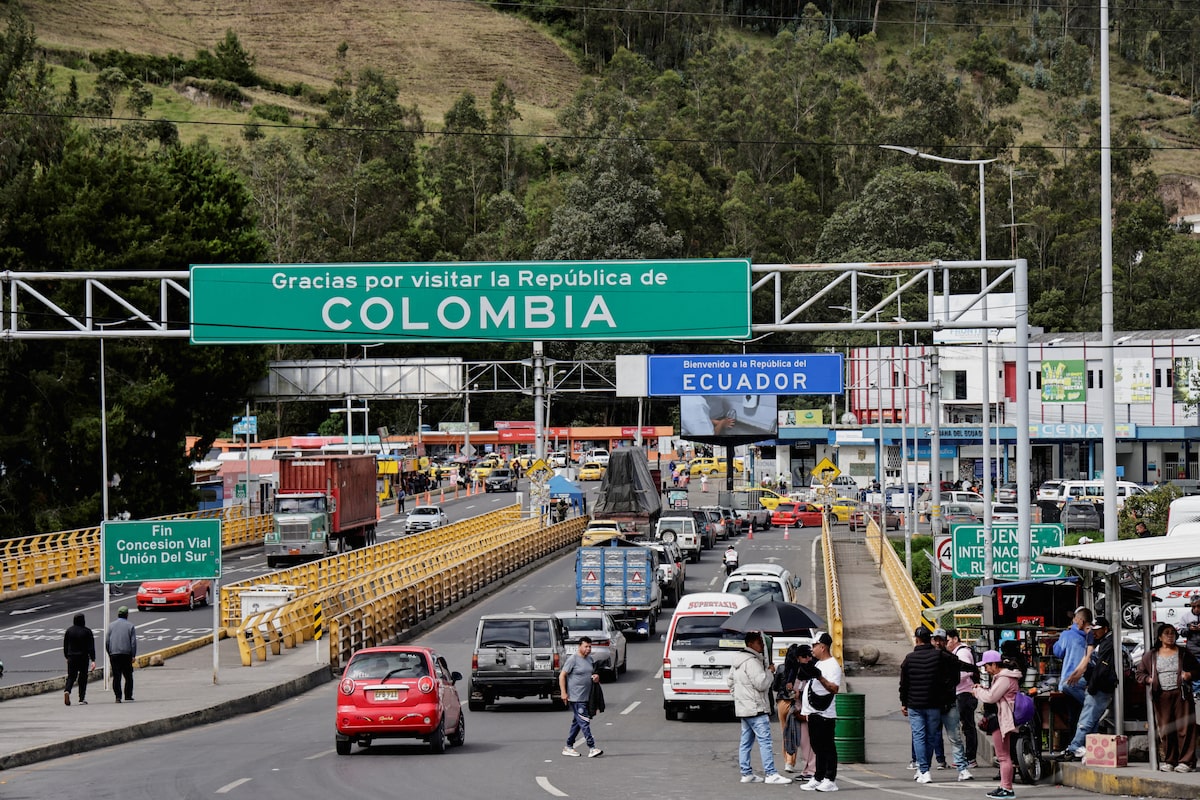
Colombia’s drug traffickers are establishing new routes through Ecuador and Peru to reach legal seaports, swapping speedboats for container ships as they adapt to U.S. military threats.Karen Toro/Reuters
The United States’ aggressive boat bombing campaign targeting suspected drug traffickers in the Western Hemisphere has begun to reshape Colombia’s drug trade and its long-running armed conflict as criminal organizations find new ways to move cocaine, experts and Indigenous leaders say.
But the lethal strikes by U.S. forces on alleged drug vessels in the Caribbean and Eastern Pacific, which have killed at least 126 people since Sept. 2, have done little to make a dent in Colombia’s lucrative cocaine trade.
Bilateral drug control efforts are expected to be top of the agenda on Tuesday when Colombian President Gustavo Petro travels to Washington to meet U.S. President Donald Trump. Mr. Trump has described his Colombian counterpart as “an illegal drug dealer” and, after removing Nicolás Maduro from power in Venezuela, he had suggested Mr. Petro could be next. But a conciliatory phone call in January led to a detente.
According to the United Nations Office on Drugs and Crime’s most recently published report, potential cocaine production in Colombia in 2023 was 2,664 metric tons. The Colombian government said it seized 794.5 tons of cocaine in 2024 (up to November), worth an estimated US$2.52-billion on the streets of North America and Europe, the world’s largest markets.
In violence-torn Colombia, fear grows over Trump’s threats of military action
Colombia, Panama and Grenada face a new Monroe Doctrine with dread and déjà vu
In Colombia, “people are scared to involve themselves in trafficking and to leave on the speedboats heading toward international markets,” said Javier Florez, director of conflict and security at the Ideas for Peace Foundation, a think tank.
However, rather than halting the cocaine trade, Operation Southern Spear, as the U.S. military effort is known, appears to have simply displaced it.
In Colombia’s Pacific region, from which most U.S.-bound cocaine departs, the country’s traffickers are establishing new routes through Ecuador and Peru to reach legal seaports, swapping speedboats for container ships as they adapt to U.S. military threats, said Mr. Florez.
The Caribbean operation has also led to the carving of new routes through the Amazon rain forest into Brazil and Venezuela. The scramble to control these lucrative corridors has aggravated an existing conflict between two rebel groups, the National Liberation Army (ELN) and Second Marquetalia, an offshoot of the demobilized FARC guerrillas. Already battling over illegal economies like gold mining, the recent surge in drug trafficking has only intensified their fighting.
“Clashes over control of drug trafficking corridors have devastated riverine communities in Venezuela and Colombia, confining or displacing populations and driving targeted killings,” said Bram Ebus, director at Amazon Underworld, an investigative journalism collective, in an interview from Bogota.
Colombian President Gustavo Petro will meet with U.S. President Donald Trump in Washington on Tuesday. The Colombian government said it seized 794.5 tons of cocaine in 2024 (up to November).Matias Delacroix/The Associated Press
Deep in the Colombian Amazon, Indigenous leaders began to sound the alarm about a rise in criminal activity on their waterways in December, reporting a surge in boats zooming down the rivers night and day in the lawless jungle region. The threat of violence has forcibly confined at least 3,000 families who are unable to leave their villages to fish, farm and hunt, according to a report published by Mr. Ebus.
Not only has Washington’s boat bombing campaign triggered conflict over new strategic routes, it has acted as a catalyst for violence in drug producing regions by pushing down the price of coca, the plant used to make cocaine.
A round of violence broke out in late December in the northeast Catatumbo region between the ELN and Frente 33, a FARC-dissident group, after a year in which levels of violence had stabilized, said Luis Niño, the government’s High Peace Adviser for the region.
He said Washington’s boat bombing campaign was one of the reasons for the violence and had raised the stakes of the conflict.
“If [the rebels] want to export [cocaine], it must be via routes not controlled by the U.S. government, and that makes it much more complex,” said Mr. Niño, who is responsible for negotiating with guerrilla groups in Catatumbo.
Venezuelans and Colombians in Bogotá tackle three big questions on their post-Maduro future
He said the logistical challenge of moving cocaine has pushed down the price of coca leaves and paste as fewer buyers travel to the region. Because rebel groups in Catatumbo rely on coca and its derivatives for a large portion of their revenue, the fall in prices has added a new imperative in their bloody turf war.
Since December, about 2,600 people in Catatumbo have been forced to flee their homes by the fighting, according to Mr. Niño.
As well as raising the stakes of the armed conflict, local farmers, the majority of whom depend on coca cultivation for their livelihood, have been hit hard.
“There are many farmers who have the product but have not been able to sell it,” said Jaime Botero, the president of the rural community action body in Tibú, the world’s largest coca-growing municipality.
The economic impact on farmers who depend on the coca trade could unleash further humanitarian consequences, and potentially fuel recruitment to armed groups, Mr. Niño said, as struggling farmers grow more desperate and more vulnerable.