
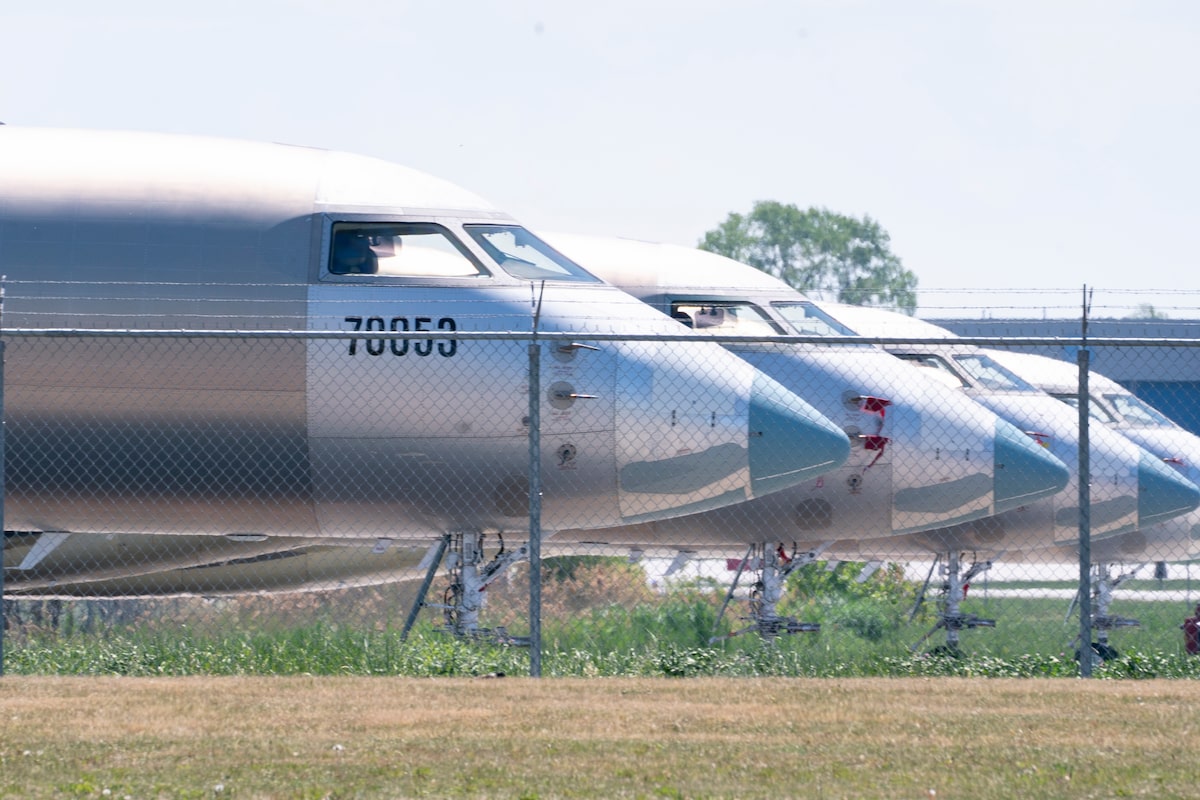
A row Bombardier Global Express aircraft at the planemaker’s plant in Montreal in 2020. U.S. President Donald Trump has threatened to decertify the jets because Canada’s regulator has not yet certified an American-made aircraft.Paul Chiasson/The Canadian Press
The federal government is trying to defuse American anger over safety approvals for General Dynamics Corp.’s GD-N Gulfstream jets after U.S. President Donald Trump blasted Canada for having “refused” to certify the planes and threatened retaliation against Bombardier Inc. BBD-B-T and other domestic aircraft manufacturers.
“Canada is working with the U.S. Federal Aviation Administration, Bombardier and General Dynamics to resolve outstanding certification matters in a way that protects safety and regulatory integrity, while maintaining market access on both sides of the border,” Transport Canada spokesman Hicham Ayoun said in an emailed statement Tuesday.
Transport Minister Steven MacKinnon said Canada has a collaborative relationship with the FAA that stretches back decades in matters of aircraft certification.
He said he’s been given the latest information on the Gulfstream approvals and has been in touch with “a number of people” on the issue but cautioned he does not interfere the certification process.
“We’re communicating with both of the manufacturers and all the people in the industry to make sure that everyone understands the timeline,” Mr. MacKinnon told reporters in Ottawa on Tuesday.
“To the extent that any ambiguities or misunderstandings may have existed, I think they’ve been dissipated,” he said.
Trump’s pledge to levy 50% tax on Canadian planes sparks confusion in industry
Mr. Trump startled Canada’s aerospace industry last Thursday with a social-media post saying the United States is decertifying Bombardier’s Global Express jets and “all Aircraft made in Canada” until Canada approves the new business jets made by Savannah, Ga.-based Gulfstream.
He said Canada has “wrongfully, illegally and steadfastly refused” to certify four Gulfstream jet models, and he threatened a 50-per-cent import tariff on Canadian aircraft sold into the U.S. if the situation was not immediately addressed.
The declaration sparked alarm and confusion among aviation-sector leaders in both Canada and the United States, with some commentators saying Mr. Trump was using his power to undermine the safety functions of regulators. The president has no authority to arbitrarily decertify aircraft, aerospace experts have said.
Bryan Bedford, a Trump nominee who now heads the FAA as its chief administrator, declined to say Monday whether the agency would pull the certifications for planes made in made in Canada, which include Bombardier Global and Challenger business jets as well as Airbus SA’s A220 and De Havilland turboprops.
But he did raise questions about whether regulators in other countries were doing as much as the FAA on the approvals process, suggesting that lack of effort is hurting American plane makers.
“Our concern is whether or not sufficient resources are being applied to U.S. products equal to the resources that we’re applying to certify foreign products,” Mr. Bedford said on the sidelines of the Changi Aviation Summit in Singapore. “We just want a level playing field.”
U.S. and European regulators have certified Gulfstream’s G700 and G800 models but with an exemption lasting until the end of 2026 to give the company time to do more testing and prove it has addressed potential issues related to ice in the jets’ fuel system. Canada hasn’t granted that exemption and is still reviewing the aircraft.
Bombardier is Gulfstream’s main rival in business jet manufacturing. The Montreal-based company would be significantly hit were the U.S. to move ahead with decertification or tariffs. The risk of those things happening in the near term appears to be dissipating however and Bombardier’s share price is clawing its way back up after a 6 per cent drop Friday.