
“After Russia’s war of aggression, we have learned the hard way that excessive dependence on individual countries can have serious consequences for our country,” said Sebastian Roloff, a lawmaker focusing on energy for the center-left Social Democrats, who rule in a coalition with Merz’s conservatives.
Roloff said Trump’s recent threat to take over Greenland and the new U.S. national security strategy underscored the need to “avoid creating excessive dependence again” and diversify sources of energy supply.
The Trump administration’s security strategy vows to use “American dominance” in oil, gas, coal and nuclear energy to “project power” globally, raising fears in Europe that the U.S. will use energy exports to gain leverage over the EU.
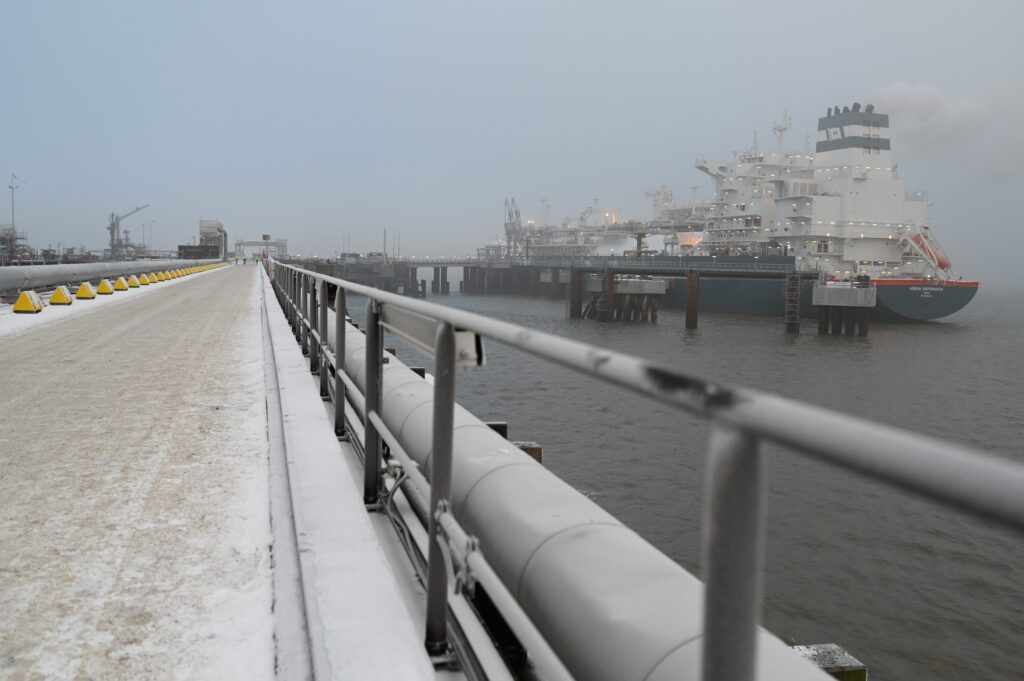 Last year, 96 percent of German LNG imports came from the U.S, according to the federal government. | Pool photo by Lars-Josef Klemmer/EPA
That’s why Merz and his delegation are also seeking closer ties to Qatar, one of the world’s largest producers and exporters of natural gas as well as the United Arab Emirates, another major LNG producer.
Last week, the EU’s energy chief, Dan Jørgensen, said the bloc would step up efforts to to reduce dependence on U.S. LNG., including by dealing more with Qatar. One EU diplomat criticised Merz for seeking such cooperation on a national level. Germany is going “all in on gas power, of course, but I can’t see why Merz would be running errands on the EU’s behalf,” said the diplomat, speaking on condition of anonymity.
‘Authoritarian strongmen’
Merz will also be looking to attract more foreign investment and deepen trade ties with the Gulf states as part of a wider strategy of forging news alliances with “middle powers” globally and reduce dependence on U.S. and Chinese markets. The EU initiated trade talks with the United Arab Emirates last spring.