
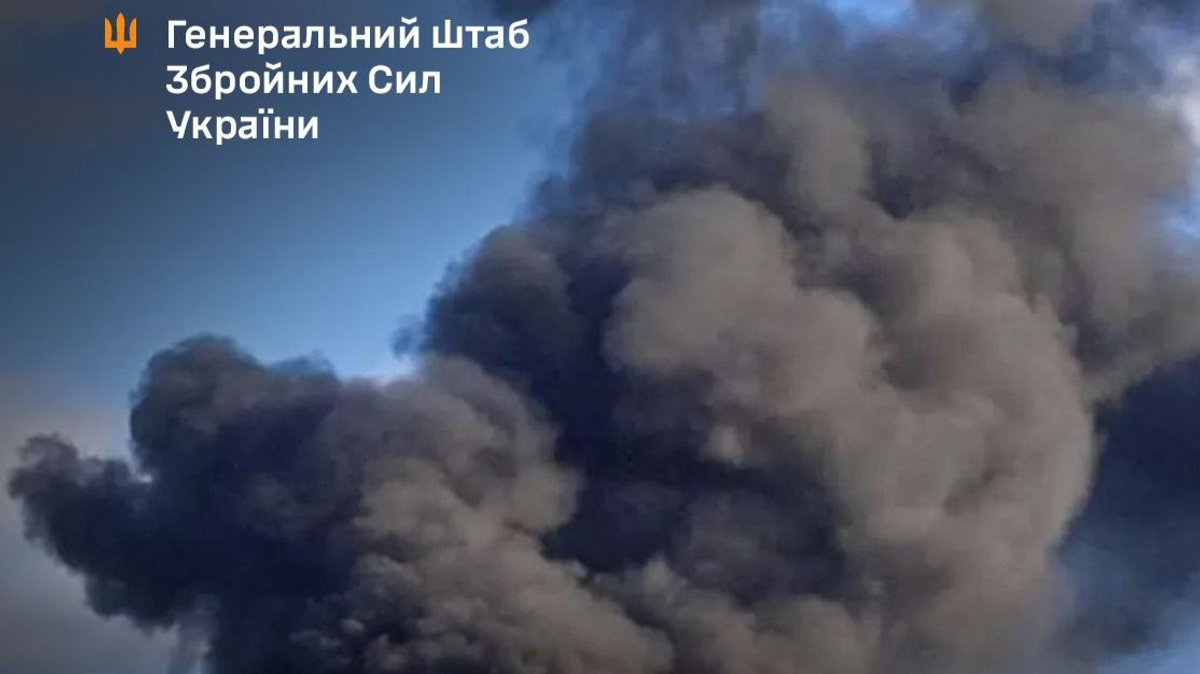
The General Staff of Ukraine’s Armed Forces said Monday that personnel had destroyed a Russian unmanned aerial vehicle (UAV) depot, eliminating around 6,000 first-person view (FPV) drones, a command post, and an ammunition storage site.
“Units of the Defense Forces of Ukraine continue to inflict fire damage on enemy military facilities in temporarily occupied territories and on Russian soil,” the General Staff said in a Telegram post.
JOIN US ON TELEGRAM
Follow our coverage of the war on the @Kyivpost_official.
Early Monday, Feb. 9, a command post of an airborne unit near Sudzha in Russia’s Kursk Region was hit.
Meanwhile, previous strikes, including one near Rostov-on-Don, destroyed three containers of FPV drones and components.
“According to preliminary data, about 6,000 FPV drones were destroyed, with several more containers damaged,” the report added.
A Russian ammunition depot in occupied Novooleksiivka, Kherson region, was also targeted.
Ukrainian officials said that the full extent of Moscow’s losses is still being assessed.
This is not the first time Ukraine has struck drone depots or launch sites.
In late December 2025, the 1st Special Center of Ukraine’s Unmanned Systems Forces (USF) carried out a rare pre-emptive strike on Russian teams preparing to launch Shahed drones at Ukrainian towns and cities.
Using waves of domestically made FP-2 drones, Ukrainian forces targeted Russian flight crews, launch equipment, and associated munitions storage at the abandoned Donetsk airport and a site near Manhush in southern Donetsk, USF commander Robert Brovdi said.

Other Topics of Interest
Ukrainian Skeleton Racer Uses Olympic Helmet to Spotlight Athletes Killed By Russia
Andriy Sybiha said last week that over 650 Ukrainian athletes and coaches have been killed and more than 800 sports facilities destroyed over the course of the full-scale invasion of Ukraine.
A 90-second video released by the USF showed drones striking multiple targets, including administrative buildings, terminal structures, and parking areas.
According to the USF, the strikes disrupted a key Russian logistical hub used to launch Geran and Shahed drones at Ukrainian communities, including a training site for drone pilots, a maintenance center, and an ammunition depot. Independent OSINT analysts confirmed repeated strikes on specific targets, such as drone assembly facilities, storage garages, and repair crews responding to fires.
In November 2025, Ukrainian Defense Forces destroyed a major base used to store and launch Shahed strike drones in Russian-occupied Donetsk, according to Brovdi.
The operation involved Ukraine’s Special Operations Forces (SSO), missile and artillery units, and the 414th Separate Brigade of the USF.
Brovdi said the strike was the result of months of careful reconnaissance: “Developing this complex target took painstaking work over several months, assembled from small pieces.”
The General Staff confirmed that Ukrainian forces targeted a Shahed storage and launch base at Donetsk airport, with multiple explosions and secondary detonations observed. The Telegram channel “Spy Dossier,” which claims to be run by intelligence officers, reported that both cruise missiles and attack drones were used in the strike.
According to the channel, the operation destroyed an ammunition depot, a fuel storage site, and a UAV pre-launch processing facility, while also damaging power and communications units.
The report claimed that up to 1,000 Geran-2 drones and more than 1,500 warheads were present at the airfield at the time, though this has not been independently verified. The SSO said that over 90 percent of the drones launched in the strike hit their intended targets.
Since September 2022, Russia has launched between 40,000 and 50,000 Shahed-type drones against Ukraine. These small, relatively inexpensive drones, carrying up to 100-kilogram warheads, are typically fired in swarms of 50-100 per night – sometimes exceeding 800 during major attacks.
Large strikes have occasionally spilled into neighboring countries, where they are typically shot down – in some cases, using missiles costing far more than the drones themselves. On Sept. 10, 2025, at least 19 drones entered Polish airspace, where the majority of them evaded interception by NATO jets for several hours.